Of everything you can buy to make your coffee better, a scale with a timer is the cheapest upgrade with the biggest payoff — bigger, dollar for dollar, than nicer beans or a fancier machine. The reason is simple: without one, you are brewing blind. A scoop of grounds and a "fill it to about there" pour is a different drink every single morning, and when a cup is bad you have no way to know why or how to fix it. A scale turns your coffee from a guess into a recipe — a set of numbers you can repeat when a cup is great and change on purpose when it is not.
There are only two numbers that matter, and a good budget scale gives you both: weight and time. Weight lets you hold a ratio — the same grams of coffee to grams of water, or the same dose in and yield out for espresso — so the strength of the cup stops drifting. Time tells you how the brew is running: a shot that used to pour in 28 seconds and now gushes in 15 is telling you the grind moved, and you can only hear that if you are timing it. Put the two together and you have the whole feedback loop that separates coffee you can reproduce from coffee that happens to you. For the ratio side of it, our coffee-to-water ratio guide is the companion to this page.
The spec that actually matters on a coffee scale is resolution, and the number to look for is 0.1g. A kitchen scale that only reads in whole grams is fine for flour and useless for espresso, where the difference between an 18g and a 19g dose is a real change in the cup and the whole game is played in fractions of a gram. Every scale on this list resolves to 0.1g, which is the floor for weighing coffee properly. You do not need to pay more for finer than that; 0.1g is where the useful precision lives and where the price stays low.
Before the picks, the honest part — what a budget scale gives up to a proper cafe scale, because it is real and you should buy knowing it. The first thing is response speed. A premium scale updates the reading almost instantly, so when you are pouring you see the weight climb in real time and stop dead on target. A cheap scale lags a beat behind the milk or water actually landing, so it is easy to overshoot your pour before the number catches up — you learn to pour a little slower and anticipate it, but it is a skill the expensive scale removes. The second is water resistance. Cafe scales are sealed against the constant splash of a busy bar; budget scales are not, so a milk slop or a shot spill onto the pad is a genuine hazard rather than a wipe-up. Keep a cheap scale dry and it lasts for years; drown it once and it may not. Beyond those two, you give up a little in build feel and the fanciness of the display — but the core job, weighing to 0.1g and timing the brew, is identical to what a scale costing five times as much does.
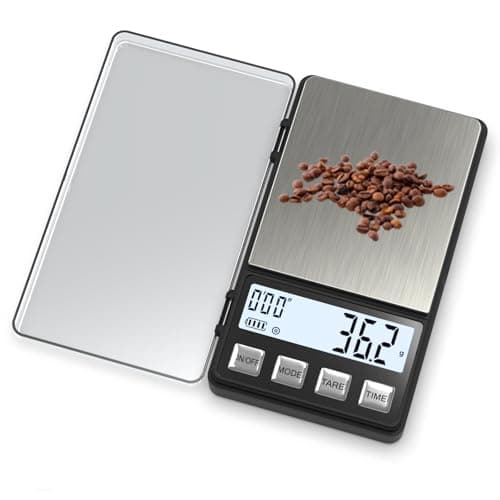
Our top pick, and the answer for most people, is the Weightman Espresso Scale with Timer. It does the two jobs that matter — 0.1g weight and a timer — for genuine pocket-money money, and it is small and thin enough to sit on the drip tray under most portafilters so you can weigh the shot as it pours. It is the single best-value way to stop brewing blind, full stop. Its cons are exactly the budget trade-offs above: the response is a touch slower than a pricier scale, so you anticipate your pour, and it is not water-resistant, so you keep it clear of spills. Neither changes the fact that it delivers the entire benefit of weighed brewing for the lowest possible outlay.
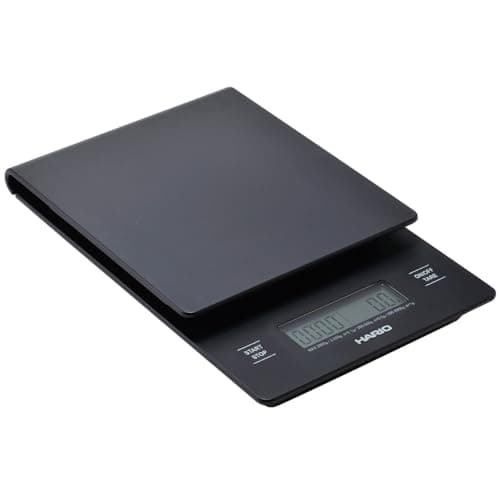
The Hario V60 Drip Scale is the pick if your coffee is mostly pour-over or drip rather than espresso. It comes from Hario, the company that designed the modern V60, and its wider platform is built to hold a full V60 or a Chemex on top — where a compact espresso scale is cramped and tippy. It reads to 0.1g and times the pour with clean, simple operation, and it is the reliable daily driver for filter brewers. The trade-offs are the mirror of its strength: that larger footprint is less friendly under a portafilter, and it keeps to a straightforward weigh-and-time job with no flow-rate readout. If you brew on a dripper more than a machine, it is the natural home for your scale.
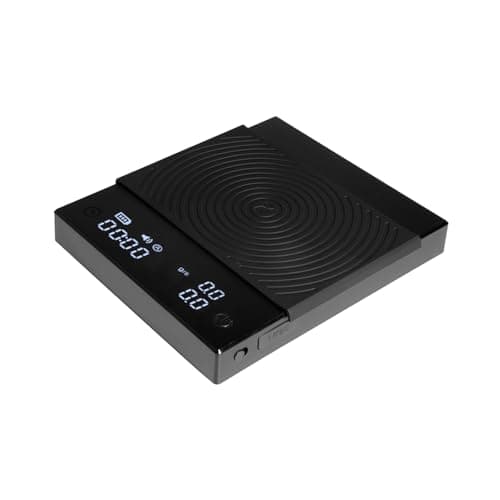
At the top of the budget bracket sits the TIMEMORE Coffee Scale Basic 2.0, the step-up you take when you want the nicer, more coffee-shaped tool without leaving affordable territory. It weighs to 0.1g and times like the others, but it adds a flow-rate readout — a genuinely useful espresso-dialing aid that the cheaper scales lack, showing you how fast liquid is actually moving so you can read a shot as it develops. Its footprint is small enough to tuck under a portafilter, so it suits espresso better than the Hario. Why third, then, if it is the most capable? Because it costs more than the Weightman for a feature not everyone needs, and it carries the same budget caveats — it is not the fully sealed, drip-proof build of a cafe scale, so keep it dry, and its auto-off can cut in mid-brew if you pause too long. If you already own any 0.1g kitchen scale with a timer, none of these is a required upgrade; they are the nicer, purpose-built version of a job your existing scale can already do.
So the short version: buy the Weightman if you want the cheapest possible path to weighed, timed brewing and you make espresso or all-rounder coffee; buy the Hario if your daily ritual is a V60 or Chemex and you want a platform built for it; and stretch to the TIMEMORE if the flow-rate feature and a slightly nicer object are worth a little more to you. Any of the three ends the guesswork, and that first jump — from no scale to any 0.1g scale with a timer — is far larger than the gap between these three. Pair whichever you choose with a good grinder and a dialing-in routine and you have the whole consistency toolkit.
How to choose a budget coffee scale
A coffee scale is a small purchase, and the choice comes down to five things. Resolution and a timer are non-negotiable; the rest is about matching the scale to how you actually brew.
1. Resolution — 0.1g is the number
This is the one spec you cannot compromise on. A scale that reads only in whole grams is a baking scale, and it is useless for espresso, where a single gram of dose is a meaningful change and the whole craft happens in tenths. Insist on 0.1g resolution, which every scale here has. You do not need finer than that for home coffee — 0.01g scales exist but they are slower, fussier, and pricier for precision you will never use in a cup. If a cheap scale does not clearly state 0.1g, walk away; it is the difference between a coffee scale and a kitchen scale wearing the label.
2. The timer is half the point
A scale without a timer only tells you half the story. Weight sets your ratio; time tells you how the brew ran — how long the shot pulled, how long the bloom and pour took on a V60. Together they are the feedback loop that lets you diagnose a bad cup: a shot that runs too fast at the right weight means the grind is too coarse, and you only know that if you timed it. Every pick here has a built-in timer, so this is really a warning about the cheapest kitchen scales that skip it — a scale you have to time with your phone is a scale you will stop timing.
3. Footprint — espresso tray or pour-over platform
Match the shape to your brew. For espresso, you want a small, thin scale that fits on the drip tray under the portafilter so you can weigh the shot in the cup as it pours — the Weightman and the TIMEMORE are built for that. For pour-over and drip, you want a wider, sturdier platform that holds a full V60, Kalita, or Chemex without perching precariously — the Hario is made for it. A scale that is the wrong shape for your method is a daily small annoyance: an espresso scale wobbling under a Chemex, or a big pour-over scale that will not fit under the group head.
4. Response speed and water resistance — what you give up
These are the two things budget scales trade away, and knowing it up front stops the disappointment. Response speed: a cheap scale lags a beat behind the liquid actually landing, so you learn to pour a little slower and stop just short of your target to let the number catch up. It is a habit, not a dealbreaker. Water resistance: budget scales are not sealed, so treat any spill as a real threat — keep the scale clear of the steam wand drip and wipe splashes immediately. A cheap scale kept dry lasts for years; the fastest way to kill one is a milk flood onto an unsealed pad. If you brew in a splashy setup and want to stop worrying, that is the honest reason to save up for a sealed cafe scale later.
5. Auto-off, battery, and the small stuff
Two minor traits are worth a look because they nag daily. Auto-off: many budget scales power down after a fixed idle time to save battery, which is fine until it cuts out mid-brew during a slow bloom or a paused shot — check whether the timer holds the display awake, and if yours is aggressive, just tap it to keep it live. Power: most run on AAA batteries, which is cheap and simple but means keeping spares; a few charge over USB, which is tidier if you brew daily. None of this changes the core value — every scale here delivers the full benefit of weighed, timed brewing — but the difference between a scale you love and one you tolerate often comes down to whether its auto-off leaves you alone while you work. And whatever you buy, keep it clean and dry, tare it before every brew, and it will quietly do its job for a long time.