Before you read a word about which tamper is best, read this: a tamper must match the diameter of your portafilter, and getting that wrong is the number-one reason these tools get returned. Most home machines use one of three sizes — 58mm on Gaggia and most commercial-style machines, 54mm on nearly every Breville, and 51mm on many De'Longhi and budget machines. A gorgeous 58mm tamper is useless in a 54mm basket. Measure your basket, or check your manual, before you buy anything on this page.
With that settled, a tamper and a distributor do two halves of one job: leaving the coffee bed even and level so water meets uniform resistance and extracts the whole puck at once. A distributor (or leveler) evens the surface; a tamper compresses it. Do both badly and water carves a channel through the low spot — the sour, fast, patchy shot that wastes good beans.
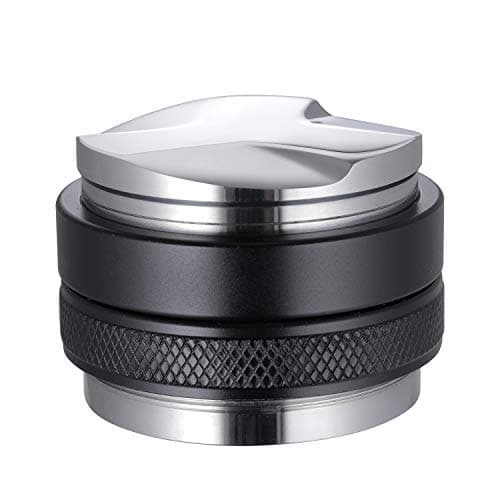
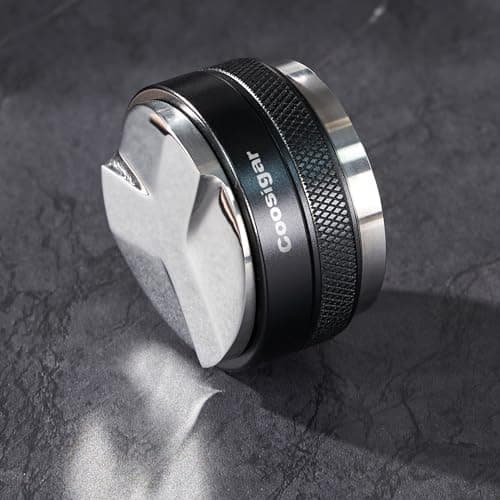
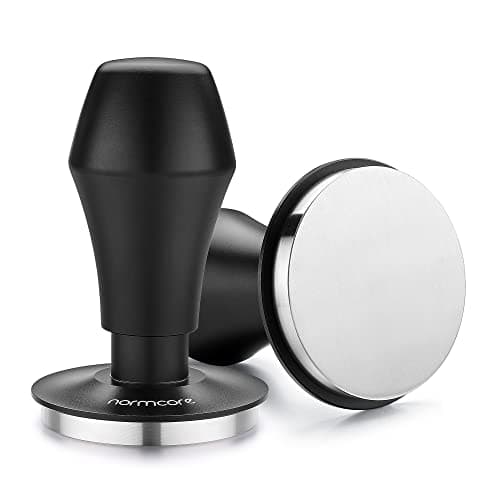
Our pick is the Normcore spring-loaded tamper because a calibrated spring clicks at a set pressure, so every tamp is identical — it removes one of the biggest sources of shot-to-shot variation for a beginner. It is a 58mm-class tool, so it suits 58mm machines. For 51mm De'Longhi and budget owners, the MATOW is a two-in-one distributor and tamper sized to fit, and for 58mm machines the dual-head leveler evens the bed before you tamp. Pick by the size that fits your machine first, and only then by the feature set.
One honest note on overlap: if you already own a WDT tool, a distributor adds the least of these three, because stirring the grounds with needles already breaks up the clumps a spinning leveler only smooths over on top. The WDT tool plus a good tamp does most of the work; a distributor is the nice-to-have on a 58mm setup once the basics are covered.
How to choose a tamper (and whether you need a distributor)
1. Size first, everything else second
It cannot be repeated too often: match the tamper to your portafilter. 58mm for Gaggia and commercial-style machines, 54mm for Brevilles, 51mm for many De'Longhi and budget machines. When in doubt, a caliper across the inside of your basket settles it. A snug fit matters — a tamper a millimeter too small leaves an untamped ring at the edge where water escapes.
2. Flat base, and calibrated if you're learning
A flat stainless base is right for almost everyone (convex bases are a niche preference). A calibrated, spring-loaded tamper clicks at a set force — usually around 30 lb — so you apply the same pressure every time. That consistency is genuinely useful while your by-hand tamp is still finding its feet. Some baristas outgrow it; a beginner benefits from it immediately.
3. Distributor vs tamper — what each one does
A distributor (leveler) spins across the top of the dose to even the surface and knock down high spots; a tamper compresses the whole bed. They are complementary, not interchangeable. A distributor helps most on machines with a wider 58mm basket where an uneven surface is easy to leave behind. On a 51mm machine a combined distribute-and-tamp tool like the MATOW covers both jobs in one.
4. Don't double up with your WDT tool
If you use a WDT tool to stir clumps out of the grounds, you have already done most of what a distributor does — the two overlap. Prioritize the WDT tool and a good tamp; add a distributor later only if you find you still leave the bed uneven. And remember the tamp is only as good as the grind feeding it — see our best grinders for espresso.