A hand grinder is one of the best-value ideas in coffee. Take out the motor and the housing, and the money left over goes into the burrs — which is why a good manual grinder often out-grinds an electric box costing twice as much. It also needs no power, packs into a bag, and makes almost no noise. The catch is simple and worth being honest about: you are the motor.
The TIMEMORE C3 leads because it is the value benchmark here — stainless burrs and a tight build that gives a consistency well beyond its price, and in the ESP version it grinds fine enough for real espresso. The KINGrinder K6 is the espresso-on-a-budget pick, with external numbered adjustment that makes dialing in a shot far easier than grinders you set from the inside. The SimCoker is the cheapest genuine step up from a blade grinder — fine for filter, a stretch for espresso. And the Hario Mini-Slim Plus is the packable ceramic classic: trustworthy for press and drip, but not the one to buy for shots.
Here is the honest limit. Grinding a fine espresso dose by hand every single morning is a genuine arm workout — the finer the grind and the more shots you pull, the more it feels like exercise. For one or two coffees a day, a trip, or a value-first first grinder, that is a fair trade and even part of the ritual. If you pull several espressos a day, an electric grinder from our espresso grinder guide is worth the money for your forearms alone.
If travel is the whole point, a hand grinder plus a packable brewer is the classic unplugged kit — pair one with a pour-over cone or a French press and you can make excellent coffee anywhere you can boil water.
The short answer
Quick picks
#ad · Live prices from the Amazon Product API, as of October 20, 2026. Where we have no verified live price, we show none — we would rather leave a gap than print a number that has rotted.
In detail
The picks, in full
The best-value manual grinder
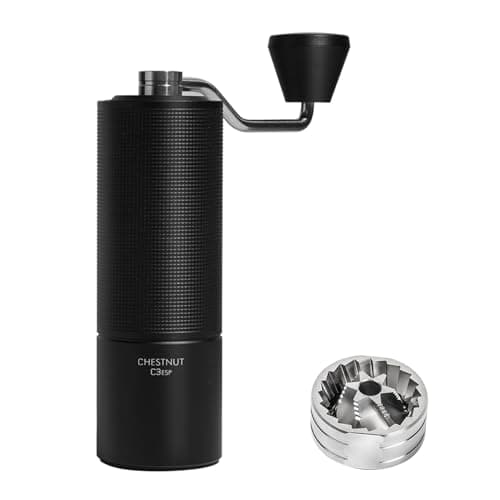
TIMEMORE Chestnut C3 ESP Hand Grinder
Stainless S2C burrsEspresso to French pressFoldable handlePortable
The hand grinder that punches absurdly above its price. Espresso-capable, and it feels premium.
- Grind consistency
- 8
- Grind range
- 8
- Ease of use
- 6
- Build quality
- 8
- Value
- 10
Pros
- +The stainless burrs and tight build give a consistency that shames electric grinders twice its price
- +The ESP version adjusts fine enough for real espresso, not just filter
- +Light, tough, and travel-friendly — a legitimate main grinder that also packs for trips
Cons
- −It's manual — grinding a fine espresso dose by hand is a genuine arm workout
- −Small single-dose capacity, so it's a one-or-two-cups-at-a-time tool
Don't buy this if…
…you make several espressos every morning. Hand-grinding fine, daily, gets tiring fast — an electric grinder like the Baratza Encore ESP is worth it for volume.
Manual espresso on a budget
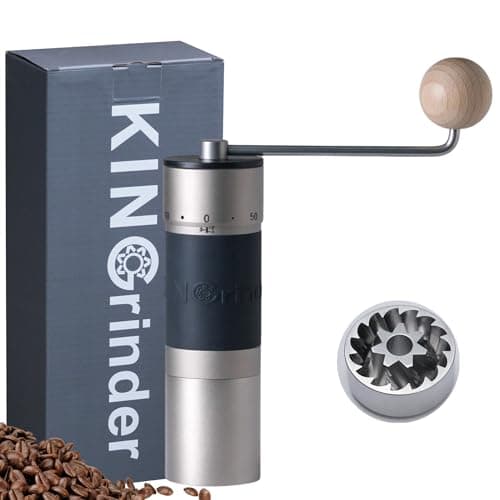
KINGrinder K6 Manual Grinder
Stainless burrsExternal numbered adjustEspresso-fine stepsManual
A lot of hand grinder for the money — external adjustment and espresso-fine steps.
- Grind consistency
- 8
- Grind range
- 8
- Ease of use
- 6
- Build quality
- 7
- Value
- 9
Pros
- +External numbered adjustment makes dialing in espresso far easier than grinders you set from inside
- +Fine, repeatable steps genuinely suited to espresso, not just an afterthought
- +Undercuts pricier hand grinders while matching a lot of their capability
Cons
- −Manual grinding for espresso is hard work, same as any hand grinder
- −Brand support and long-term reputation are thinner than TIMEMORE or 1Zpresso
Don't buy this if…
…you value a proven brand and resale value. TIMEMORE has the longer track record — the K6 is the value play, not the safe-brand play.
The lowest-cost step up from a blade grinder
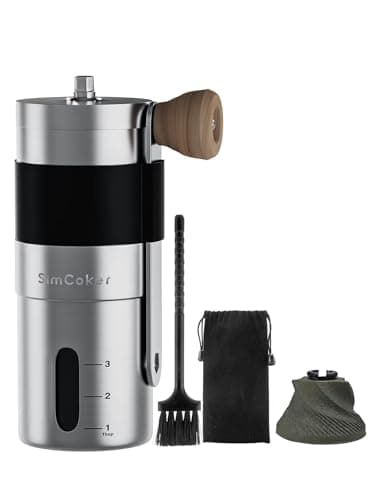
SimCoker Manual Coffee Grinder (Portable Burr Mill)
Ceramic conical burrSimCoker rates it 20g304 stainless bodyHand crank, no power
The cheap hand grinder that beats any blade grinder. Fine for filter and travel, a stretch for espresso.
- Grind consistency
- 6
- Grind range
- 5
- Ease of use
- 6
- Build quality
- 6
- Value
- 9
Pros
- +A true burr grind for pocket money — an enormous improvement over the blade grinder most people start with
- +SimCoker lists the body as 304 stainless steel and the burr as ceramic, so there is nothing in it to rust
- +Small enough to live in a bag and needs no power at all, and the listing includes a cleaning brush and a storage pouch
Cons
- −No numbered settings are published for it, so you cannot write down a grind and come back to it — that rules out dialing in a shot
- −SimCoker's stated capacity is 20g, roughly two cups, so a full pot means grinding in rounds
Don't buy this if…
…you make espresso or grind for several cups daily. The listing names espresso among its uses, but with no numbered settings you cannot repeat a shot — the TIMEMORE C3 is the small step up that changes everything.
Budget filter grinding, and travel
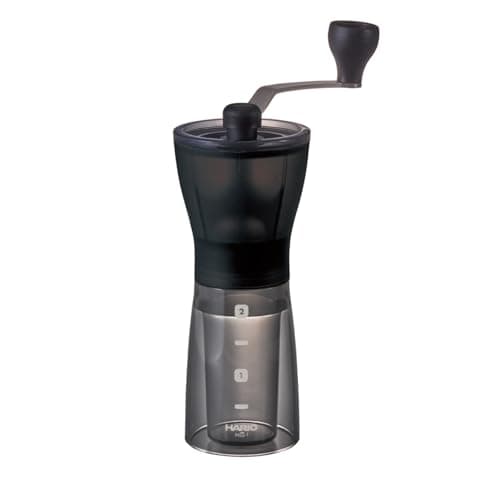
Hario Mini-Slim Plus Ceramic Coffee Mill
Ceramic conical burrHario rates it 24gDetachable crankFilter-oriented
Hario's slim ceramic hand mill — a real burr grind for filter, in the smallest package here.
- Grind consistency
- 6
- Grind range
- 4
- Ease of use
- 6
- Build quality
- 5
- Value
- 8
Pros
- +A genuine ceramic conical burr grind for under forty dollars — Hario's own line is that the burrs shave the beans rather than cracking them the way a blade grinder does, and that is the whole difference
- +Hario lists it at 150 x 72 x 220mm with a crank handle that detaches, so it packs flatter than anything else on this page — it was designed as a travel mill
- +Ceramic burrs don't rust, and Hario rates the coarseness adjustment as easy to set — fine for locking in one brewer and leaving it there
Cons
- −Hario's stated capacity is 24g, about two cups, so a full pot means grinding in rounds
- −No numbered settings are published for it, so you can't return to a known espresso point the way the KINGrinder's external dial lets you — treat it as a filter mill
Don't buy this if…
…you want espresso from a hand grinder, or you grind for more than a cup or two at a time. Hario sells this as a compact filter mill and is honest about that — the TIMEMORE C3 ESP is the hand grinder built for shots.
How to choose a manual grinder
The mechanism is the same as any burr grinder; the difference is that you supply the force, so a few things matter more than they do on the counter.
Do you need espresso, or just filter? This is the biggest fork. Espresso by hand asks for both a grinder that reaches that fineness (the TIMEMORE C3 ESP, the KINGrinder K6) and the patience to crank it. Filter is far easier work and opens up cheaper options like the SimCoker or the Hario Mini-Slim Plus. Buying a filter-first grinder like the Mini-Slim Plus for espresso is the classic mismatch — Hario publishes no numbered settings for it, so there is no known click to come back to.
How you adjust it. External, numbered adjustment (the KINGrinder) lets you return to a known espresso setting without disassembly — a real advantage for shots. Internal adjustment is fine for filter, where the exact number matters less.
Capacity and effort. Hand grinders are single-dose by nature, so they are a one-or-two-cups-at-a-time tool. That is perfect for travel and for a solo drinker, and frustrating if you grind for a full pot or a household every morning. If that is you, the electric grinders on our main grinder guide are the saner buy. Whatever you choose, it is still a burr grinder — and even the cheapest here beats any blade grinder, as our burr vs blade explainer lays out.
How we picked
We do not run a testing lab
We compiled published manufacturer specifications, computed what each option costs to run where relevant, and cross-referenced aggregated owner reviews, then scored each product against a published rubric. The scores are judgments from documented research — they are not measurements we took, because we do not have a lab and we are not going to pretend we do. Where a number came from a manufacturer or a standard, we name it in Sources.
Questions
Frequently asked
Can you really make espresso with a hand grinder?+
Yes — a hand grinder built for it, like the TIMEMORE C3 ESP or the KINGrinder K6, grinds fine and precisely enough for real espresso. The honest catch is effort: grinding a fine dose by hand is an arm workout, and doing it for several shots a day gets old. For volume, an
electric espresso grinder is worth it.
Are hand grinders good value compared to electric ones?+
Often, yes. With no motor or housing to pay for, more of the price goes into the burrs, so a good manual grinder like the TIMEMORE C3 can out-grind electric grinders costing more. You pay in effort and in single-dose capacity, not in grind quality.
Which hand grinder is best for travel?+
Any of these packs into a bag, but the TIMEMORE C3 is the standout all-rounder — tough, light, and consistent enough to be a legitimate main grinder that also travels. Pair it with a packable
pour-over setup for an unplugged kit that makes great coffee anywhere.
What happened to the Hario Skerton?+
It is no longer sold on its own. As of September 2026 the Skerton and Skerton Pro have dropped off Amazon as standalone products — what is left are odd bundles with paper filters, most without a live offer. If you wanted a Hario ceramic hand mill, the Mini-Slim Plus is the one still stocked, and it is the one on this list. If you wanted the Skerton specifically for its bigger glass catch jar, nothing in Hario's current manual range replaces that directly; the TIMEMORE C3 is the better grinder anyway.
Receipts
Sources
We do not run a testing lab, and we do not pretend to. Where a measured number came from a manufacturer spec sheet or a published standard, we name it and link it. Where we could not verify something, we say so on the page rather than quietly leaving it out. Read our full method.