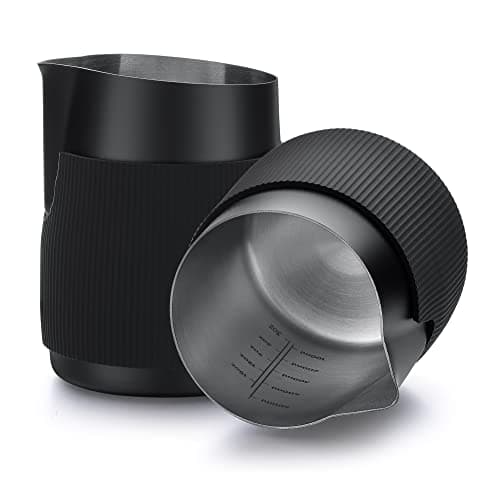
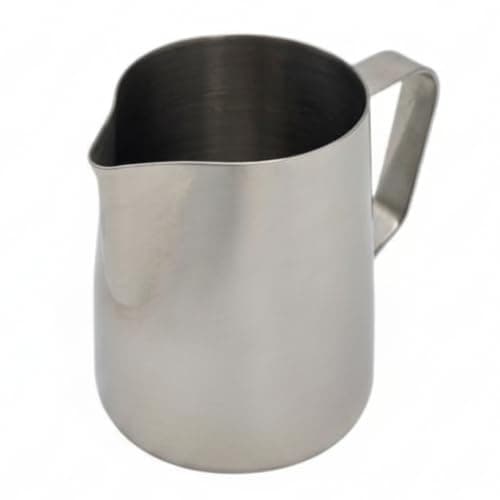
A milk pitcher — the milk pourer, frothing jug or steaming pitcher, depending on who you ask — looks like the least technical object in espresso and is quietly one of the most. Its size sets how milk rolls during steaming (the whirlpool that turns bubbles into microfoam needs room to move, but not so much room the volume never spins), and its spout geometry is most of what people call latte-art skill. The wrong pitcher makes both jobs harder every single morning.
The sizing rule is simple: steam roughly double the milk you'll pour, in a pitcher about double the volume you steam. For one-drink households that means a 12oz pitcher — which is what the classic Rattleware, the café-standard workhorse with a sharp, well-defined spout, gives you at a price that barely registers. Two-drink mornings want more room, and that is where the 20oz Normcore comes in: handleless, so you hold the body and judge the milk temperature through the steel the way baristas do, with a rounded spout that pours forgiving hearts.
Choosing in one minute
Match the pitcher to your machine's steam power: home wands (Bambino-class) roll a 12-20oz pitcher beautifully and struggle to move a 30oz; oversized pitchers are the most common self-inflicted steaming handicap. Two drinks max per steam: 20oz. Single cortados and flat whites: 12oz.
Spout: round for texture, sharp for art. A rounded spout pours forgiving streams for basic hearts; a sharp, narrow spout gives the fine control rosettas demand — and demands steadier hands. Buy the sharp spout only if latte art is the actual goal.
Skip the gadget features — thermometers clipped to pitchers lag badly (your palm on the side is faster and always attached), and nonstick interiors add nothing but a coating to scratch. Steel, the right size, the right spout: done. Then it's all technique.
Pitcher size, matched to the drink you actually make
Work backwards from the cup. A single cortado or flat white uses a small pour, so a 12oz pitcher is right — steam much less milk than that in a big jug and it never forms a whirlpool, which is how you end up with hot milk and stiff foam instead of microfoam. One latte or cappuccino is comfortable in 12oz and fine in 20oz. Two milk drinks at once is the case for the 20oz. Above that, on a home machine, you are working against the wand: domestic boilers do not have the steam power to roll 30oz of milk, and the texture suffers for it. If you regularly make two very different drinks, two cheap pitchers beat one compromise pitcher — they cost less than a bag of good beans. The drink-by-drink breakdown is in latte vs cappuccino vs flat white.
Handled vs handleless — a real decision, not a style one
A handled pitcher keeps your hand off hot steel, which is the sane place to start: you can concentrate on the whirlpool without also managing discomfort, and you can hold it steadily through a long pour. A handleless pitcher like the Normcore puts your palm directly on the body, which is the traditional way of judging temperature — you stop steaming when it becomes uncomfortable to hold, at roughly 140°F, no thermometer required. That feedback is genuinely useful once you know what right feels like and genuinely off-putting before then. Start handled, move handleless if you want the feedback.
Steel gauge, markings and balance
Three build details separate a pitcher you keep from one you replace. Steel gauge: thin steel heats fast, which makes temperature feedback jumpy and dents easy; a heavier body is steadier on both counts. Internal markings are a small convenience — they let you fill to the same line every time without weighing — but a scale does that job better and you probably own one already. Balance is the one people underrate: a pitcher that sits nose-heavy when full drifts as you pour, and a drifting pour is a ruined pattern. Neither marketing copy nor a photo tells you about balance, which is why the café-standard shapes persist — they were settled by people pouring hundreds of drinks a day.
What to skip
Clip-on thermometersread slow, sit in the whirlpool's way, and solve a problem your hand already solves. Non-stick and colored coatings add a surface to scratch and nothing to the milk. Very large pitchers are the most common self-inflicted handicap on a home machine. And plastic or glass jugs are simply the wrong tool — you need steel to feel the temperature climb and to survive a steam wand purge. Buy steel, in the right size, with a spout that matches your ambitions, and put the rest of the money into the machine doing the steaming.