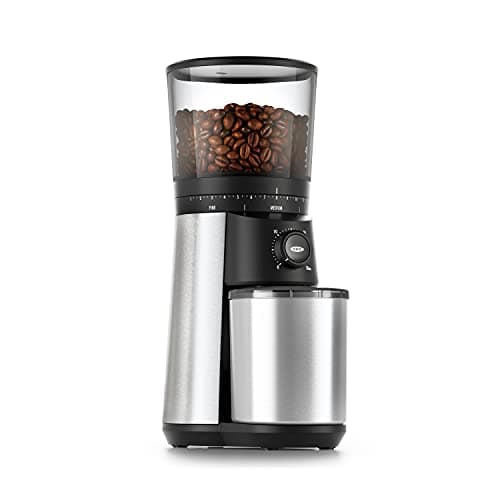
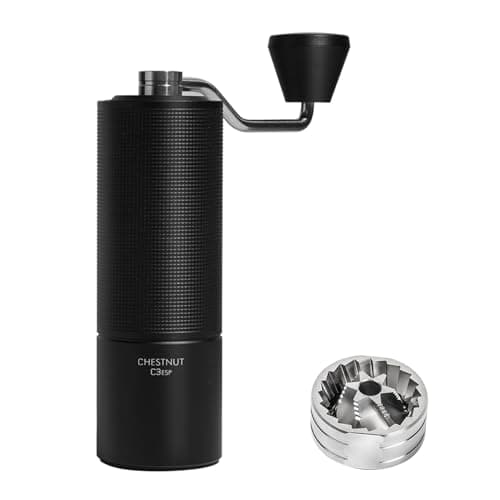
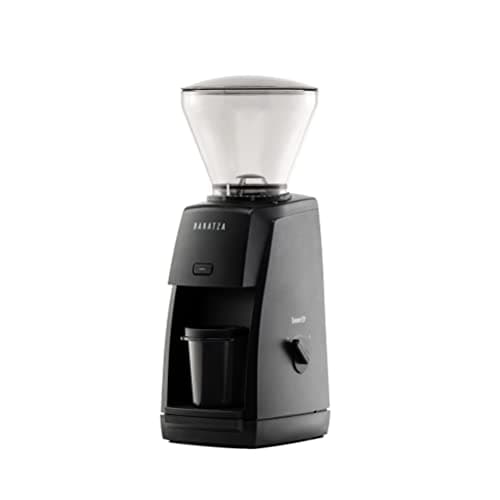
A burr grinder crushes coffee beans between two abrasive burrs set a fixed distance apart, producing even, uniform particles you can dial in. A blade grinder chops beans with a spinning propeller into random, uneven fragments. For every brew method, a burr grinder makes better, more consistent coffee — so if you buy one thing for your coffee, buy a burr grinder.
That is the whole answer, but the why is worth understanding, because it explains almost everything about why home coffee tastes flat, sour, or bitter — and why a modest upgrade fixes it. The two devices do fundamentally different things to a bean, and only one of them is grinding.
What each one actually does to the bean
A blade grinder is a small propeller spinning in a chamber. It does not grind so much as smash. Beans nearest the blade get pulverized into fine dust while beans at the edges stay in coarse chunks, and because the blade throws everything around at random, you have no control over the mix and no way to repeat it. Grind for ten seconds and you get one random distribution; grind for twelve and you get a different one. There is no setting, only a guess.
A burr grinder works the way a mill does. Two hardened burrs — either cone-shaped (conical) or ring-shaped (flat) — sit a set gap apart, and beans are drawn through that gap and crushed to a size the gap allows. Anything larger stays until it is small enough to pass; anything the right size falls through. Move the burrs closer for a finer grind, farther for coarser, and the setting holds. The result is a narrow band of similarly sized particles that you chose on purpose and can reproduce tomorrow.
Why particle size decides how coffee tastes
Brewing is extraction: hot water dissolves flavor out of ground coffee over time. How fast a particle gives up its flavor depends on its size. Small particles extract fast; large particles extract slowly. That single fact is why grind consistency is not a nicety — it is the ballgame.
When particles are even, as from a burr grinder, they extract at roughly the same rate. You can stop the brew at the point where the coffee has given up its sweet, balanced flavors and before it starts giving up harsh ones. That is a clean, balanced cup.
When particles are a chaotic mix, as from a blade grinder, there is no such point. By the time the boulders have extracted enough to taste like anything, the dust has been over-extracted into bitterness. So you get the worst of both ends at once — the under-extracted sourness of the big pieces and the over-extracted bitterness of the fines, in the same cup. People taste that and blame their beans, their water, or their machine, when the culprit is a bag of gravel going into the brewer.
The comparison, laid out
Put the two side by side and it is not close. On particle evenness, a burr grinder produces a tight, uniform grind while a blade produces a wide, random one. On control, a burr has repeatable settings from espresso-fine to French-press-coarse; a blade has none — only how long you hold the button. On repeatability, a burr gives you the same grind every time so you can actually improve; a blade gives you a new lottery ticket each morning. On heat, a blade's high-speed friction can scorch delicate grounds, while burr grinders run cooler. The only category a blade grinder wins is up-front price — and even that is a false economy, because a value burr grinder costs little more and transforms every cup you make.
The bottom line
Buy a burr grinder — even a cheap one. The step from a blade grinder to the least expensive burr grinder is the single biggest improvement most people can make to their coffee, bigger than better beans and far bigger than a better machine. From there, which burr grinder depends on how you brew: see the full grinder rankings for the all-rounders, our best burr coffee grinders roundup for the field sorted by price bracket, the espresso grinders if you pull shots, or the manual hand grinders for the best value and travel picks. Whatever you land on, make it a burr.
So which burr grinder should you actually buy?
"Burr, not blade" is the decision that matters most, but it still leaves a choice. Here is the short version of how to spend once you have ruled out blades for good.
If you brew filter only — drip, pour-over, or press — you need a burr grinder with a good coarse-to-medium range, and you can skip the expensive espresso precision entirely. A conical burr grinder is the sensible, quiet, affordable default.
If you make espresso, or might, buy a grinder that reaches espresso fineness with fine adjustment near that end. A filter-only grinder cannot get there, so this is the one spec worth paying up for — the details are on our best grinders for espresso.
If value or travel is the priority, a manual hand grinder puts more of your money into the burrs than any electric box at the price. You trade a little effort for a lot of grind quality — our hand grinder guide has the picks. And whichever route you take, match the grind to the brewer using our coffee brewing methods guide, and read how we research to see how we score every grinder we rank.