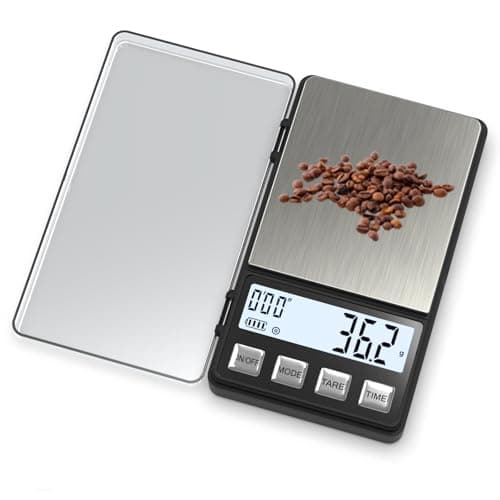
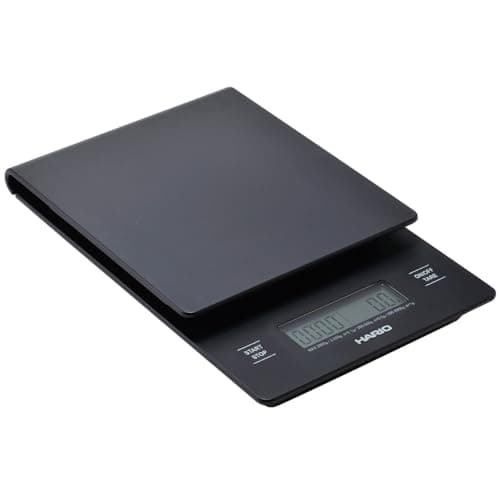
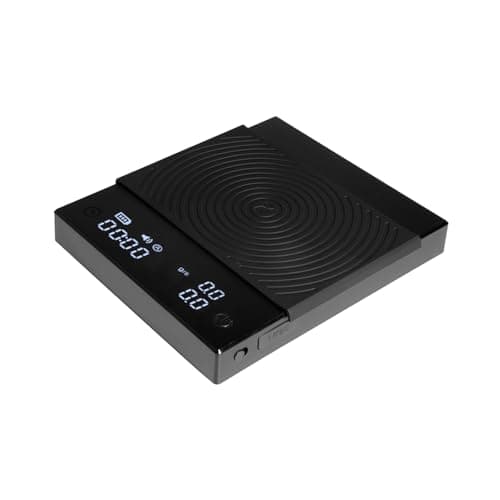
If you buy one thing on this whole site to make your coffee more consistent, make it a scale with a timer. It is not the exciting purchase, but weighing your coffee is the single biggest jump in consistency available to a home brewer — it turns "a scoop or two, pull until it looks right" into a recipe you can repeat and adjust: so many grams in, so many grams out, in so many seconds. Everything a barista does to dial in a shot is impossible without those numbers.
For espresso, two features matter. First, resolution: you want 0.1g, because a gram either way on an 18-gram dose meaningfully changes the shot, and a scale that only reads whole grams hides exactly the difference you are trying to control. Second, a timer, so you can watch your shot time alongside the weight and read the two together. A cheap kitchen scale that reads to 1g and has no timer will not do the espresso job properly.
Our pick is the TIMEMORE for the coffee-shaped details that matter — 0.1g resolution, a built-in timer, a small footprint that fits under a portafilter, and a flow-rate readout that is a genuine dialing aid the cheap scales lack. If the budget is tight, the Weightman does the two essential jobs — weigh to 0.1g and time the shot — for a fraction of the price, and that is genuinely enough. And if you mostly brew pour-over or drip, the Hario V60 scale has a wider platform built for a full brewer sitting on top, where a compact espresso scale gets cramped.
Where you can save: none of these need to be expensive to work. The jump from no scale to any 0.1g scale-and-timer is enormous; the jump from a cheap one to a premium one is small by comparison — better response speed, water resistance, and flow data. Buy the cheapest one that reads to 0.1g and times the shot, and spend the difference on better beans.
How to choose a coffee scale
1. Resolution — 0.1g for espresso, 1g is fine for filter
For espresso, 0.1g is the number to look for. Small changes in dose and yield are exactly what you adjust to fix a sour or bitter shot, and a scale that rounds to the nearest gram erases them. For pour-over and French press you can live with 1g resolution, but since 0.1g scales are cheap now, there is little reason not to have the finer reading for both.
2. A timer is non-negotiable
Weight tells you the ratio; the timer tells you the extraction. Read together, a slow-running shot at the right weight and a fast one point you toward a finer or coarser grind. A built-in timer means one device on the counter instead of juggling a phone stopwatch mid-pour.
3. Footprint — espresso wants small, pour-over wants roomy
An espresso scale needs to be small and low enough to sit on the drip tray under the portafilter — a big platform simply won't fit. A pour-over scale is the opposite: it wants a wide, flat top to hold a V60 or Chemex and its carafe steadily. If you do both, a compact scale is the more flexible single choice; the Hario is the specialist for a filter setup.
4. Water resistance and battery
Most home coffee scales are not sealed, so a shot drip or milk splash is a real hazard — keep a cloth handy and wipe spills fast. Watch the auto-off timing too: an aggressive one can switch the scale off mid-brew if you pause. These are the details that separate a budget scale from a café one, and for home use they are livable. New to weighing your coffee at all? Start with how to make espresso at home.