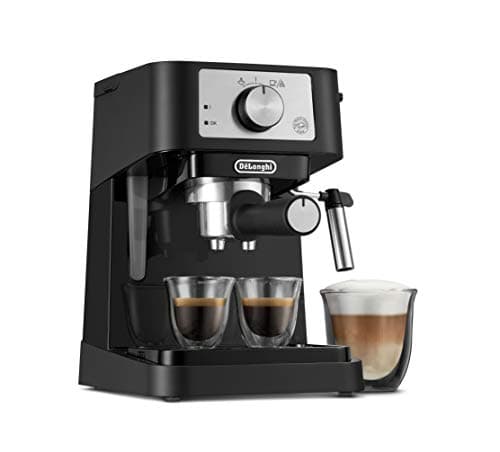
The De'Longhi Stilosa is the cheapest honest way to find out whether you're actually going to make espresso at home, and that framing — not "is it the best machine?" — is the right way to judge it. It costs a fraction of the Breville and De'Longhi machines most people eventually buy, and for that money it does pull a real pressurized shot and steam milk with a manual wand. The question this review answers is exactly what you give up at that price, and the specific person for whom giving it up is the smart move.
What you get is more real machine than the price suggests. De'Longhi rates the Stilosa with a 15-bar pump, it includes a tamper, and it fits a genuine manual steam wand rather than an automatic frother — so you can practice texturing milk by hand, the same skill you'd learn on a machine costing five times as much. It's compact and light enough to stash in a cupboard if the hobby doesn't stick, which is exactly the point of a machine at this price: it lowers the cost of finding out. For someone curious about espresso but unwilling to spend real money on a maybe, that is a genuinely useful proposition.
Now the honest part — what a sub-$100 machine gives up, because it gives up plenty. First, the basket. De'Longhi equips the Stilosa with a pressurized (dual-wall) portafilter basket, which uses a small valve to build pressure and force out a foamy crema even from mediocre or slightly stale coffee. That's forgiving and beginner-friendly, but it's also a ceiling: a pressurized basket manufactures crema rather than rewarding good grinding and technique, so no matter how good your beans or your skill get, the shot can only improve so far. Second, the steam. The Stilosa's wand is real but modest — the boiler is small and the steam pressure is weaker than pricier machines, so texturing proper microfoam is slower and harder than on a machine with more power behind the wand.
The rest of the compromises are the ones you'd expect at the price. There's no grinder, so this is only part of a setup, and the machine's modest temperature stability means the shot drifts more than it would on a machine with better thermal control. The build is plastic-heavy and feels its price in the hand. None of this is a defect — it's the honest cost of a sub-$100 machine, and De'Longhi has clearly chosen forgiveness and affordability over ceiling and refinement. The Stilosa hits that brief cleanly; the mistake is expecting it to be something it was never priced to be.
So who is it genuinely right for? Three people. The curious first-timer who wants to try espresso without committing real money, and would rather spend the difference finding out whether they enjoy the ritual. The tight budgetthat simply can't stretch to a Bambino or a Barista Express right now but wants real, non-pod espresso today. And the space-constrained or occasional drinkerwho wants a machine they can pull out now and then and put away. For all three, the Stilosa is the right tool precisely because it's cheap and unpretentious — it does the job of being your entry point and nothing more.
Who should skip it? Anyone who already knows they're serious. The most expensive way to buy an espresso machine is to buy twice, and if you can tell you'll be dialing in shots and chasing better milk within a few months, the Stilosa's low ceiling will frustrate you fast and you'll end up spending on a real machine anyway. If your only constraint is counter space, the De'Longhi Dedica gives you a slimmer, more refined machine for a bit more. And if you want a real ceiling — genuine microfoam and a shot worth dialing in — step up to the Breville Bambino Plus, which is where serious buyers should start. We cover the whole affordable field in our budget espresso machines guide.
What's it like to live with? Cheerful and undemanding, within its limits. It heats reasonably quickly, the controls are simple, and the pressurized basket means your first shots will look respectable even before your technique catches up — which is exactly the encouragement a beginner needs. The weak steam is the part you'll feel most: milk drinks take patience, and the microfoam won't rival a Breville's. Treat it as a learning machine and a low-stakes experiment rather than a forever purchase, and it's a likeable little thing that punches above its price.
As always, the Stilosa wasn't in our hands. We worked from De'Longhi's published specifications, the well-documented behavior of pressurized baskets and small-boiler steam systems, and the machine's long ownership record, and we priced it live. Where a claim is the manufacturer's — the 15-bar pump, the pressurized basket design — we report it as De'Longhi's spec rather than a measurement of our own, in line with our research method.
The short answer
Quick picks
#ad · Live prices from the Amazon Product API, as of Sep 16, 2026. Where we have no verified live price, we show none — we would rather leave a gap than print a number that has rotted.
In detail
The picks, in full
Testing the waters on a tight budget
De'Longhi Stilosa (EC260)
15-bar pumpManual steam wandTamper includedCompact footprint
The honest cheapest way to find out whether you're actually going to do this.
- Shot quality
- 6
- Steam & milk
- 6
- Ease of use
- 7
- Build quality
- 5
- Value
- 9
Pros
- +Costs a fraction of the Breville and De'Longhi machines while still pulling a real pressurized shot
- +A genuine manual steam wand, so you can practice milk without an auto-frother doing it for you
- +Small and light enough to stash in a cupboard if the hobby doesn't stick
Cons
- −No grinder, single-walled basket, and modest temperature stability — the shot ceiling is lower than the pricier machines
- −Plastic-heavy build that feels its price
Don't buy this if…
…you already know you're serious. You'll outgrow it fast and end up buying twice — start with the Barista Express or Bambino Plus and skip the upgrade.
The narrowest counters
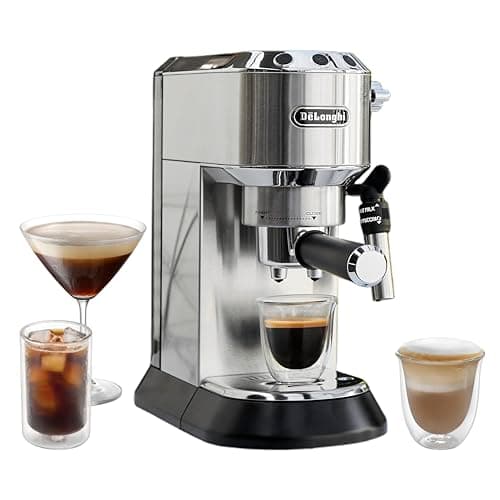
De'Longhi Dedica Deluxe (EC685)
4.9-inch wide15-bar pumpManual milk frotherFast pre-heat
The slimmest real machine here — barely wider than a wine bottle, and it works.
- Shot quality
- 7
- Steam & milk
- 6
- Ease of use
- 8
- Build quality
- 6
- Value
- 8
Pros
- +De'Longhi lists it at under five inches wide, which genuinely solves the 'no counter space' problem better than anything else here
- +Heats quickly and pulls a respectable shot for the size and price
- +Manual frother lets you learn milk texturing properly
Cons
- −The small stature means a small boiler and tank — it's built for one or two drinks at a time
- −No grinder, and the pressurized basket flatters mediocre grinding rather than rewarding good grinding
Don't buy this if…
…counter space isn't your constraint. You're paying a slight premium for slimness — a Stilosa or a Bambino Plus gives you more machine for the footprint you'd otherwise use.
People who already own a grinder
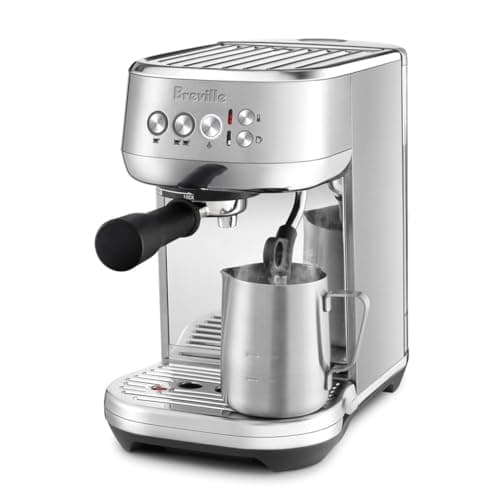
Breville Bambino Plus (BES500)
No built-in grinder54mm portafilter3-second heat-upAutomatic milk texturing
The one to buy if you already have a grinder. Tiny, fast to heat, and it auto-steams milk.
- Shot quality
- 8
- Steam & milk
- 8
- Ease of use
- 9
- Build quality
- 7
- Value
- 9
Pros
- +Breville rates it at a 3-second heat-up — you genuinely can go from cold to a shot faster than a kettle boils
- +The automatic milk-texturing wand froths to a set temperature and texture with no technique required, which is the feature beginners actually benefit from
- +A tiny footprint that fits a cramped counter where the Barista Express won't
Cons
- −No grinder, so you must own or buy one — factor that into the real price
- −Small water tank means frequent refills if you make several drinks a day
Don't buy this if…
…you don't have a grinder and don't want to buy one. Pre-ground coffee makes bad espresso in any machine, and this one gives you nowhere to grind — get the Barista Express instead.
Who should buy the De'Longhi Stilosa — and who shouldn't
Buy it ifyou want the cheapest honest way to try real espresso at home, you have a tight budget or limited space, and you'd rather spend a little to find out whether the hobby sticks than commit real money to a maybe. As a first taste of non-pod espresso, or a machine you can put away between uses, it does exactly what it's priced to do.
Skip it ifyou already know you're serious about espresso — you'll outgrow its low ceiling fast and end up buying twice, so start with a Bambino Plus or a Barista Express instead. Skip it too if you want strong steam for milk drinks, or if your only real constraint is counter width — the slimmer Dedica is the better narrow-counter buy.
The pressurized basket: what it does and where it stops
The single most important thing to understand about the Stilosa is its pressurized basket. De'Longhi fits a dual-wall basket that uses a valve to build pressure and push out a foamy crema even from coarser, cheaper, or slightly stale coffee — which is why your early shots look good and why the machine is so forgiving for a beginner. The catch is that this crema is manufactured by the basket, not earned by extraction, so the machine flatters mediocre grinding rather than rewarding good grinding. It means you can make a passable shot with almost no skill, but also that the shot has a low ceiling no amount of technique or better beans will lift. It's a fair trade at this price — just know it's the trade you're making.
The steam wand: honest expectations
The Stilosa has a genuine manual steam wand, which is a real plus at the price — you can actually learn to texture milk rather than push a button. But temper your expectations: the boiler is small and the steam is weaker than on a Bambino or a Barista Express, so building proper microfoam is slower and takes more patience, and the results won't match a more powerful machine. For a cappuccino or a casual latte it's workable; for silky latte-art microfoam, it's a struggle. Our steaming guide will help you get the most out of a modest wand.
Stilosa vs Dedica
These are the two entry De'Longhi machines most budget buyers cross-shop, and they split on footprint and polish. The Stilosa is cheaper and plainer; the Dedica Deluxeis barely wider than a wine bottle — De'Longhi lists it at under five inches — and heats and pulls a shot with a bit more refinement, for a modest premium. Both use pressurized baskets and manual frothers, so neither has a dramatically higher ceiling. Choose the Stilosa if price is the priority; choose the Dedica if a genuinely tiny footprint is worth paying a little more for. If counter space isn't your constraint, the Stilosa gives you more machine for the money.
Stilosa vs Bambino Plus — the real step up
This is the comparison that matters most, because it's the honest upgrade path. The Breville Bambino Pluscosts several times more, but it changes what's possible: a much faster heat-up, far stronger steam, an automatic milk-texturing wand that makes café-style microfoam with no skill, and a real shot worth dialing in. If you already suspect you're serious, the Bambino Plus is where you should start — the money you'd spend on the Stilosa first is money spent twice. The Stilosa is the right buy only when you genuinely want the cheapest possible way in; the moment you want a ceiling, it's the Bambino Plus.
What to pair it with
The Stilosa has no grinder, and here's the honest tension: the pressurized basket means it tolerates pre-ground coffee better than a machine with a non-pressurized basket would, so you can get started without a grinder. But fresh beans ground just before brewing still make a better cup, and if you find yourself wanting to improve, a modest grinder is the first upgrade — see our best grinders for espresso. Just be careful not to spend more on accessories than the machine cost; if you're investing that much, you've outgrown the Stilosa and should look up the range.
The "buying twice" trap
The one mistake to avoid with a machine like this is buying it when you already know you're serious. The Stilosa is brilliant at being a low-cost entry point and a low-stakes experiment, but it is not a machine you grow with — its ceiling is low by design. If you can honestly say you'll be dialing in shots and chasing better milk within a few months, skip it and start one tier up. The cheapest machine is the most expensive choice if it's just a stepping stone to the machine you were always going to buy. Our how to make espresso at home guide will help you decide how serious you really are before you commit.
How we picked
We do not run a testing lab
We compiled published manufacturer specifications, computed what each option costs to run where relevant, and cross-referenced aggregated owner reviews, then scored each product against a published rubric. The scores are judgments from documented research — they are not measurements we took, because we do not have a lab and we are not going to pretend we do. Where a number came from a manufacturer or a standard, we name it in Sources.
Questions
Frequently asked
Is the De'Longhi Stilosa worth it?+
For the right buyer, yes — it's the cheapest honest way to try real espresso at home. It pulls a genuine pressurized shot, includes a manual steam wand and a tamper, and costs a fraction of a Bambino or Barista Express, so it's ideal for a curious first-timer, a tight budget, or an occasional drinker. It's not worth it if you already know you're serious: the low ceiling means you'll outgrow it and end up buying twice. Judge it as an entry point, not a forever machine.
Can the Stilosa make good espresso?+
It makes decent, forgiving espresso for the price, but with a ceiling. De'Longhi fits a pressurized basket that manufactures a foamy crema even from mediocre coffee, so your shots look respectable early — but that same basket flatters rather than rewards good grinding, so the shot can only get so good no matter how much you improve. For a beginner it's encouraging and drinkable; for someone chasing a truly great shot, a machine with a non-pressurized basket like the
Bambino Plus has a much higher ceiling.
Stilosa vs Dedica — which should I buy?+
They're close. The Stilosa is cheaper and plainer; the
Dedicais barely wider than a wine bottle and a bit more refined, for a modest premium. Both use pressurized baskets and manual frothers, so neither has a dramatically higher ceiling. Buy the Stilosa if the lowest price is the priority; buy the Dedica if a genuinely tiny footprint is worth paying a little more for. If counter space isn't your issue, the Stilosa is the better value.
Does the Stilosa steam milk?+
Yes — it has a real manual steam wand, so you can froth milk for a cappuccino or latte and practice texturing by hand. The honest limit is power: the boiler is small and the steam is weaker than on pricier machines, so building proper microfoam is slower and harder, and the results won't match a Bambino or Barista Express. It's genuinely usable for casual milk drinks, but if silky latte-art microfoam is your goal, you'll want a machine with a stronger wand.
Receipts
Sources
We do not run a testing lab, and we do not pretend to. Where a measured number came from a manufacturer spec sheet or a published standard, we name it and link it. Where we could not verify something, we say so on the page rather than quietly leaving it out. Read our full method.