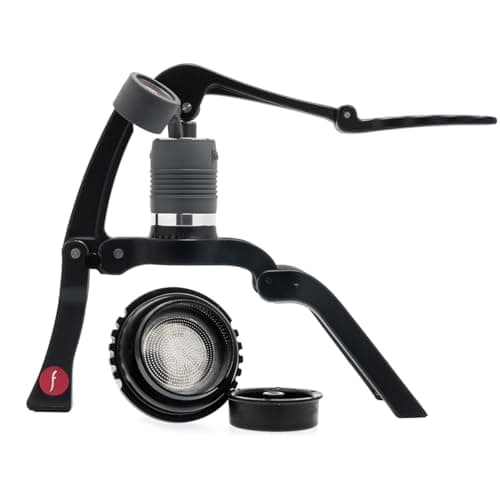
The WACACO Nanopresso does something no full machine can: it makes a real, crema-topped shot of espresso from something that fits in a jacket pocket, with no plug, no battery, and nothing to charge. You add finely ground coffee and hot water, pump the built-in piston by hand, and it pushes out a genuine pressurized shot. For a backpack, an office drawer, a hotel room, or a campsite, that is a small miracle — and it is why the Nanopresso is the default recommendation for pocket espresso.
The honest picture is that it is a travel tool, and a very good one, rather than a replacement for a kitchen machine. WACACO rates it at 18 bar from the hand pump, and it does produce a legitimate crema shot that no other device this size can match. But it is a single-shot, one-at-a-time affair: the capacity is small, every shot is a manual pump, and the result depends heavily on your grind and your technique — it is forgiving of nothing. Get the grind right and pump with a steady hand and it rewards you; get lazy and it lets you know.
The natural comparison is the Flair 2GO, the other portable maker people weigh against it, and the two answer slightly different questions. The Nanopresso is smaller, cheaper, and more genuinely pocketable — the thing you throw in a bag without thinking. The Flair 2GO is a lever press that is a step up in both size and shot quality: it collapses to pack, but it is a deliberate, tabletop ritual rather than a pocket gadget, and its shot embarrasses cheap electric machines. If ultimate cup quality on the road matters most, the Flair edges it; if pack-anywhere convenience matters most, the Nanopresso wins.
What is the experience actually like? More involved than any electric machine, and that is rather the point for the people who love it. You grind fine, boil water separately — a travel kettle, a campfire, a hotel tap that runs hot enough — fill the basket, and then pump the piston by hand while the shot builds, feeling the resistance rise as the water reaches brewing pressure. It is a deliberate ritual measured in minutes, not the ninety seconds of a button press, and it produces a single shot at a time. Done with care it is genuinely rewarding; done in a hurry it is fiddly. Be honest about which of those describes your mornings before you decide this is your everyday maker.
The value case is strong in a specific way: the Nanopresso is cheap enough to be a dedicated second setup rather than a compromise on your main one. You are not asking it to replace a kitchen machine, so its limits — single-shot capacity, hand effort, unforgiving of a lazy grind — stop being flaws and become the price of fitting real espresso into a bag. There is also almost nothing to break: no boiler, no pump motor, no electronics, just a piston and seals you can replace. For a device that lives in luggage and gets knocked around, that simplicity is a feature, not an absence.
One thing to be clear-eyed about before you buy: if this is meant to be your main espresso at home, it is the wrong tool. On a kitchen counter, a modest electric machine like the De'Longhi Stilosa or the Breville Bambino Plus will out-perform a hand pump every morning without the effort — the Nanopresso's whole point is portability, not throughput. We did not lab-test this device; we worked from the published specifications and the well-understood behavior of manual, hand-pumped makers, and priced it live.
Who the Nanopresso is for — and who should skip it
Buy it if you want real espresso where there is no power — travel, camping, a desk, a hotel room — and you value pack-anywhere size above all. It is cheap enough to be a dedicated travel-only setup rather than a compromise on your main machine, and it makes a crema shot nothing else its size can. For a coffee person who refuses to give up espresso on the road, it is close to essential.
Skip it if you want your everyday kitchen espresso. It is a single-shot, hand-pumped device — one drink at a time, with real effort each time — so at home a modest electric machine will beat it every morning without the hand cramp. If a manual maker genuinely appeals but you want the best possible shot and do not need pocket size, look at the manual and portable makers roundup, where the Flair 2GO leads on cup quality. And if you just want easy espresso at home, the budget machines are the honest answer.
Nanopresso vs Flair 2GO
Same category, two philosophies. The Nanopresso is the pocketable, cheaper, throw-it-in-a-bag choice — a hand-pumped piston that makes a good shot in the smallest possible package. The Flair 2GO is a collapsible lever press that is larger and pricier but pulls a better, more controllable shot, and rewards a careful setup. The lever gives you a direct feel for the pressure through the pull, which is part of why enthusiasts prefer it; the Nanopresso's hand pump is quicker to learn and far more pocketable. Neither needs power, both collapse to travel, and both demand a good grind — the split is really about how much you prioritize the cup over the carry. Pick the Nanopresso for maximum portability and value; pick the Flair 2GO when the shot itself is the priority and you have a flat surface and a minute to work on it.
The grind matters more here than anywhere
Manual makers have no pressurized basket to hide behind, so a consistent, espresso-fine grind is not optional — it is the difference between a great shot and a watery one. A good grinder is the single most important thing you can pair with a Nanopresso, and a compact hand grinder keeps the whole kit unplugged and packable. And because there is no steam wand, milk drinks need a separate frother; the Nanopresso makes the espresso, not the latte.
What to pack alongside it
A pocket espresso maker is only half of a travel kit. The other half is a consistent, espresso-fine grind, so a compact hand grinder is the natural companion — it keeps the whole setup unplugged and packable, and it matters more here than on any electric machine because there is no pressurized basket to hide a bad grind. Pre-ground coffee will disappoint you within days of opening the bag, so grinding on the road is worth the small extra bulk. If you take milk drinks, add a tiny battery or hand frother; the Nanopresso makes the espresso, never the foam. And a small pouch of a forgiving espresso blend rounds out a kit that fits in a jacket pocket, so you are never more than a kettle away from a real shot.