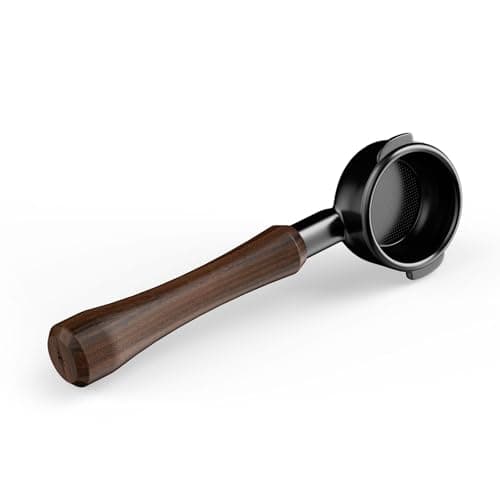
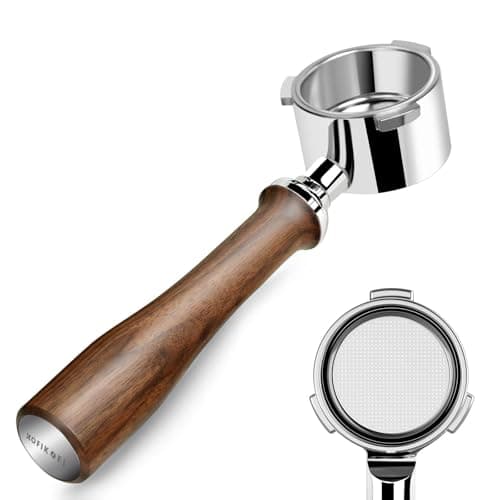
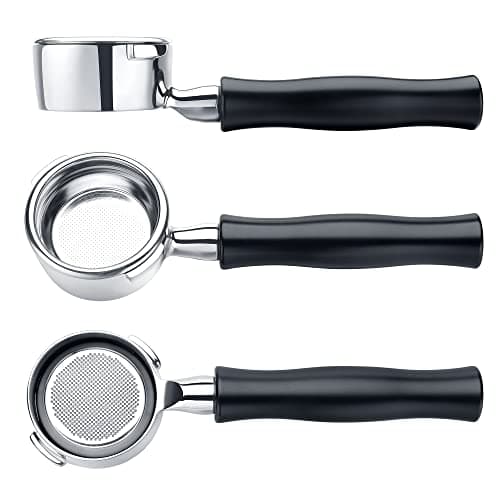
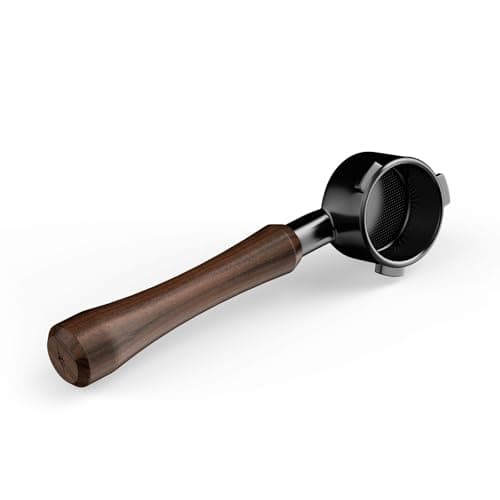
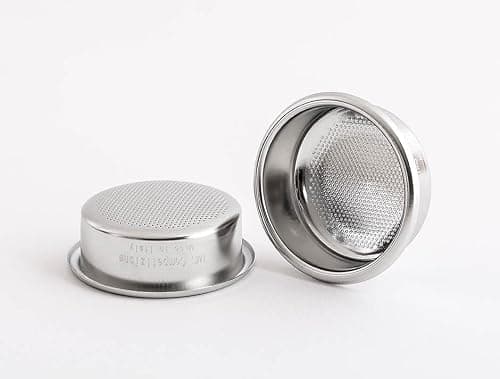
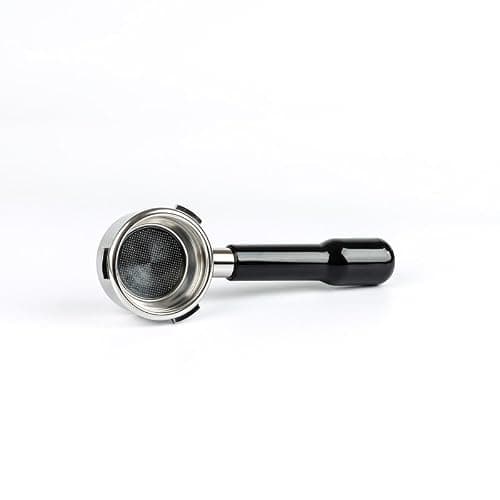
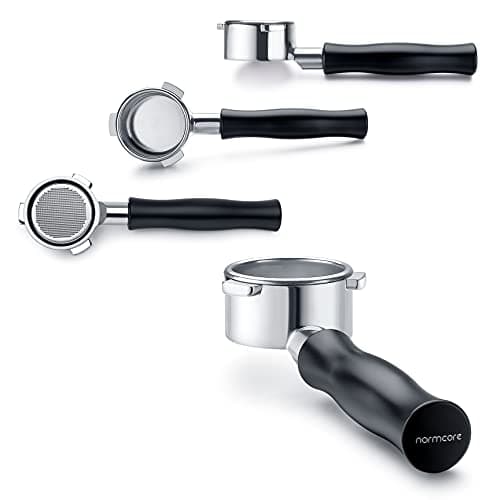
A bottomless portafilter — a naked portafilter, if you prefer — is a portafilter with the spouts and the bottom plate removed, so the underside of the coffee puck is exposed while the shot runs. That is the entire product. It brews no better than the portafilter that came with your machine. What it does is remove the lid from the one part of espresso you have never been able to see, and once you can see it, a whole class of mysterious problems stops being mysterious.
Here is the honest framing most roundups skip: a bottomless portafilter fixes nothing. It is a diagnostic. Espresso Parts describes it as a tool for training, troubleshooting and quality control, and that is exactly right — it tells you whether water is passing evenly through your puck or tunneling through one side of it. Channeling, the thing it reveals, is water finding the path of least resistance through unevenly packed coffee, and in a spouted portafilter it is completely invisible: the spouts collect everything and pour a respectable-looking stream whether your puck extracted evenly or shot sideways. With the bottom removed, an even extraction appears as a single centered cone of coffee that gathers under the middle of the basket. An uneven one sprays jets at the walls of your machine. There is no ambiguity and no interpretation required.
That is why this is the first espresso purchase we would make after a grinder and a scale, and why it is far more useful than it is expensive. It also explains the one criterion that outranks everything else on this page.
Fit comes first, and it is not negotiable
Portafilters are sized by group head diameter, and they are not cross-compatible. Commercial and prosumer machines — E61 groups, Rocket, ECM, Lelit, Gaggia, Rancilio — use 58mm. The entire Breville / Sage Barista line uses 54mm. De'Longhi's Dedica family uses 51mm. And even within a diameter, the ear pattern differs: E61 groups take a flat two-ear portafilter, while Gaggia, Breville and most 51mm machines take three ears. A three-ear 58mm portafilter will not seat in an E61 group no matter how correct the diameter is.
This is the single most common way people waste money in this category, so every pick below is organized by what it fits rather than by brand, and we have deliberately favored listings that name the machines. Every item here was checked against Amazon's live catalog on October 10, 2026 and was in stock on that date. We have not pressure-tested these parts in a lab, because we do not have one; how we research says exactly what we do instead.
For a Breville (54mm)
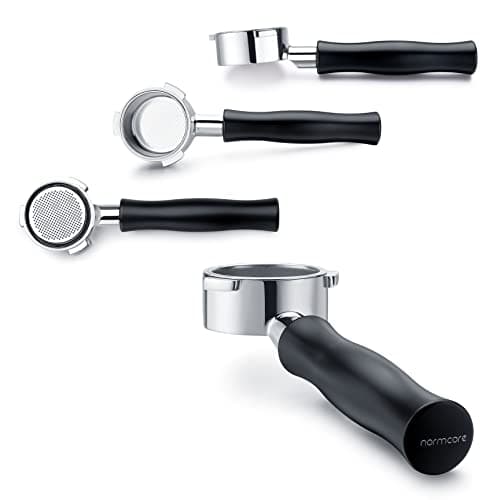
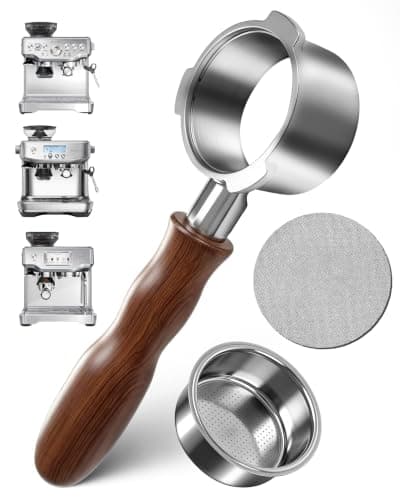
The Normcore 54mm is the pick for most people on this page, because most home espresso machines sold in the US are Brevilles and because it ships with an 18g basket. That basket is not a bonus, it is the point: the dual-wall pressurized baskets a Breville comes with create crema artificially by forcing the coffee through a single small hole, which means they will happily produce a pretty-looking shot out of a badly prepared puck. Put a pressurized basket in a bottomless portafilter and you have spent money to hide the exact information you bought the tool to see. Normcore documents fitment across the Barista Express, Pro, Touch and Bambino line better than anyone else in this category. The honest cons: it costs roughly what a decent tamper costs and it diagnoses rather than fixes, and you will spray espresso across your counter the first few times you use it. That is the tool working.
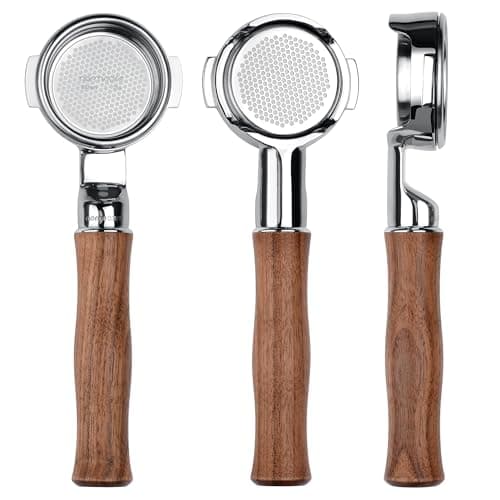
The MHW-3BOMBER 54mm (BP7118B)is the one to buy if you want the upgrade to feel like one. Three ears, a heavier head that seats more positively in the group, a real wood handle that stays cooler than metal, an 18g basket in the box, and a listing that names the BES870XL, BES878 and BES880 explicitly. It is the most expensive 54mm option here and it produces espresso identical to the cheaper ones — you are paying for feel and finish, which is a legitimate thing to pay for as long as you know that is what you are buying. Keep the wood out of the dishwasher.
The CAFEMASY 54mm is the budget answer, and for the specific job of finding out whether you channel it is all you need. Same 54mm Breville fitment, nothing to maintain, roughly half the money of the name brands. Fit and finish are visibly a tier down and the handle is the giveaway. One practical warning that applies across this whole price bracket: read the listing before you order, because budget 54mm portafilters vary on whether a basket is included, and without a single-wall basket the portafilter is useless to you.
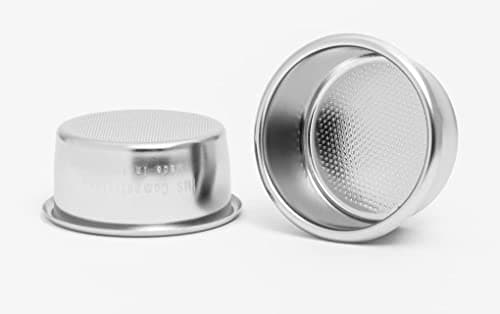
The IMS Precision 54mm basket (18-22g) belongs in the same breath as all three. It is the part that actually improves the shot rather than revealing it: IMS baskets are machined to tighter hole tolerances than stock baskets, which is the mechanism behind more even flow, and the 18-22g rating gives a Breville genuine dose headroom the factory baskets do not have. The listing covers the Express, Bambino, Bambino Plus, Barista Pro, Impress, Barista Touch and Infuser, and states plainly that it does not fit the JET. Two honest cons: moving above 18g changes your grind and your yield, so expect to re-dial rather than plug and play, and if your portafilter already shipped with a precision basket, buying another one buys you nothing.
For a 58mm machine (E61, Gaggia and friends)
The MHW-3BOMBER 58mm (BP7120L)is the 58mm pick, and it earns it on fitment clarity more than anything else. It is a flat two-ear portafilter — the correct pattern for an E61 group — and the listing names E61, Flair 58, ECM, Rocket, Sanremo, Synesso and VBM. In a category where most 58mm listings say "fits 58mm machines" and leave you to find out, that list is the product. It includes an 18g basket, so a prosumer machine with a tired stock basket gets two upgrades at once. The cons are the flip side of the same coin: two-ear E61 fitment means it will not fit a Gaggia or a Breville, and it is priced like the prosumer accessory it is.
The Normcore 58mm for Gaggiais the right answer for the single most common 58mm home machine. It is cut specifically for Gaggia's group rather than sold as a generic 58mm, it includes a basket so the Gaggia's stock pressurized basket can go in a drawer, and its anodized handle is noticeably lighter in the hand than the stock unit. On a Gaggia Classic this is the upgrade that changes your shots, because it is the one that finally shows you what the pressurized basket was hiding. The honest con is a useful one: on a stock, non-PID Gaggia it will also reveal temperature-surfing inconsistency you cannot fix without adding a PID. Knowing that is still better than not knowing it.
The Normcore Slim 58mmis the premium end: an American walnut handle, a slim head profile that clears taller cups under the group, and — the actual justification — Normcore's high-extraction basket in the box rather than a generic one, so the shot changes as well as becoming visible. It is the most expensive item on this page by a wide margin, and its listing is admirably blunt that it does not fit Ascaso, Decent, Profitec Go or Flair 58. If you only want the diagnostic, the MHW-3BOMBER shows you the same puck for substantially less.
The 58mm 3-ear for Calphalon Temp iQ is on this page for a small group of people who are routinely told their machine has no options. Temp iQ owners searching for a bottomless portafilter usually come back empty-handed or buy a generic 58mm that will not seat; this one is cut for the Calphalon group and priced in line with the budget 54mm parts despite the much smaller market. The handle is ABS and feels like the budget part it is, and you should confirm whether a basket is included before ordering.
The IMS Competition Convex 58mm basket (18g)is the 58mm counterpart to the precision basket above, and the same logic applies: the portafilter shows you channeling, a precision basket is one of the few parts that measurably reduces it. It costs a fraction of the portafilter it drops into. Its limits are honest — a basket narrows variance rather than eliminating it, and 18g is a fixed target, so if you dose 20g or more you want a bigger basket instead.
For a De'Longhi Dedica (51mm)
The KOFIKOFI 51mmis the highest-impact upgrade a Dedica owner can make, and the reason is not the portafilter — it is what the portafilter forces. The Dedica ships with a pressurized basket, which is why so many owners conclude the machine cannot pull real espresso. Move it to a non-pressurized basket in a naked portafilter and it becomes a different machine. KOFIKOFI names the EC680, EC685 and EC885 explicitly, which is unusual in a 51mm market full of vague listings. Two real cons: 51mm baskets hold less coffee, so your dose range is tight and there is little room for error, and this upgrade is actively worse than useless if your grinder cannot reach espresso fineness — on pre-ground coffee a bottomless 51mm will gush.
The Normcore 51mmis the better-built alternative and the one with the widest fitment list: Dedica EC680 and EC685 plus SMEG and EUPA machines, with a basket included — which on a 51mm machine is the harder half of the upgrade to source separately. It costs more than the KOFIKOFI for the same diagnostic, and it is listed for the EC680 and EC685, so EC885 owners should confirm fit before ordering. If your machine is definitely a Dedica and nothing else, the KOFIKOFI names all three generations and costs less. If you have a SMEG, this is your only real option.
How to read a naked shot
The whole value of this tool is in thirty seconds of watching, so it is worth knowing what you are looking at. A well-prepared puck produces a slow start, then several thin streams that converge into one centered cone of dark, syrupy coffee falling from the middle of the basket. It stays centered for the whole shot. That is what you want, and it looks unmistakably correct the first time you see it.
Everything else is information. Jets spraying sideways at the machine walls mean channeling: water has found a weak path through the puck. Flow leaning to one side from the beginning usually means your tamp was angled. A blonde, fast, pale gusher means the grind is too coarse or the dose is too low. Dripping that never establishes a streammeans the grind is too fine or the dose too high. And a wide spray right at the start that then settles down is often just pre-infusion doing its job — judge the body of the shot, not the first second of it.
The three fixes, in the order that works
Once you can see channeling, the temptation is to tamp harder. Do not. Harder tamping is almost never the answer and frequently makes things worse. Work in this order:
1. Grind.Check the grinder before anything else. An inconsistent grind produces a puck with inconsistent resistance, and no amount of preparation fixes that. This is where a decent burr grinder earns its money — see best espresso grinders under $200 and our espresso grind size guide.
2. Distribution. Break up clumps and level the bed before you tamp. A WDT tool is the cheapest meaningful fix in espresso and the single biggest reduction in channeling most people will ever make. Our puck prep tools roundup covers distributors and levelers too.
3. Tamp.Level and consistent, not heavy. Once the puck is compressed, additional force does very little, and an angled tamp does a great deal of damage — our espresso tamping guide has the technique. If you would rather remove the variable entirely, machines with assisted tamping now exist; the Breville Barista Express Impress applies a published constant force on every shot.
Pressurized baskets: the thing to get rid of first
If your machine came with dual-wall or "pressurized" baskets — most Brevilles, every Dedica, most sub-$300 machines — swap them out before you buy anything else. A pressurized basket has a single tiny outlet that builds back-pressure artificially, which is how a cheap machine produces crema from stale supermarket coffee. It is a crutch, and it is specifically a crutch that hides extraction problems. In a bottomless portafilter it defeats the entire purpose. Several picks above include a single-wall basket for exactly this reason; if yours does not, buy one in the same order.
Expect mess, and plan for it
A naked portafilter will spray. That is the design. Pull your first few shots with a towel down and the machine pulled forward, do not wear a white shirt, and accept that you will be wiping the drip tray area more often than before. Most owners find the spraying stops almost entirely once their puck prep improves, which is the point — the mess is the feedback. If you are making milk drinks and do not want to lose the double-spout split, keep your original portafilter; they take seconds to swap and there is no reason to own only one.