Skip to content
Bean & Burr

HUB 02 · Coffee Makers

Bodum Chambord French Press Review

The French press everyone pictures, reviewed honestly — why it's still the default buy, the grit it leaves, and when to spend up or down instead.

By Stephen V.Updated How we research
#ad

We earn a commission when you buy through our Amazon links, at no extra cost to you. It never affects our rankings, and we say so when the cheaper product is the better buy. How this works.

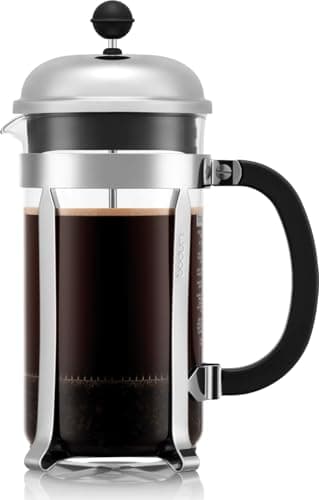
When someone says "French press," the Bodum Chambord is the object they're picturing — the borosilicate glass beaker, the polished stainless frame, the little domed knob on the plunger. It has been made in essentially this form for decades, and it remains the one we point most people to first. Not because it's the most advanced press you can buy, but because it does the fundamental job as well as anything and costs about as much as two coffee-shop lattes.

The method is the most forgiving in coffee. You drop coarse grounds in the beaker, pour hot water over them, wait about four minutes, and press the metal mesh to the bottom. Because that mesh filters instead of paper, the coffee's natural oils and fine particles stay in the cup — which is exactly what gives press coffee its heavy, round, full body. There are no paper filters to buy, no gooseneck kettle to master, and no timing window narrow enough to ruin. Dollar for dollar, it's the cheapest way to make coffee that genuinely tastes good.

The Chambord earns its reputation on the details around that method. The borosilicate glass is heat-resistant and, crucially, cheap and universally stocked — the day you knock the beaker off the counter, a replacement is a few dollars and a click away rather than a reason to bin the whole press. The stainless frame feels genuinely solid in the hand, a step above the plastic-framed presses it's often compared to, and it's the reason the Chambord looks the part on a counter or a breakfast table. Parts are everywhere: beakers, mesh screens, cross plates, knobs. This is a product designed to be kept, not replaced.

What it's like to live with

In daily use, the Chambord is close to idiot-proof, which is the highest compliment you can pay a brewer. It scales easily — the 34oz size makes enough for two or three mugs — and the cleanup, while messier than an AeroPress, is a rinse-and-tap-out affair once you get the puck moving. It keeps coffee reasonably warm for the ten or fifteen minutes it takes to drink a pot, though glass is a poor insulator, so a press is not the tool for nursing a cup over an hour. Decant it into a mug or thermos the moment you plunge and it holds up fine.

Two honest limitations keep it from being perfect. First, grit: the single metal mesh lets fine sediment through, so the last inch of the cup carries a little silt. Most people never mind it, and the fix is partly technique — a coarse, even grind produces far less dust — but it's real, and it's the thing sediment-sensitive drinkers dislike about press coffee generally. Second, the glass: borosilicate is tougher than it looks, but it is still glass, and a hard floor will win. If you're clumsy or the press lives somewhere it'll take knocks, that's worth weighing.

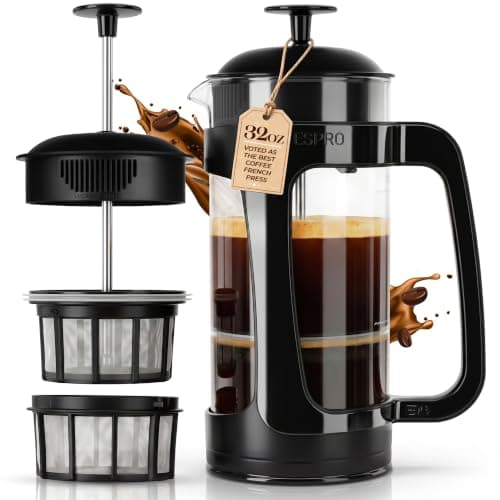
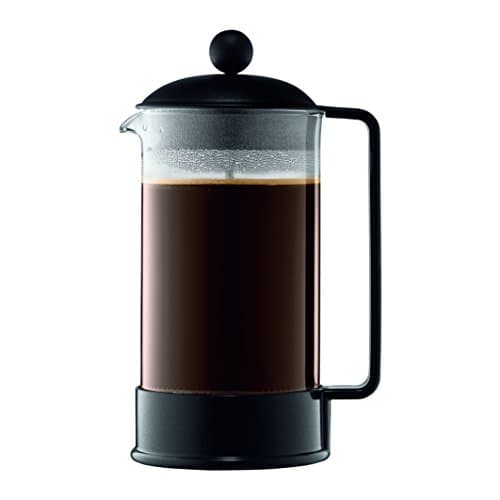
Both of those limits point to the two products alongside it in the picks. The Espro P3is the answer to grit: a patented double micro-filter catches far more fines than a standard mesh, so the cup is clean to the bottom, and the filter also stops the brew from over-extracting as it sits. It costs more and is a little more to clean, and if a bit of sediment doesn't bother you, you're paying to solve a problem you don't have. And the Bodum Brazilis the answer to price: it's essentially the same borosilicate beaker and the same brew in a plastic frame instead of steel, and it's the single best value in this whole category — you give up the handsome look and nothing about the coffee.

The short answer

Quick picks

#ProductBest forScorePrice
01
Bodum Bodum Chambord French Press (34oz)
Bodum Chambord French Press (34oz)

The French press. The one everyone pictures, and still the one to buy.

The default French press
7.8
$39.69Amazon
02
ESPRO ESPRO P3 French Press
ESPRO P3 French Press

A French press with a double micro-filter — the fix for the gritty last sip.

French press body without the sediment
7.4
$39.94Amazon
03
Bodum Bodum Brazil French Press (34oz)
Bodum Brazil French Press (34oz)

The cheapest way to make genuinely good coffee. A plastic-framed press that just works.

The lowest-cost good cup
7.8
$19.99Amazon

#ad · Live prices from the Amazon Product API, as of Jul 29, 2026. Where we have no verified live price, we show none — we would rather leave a gap than print a number that has rotted.

In detail

The picks, in full

01
Bodum Bodum Chambord French Press (34oz)

The default French press

Bodum Chambord French Press (34oz)

34 ozBorosilicate glassStainless frameMade in Portugal
7.8/10

The French press. The one everyone pictures, and still the one to buy.

Brew quality
8
Ease of use
8
Build quality
8
Versatility
6
Value
9

Pros

  • Full-immersion brewing with a metal filter gives you the heavy, full body that paper filters strip out
  • The classic design is classic for a reason — replacement parts and glass are cheap and everywhere
  • No paper filters to buy, ever — the running cost is zero

Cons

  • The metal mesh lets fine sediment through, so the last sip has grit
  • Glass carafe — it will eventually meet a hard floor

Don't buy this if…

you hate any sediment in your cup or you're clumsy near a tile floor. A grit-reducing Espro or a paper-filtered pour-over is the cleaner-cup answer.

$39.69View on Amazon

Price as of Jul 29, 2026. Prices change — Amazon's is the one that counts.

#ad · we may earn a commission from this link to Bodum Chambord French Press (34oz)

02
ESPRO ESPRO P3 French Press

French press body without the sediment

ESPRO P3 French Press

Double micro-filterBorosilicate glass32 ozGrit-free brew
7.4/10

A French press with a double micro-filter — the fix for the gritty last sip.

Brew quality
8
Ease of use
7
Build quality
8
Versatility
6
Value
8

Pros

  • The patented double filter catches far more fines than a standard mesh, so the cup is clean to the bottom
  • The filter also stops the brew when you plunge, reducing the over-extraction that makes press coffee bitter as it sits
  • Same full-immersion body as any press, minus the trademark grit

Cons

  • The double filter is more to rinse and clean than a plain mesh
  • Costs more than a basic Bodum for a difference only sediment-sensitive drinkers will prize

Don't buy this if…

a little grit doesn't bother you. Then you're paying extra to solve a problem you don't have — the Bodum Chambord is the cheaper, simpler press.

$39.94View on Amazon

Price as of Jul 29, 2026. Prices change — Amazon's is the one that counts.

#ad · we may earn a commission from this link to ESPRO P3 French Press

03
Bodum Bodum Brazil French Press (34oz)

The lowest-cost good cup

Bodum Brazil French Press (34oz)

34 ozBorosilicate glassPlastic frameMade in Portugal
7.8/10

The cheapest way to make genuinely good coffee. A plastic-framed press that just works.

Brew quality
8
Ease of use
8
Build quality
7
Versatility
6
Value
10

Pros

  • Costs about the price of two coffee-shop lattes and makes better coffee than either
  • Same borosilicate carafe and brewing as the pricier Chambord — the frame is the only real difference
  • The single best value in this entire guide, full stop

Cons

  • The plastic frame feels cheaper than the Chambord's steel
  • Same mesh-filter grit as any standard press

Don't buy this if…

you want something that looks the part on the counter. It's built to a price and shows it — the Chambord is the handsomer press for a few dollars more.

$19.99View on Amazon

$27.5027% off

Price as of Jul 29, 2026. Prices change — Amazon's is the one that counts.

#ad · we may earn a commission from this link to Bodum Brazil French Press (34oz)

Who the Bodum Chambord is for

Buy it ifyou want the best-known, best-supported French press at a fair price, you like a heavy, full-bodied cup, and you don't want to fuss with paper filters or pouring technique. It's the right default for most kitchens, and the steel frame makes it the one you're happiest leaving out on the counter. Feed it a coarse, even grind and it will make excellent coffee for years.

Buy the Espro P3 instead if the gritty last sip is a dealbreaker for you — its double filter is the cleanest a press gets, and it doubles as a fix for the over-extraction that makes a standing press turn bitter. Buy the Bodum Brazil instead ifyou only care about the coffee and the budget: the brew is identical, the frame is the only real difference, and it's the cheapest route to a genuinely good cup on this whole site. And if you want the cleanest possible cup rather than the fullest, a paper-filtered pour-over is the opposite tool — bright and articulate where the press is heavy and round.

Get the most out of it

A press rewards two habits above all. Grind coarse and even — roughly like sea salt — because the mesh lets any fine dust straight through into your cup, which is why a burr grindermatters more to a press than to almost any other brewer; a blade grinder makes exactly the dust a press can't filter out. And decant the coffee the moment you plunge: left sitting on its own grounds, it keeps extracting and turns bitter. Our guide to using a French press walks through the full ratio and timing.
How we picked

We do not run a testing lab

We compiled published manufacturer specifications, computed what each option costs to run where relevant, and cross-referenced aggregated owner reviews, then scored each product against a published rubric. The scores are judgments from documented research — they are not measurements we took, because we do not have a lab and we are not going to pretend we do. Where a number came from a manufacturer or a standard, we name it in Sources.

Questions

Frequently asked

Is the Bodum Chambord worth it?
For most people, yes — it makes a rich, full-bodied cup with almost no skill required, costs about the price of two lattes, and its glass and parts are cheap and everywhere, so it lasts. You're paying a small premium over the plastic-framed Bodum Brazil for the steel frame and looks, not for better coffee; the brew from the two is identical.
Why is my Chambord coffee gritty at the bottom?
The single metal mesh lets fine particles through, so a little silt settles in the last inch — normal for any standard press. Grind coarser and more evenly with a burr grinderto cut the dust dramatically, and stop plunging before the mesh hits the very bottom. If you want it truly grit-free, the Espro P3's double filter is the fix.
Chambord vs Espro P3 — which should I buy?
The Chambord if a little sediment doesn't bother you and you want the classic press at the lower price. The Espro P3if the gritty last sip is a dealbreaker — its double micro-filter makes the cleanest cup a press can, and it slows the over-extraction that turns a standing press bitter. You pay more and clean a bit more for that, so it's only worth it if you're sediment-sensitive.
What grind should I use in a French press?
Coarse and even — roughly like sea salt. Too fine and the mesh lets the dust through as grit and the coffee over-extracts into bitterness. This is the press's make-or-break, which is why a burr grinder matters more here than on most brewers. Steep about four minutes, plunge, and pour it all out so it stops brewing.

Keep reading

Receipts

Sources

We do not run a testing lab, and we do not pretend to. Where a measured number came from a manufacturer spec sheet or a published standard, we name it and link it. Where we could not verify something, we say so on the page rather than quietly leaving it out. Read our full method.