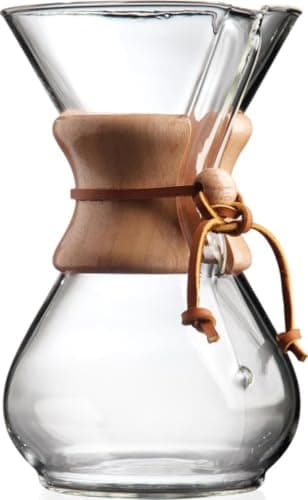
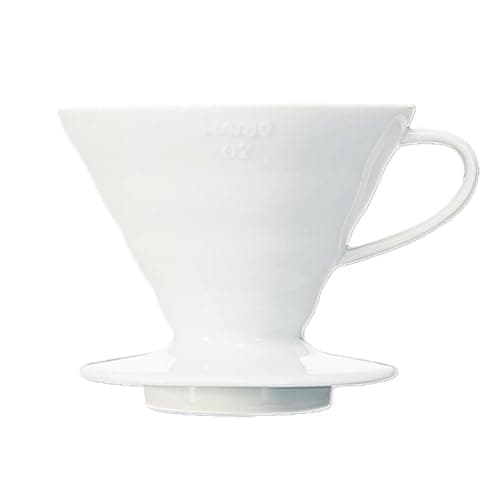
Both are manual pour-over, both are design icons, and they produce noticeably different coffee. The reason is almost entirely paper: Chemex's proprietary filters are far thicker than V60's, holding back oils and fine particles for a strikingly clean, tea-like cup — at the cost of slower flow. The V60's thin filter and big single hole let you control the flow with your pour: more body, more aroma, more variables in your hands.
Geometry reinforces the split. The Chemex is carafe-and-brewer in one, happiest at 3-6 cups, elegant on a table, forgiving of a mediocre pour — the water largely finds its own pace through that thick paper. The V60 is a single-cup instrument that rewards a gooseneck kettle, a scale and attention: poured well it is the clearest window on a good bag of beans; poured carelessly it will tell on you.
Same 1:15-1:17 ratio territory, same need for a uniform medium grind — the decision is batch-vs-cup and forgiving-vs-precise, not better-vs-worse.
The short answer
Quick picks
| # | Product | Best for | Score | Price |
|---|
| 01 | | The classic pour-over starting point | | $25.00·Amazon |
| 02 | Chemex Classic (6-Cup)The pour-over that doubles as a decanter. Thick filters, the cleanest cup, and it's beautiful. | Clean, bright coffee for two or more | | $47.03·Amazon |
#ad · Live prices from the Amazon Product API, as of October 27, 2026. Where we have no verified live price, we show none — we would rather leave a gap than print a number that has rotted.
In detail
The picks, in full
The classic pour-over starting point
Hario V60 Dripper (02)
60° coneSpiral ribsSingle large holeCeramic
The world's default pour-over cone. Cheap, brilliant, and endlessly rewarding to learn.
- Brew quality
- 9
- Ease of use
- 6
- Build quality
- 9
- Versatility
- 7
- Value
- 10
Pros
- +The cone shape and single big hole give you total control over flow and extraction — the reason it's the enthusiast default
- +Costs almost nothing and pairs with cheap filters
- +Produces a clean, bright, articulate cup that shows off good beans
Cons
- −The control is a double edge — a sloppy pour makes a mediocre cup, so it rewards a kettle and a bit of practice
- −You'll want a scale and ideally a gooseneck kettle to get the most from it
Don't buy this if…
…you want to walk away while it brews. Pour-over is hands-on for two to three minutes — if that's a chore, a French press or a drip machine is the set-and-forget option.
Clean, bright coffee for two or more
Chemex Classic (6-Cup)
Thick bonded filtersOne-piece glass6-cupBrew and serve in one
The pour-over that doubles as a decanter. Thick filters, the cleanest cup, and it's beautiful.
- Brew quality
- 9
- Ease of use
- 6
- Build quality
- 8
- Versatility
- 7
- Value
- 8
Pros
- +The heavy Chemex filters remove more oils and fines than any other paper here — the cup is exceptionally clean and clear
- +Brews a carafe's worth at once, so it scales to guests better than a single V60 cone
- +A genuine design object — it lives in a museum collection, and it looks it on the counter
Cons
- −The proprietary thick filters cost more than standard ones and aren't in every shop
- −That very clean profile strips some body — it's the opposite end from a French press
Don't buy this if…
…you like a heavy, full-bodied cup. The thick filters deliberately remove the oils that give coffee weight — a French press is the right tool for body.
Pick by morning, not by aesthetics
Chemex if:you brew for two-plus people at once, prefer the cleanest possible cup, or want the forgiving version of pour-over — the thick filter smooths over technique wobbles. Budget for its proprietary filters; generic cones don't fit properly and change the cup.
V60 if:you brew one cup at a time and enjoy the craft — it's cheaper to start, its filters are everywhere, and its ceiling (with a good grinder and deliberate pouring) is the highest in manual brewing. It's also the better teacher: every variable you learn on a V60 transfers everywhere else.
Genuinely torn? The V60 first — the cost of finding out is a fraction of the Chemex, and if you end up wanting both, they coexist happily: V60 weekdays, Chemex when company comes.
How we picked
We do not run a testing lab
We compiled published manufacturer specifications, computed what each option costs to run where relevant, and cross-referenced aggregated owner reviews, then scored each product against a published rubric. The scores are judgments from documented research — they are not measurements we took, because we do not have a lab and we are not going to pretend we do. Where a number came from a manufacturer or a standard, we name it in Sources.
Questions
Frequently asked
Does the Chemex really taste different from a V60?+
Yes, noticeably — the Chemex's much thicker filter strips more oils and fines, yielding a cleaner, lighter-bodied, almost tea-like cup; the V60 lets more through, giving more body and aromatic presence. Same beans, same ratio, two recognizably different results. Neither is wrong; they're two renderings of the coffee.
Which is easier for a beginner?+
The Chemex — its thick filter and self-regulating flow forgive pour technique, so decent cups come almost immediately. The V60 asks for a controlled pour (ideally a gooseneck) before it behaves. If 'easy' means 'hard to ruin', Chemex; if it means 'cheap to start and worth learning', V60.
Do I need a gooseneck kettle for these?+
For the V60, practically yes — its flow control IS your pour, and a regular kettle's glug makes consistency luck. For the Chemex you can get away without one; the filter does more of the regulating. Either way a scale matters more than the kettle: ratio errors dwarf pour errors.
Receipts
Sources
We do not run a testing lab, and we do not pretend to. Where a measured number came from a manufacturer spec sheet or a published standard, we name it and link it. Where we could not verify something, we say so on the page rather than quietly leaving it out. Read our full method.