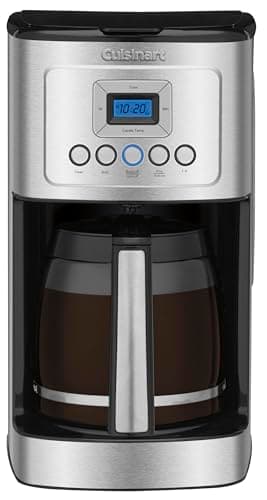
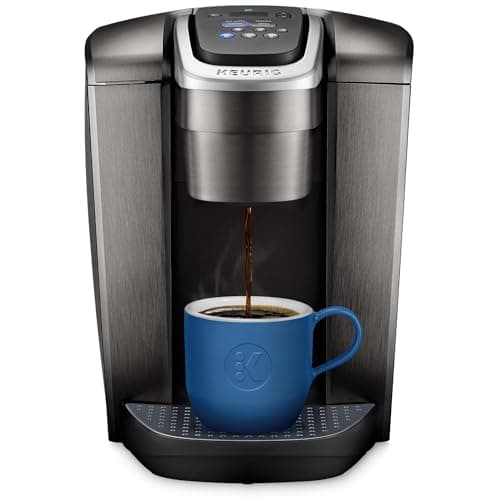
Keurig versus drip is not really a fight about coffee — it is a fight about time, money, and how many people you are brewing for. A Keurig punches a hole in a sealed pod and pushes hot water through it, handing you one cup in about a minute with nothing to clean up. A drip machine like the Cuisinart PerfecTemp DCC-3200brews a whole carafe at once from loose grounds, which costs far less per cup and lets you use any beans you like, in exchange for a few extra minutes and a filter to bin. Neither is objectively better. The right answer depends on whether you value the sixty-second single cup or the cheaper, better batch — and this comparison walks through both so you can pick with your eyes open.
Start with the thing Keurig actually sells, because it is real and worth respecting: convenience. The Keurig K-Elite is the best-appointed pod machine we recommend, and it does the one job the category exists for extremely well. You drop in a K-Cup, press a button, and a single cup arrives in roughly a minute with no grinding, no measuring, no wet grounds to knock out, and no carafe to rinse. The K-Elite goes a rung above the basic pod machines with strength and temperature control, an iced setting, five brew sizes, and a large reservoir that holds several drinks between refills. If your morning is one cup, out the door, and the appeal of coffee is that it appears with zero fuss, a pod machine is genuinely the tool built for you, and the K-Elite is the one we would buy.
The drip machine plays a different game entirely: value and volume. The Cuisinart DCC-3200 brews up to fourteen cups on a twenty-four-hour timer, so a household or an office wakes up to a full pot already made, and it does it from loose grounds that cost a fraction of what pods cost per cup. That per-cup gap is the whole economic argument. A bag of whole beans makes far more coffee per dollar than the equivalent number of K-Cups, and the more coffee you drink, the faster the drip machine pays for itself and keeps paying. Add brew-strength control and a self-clean cycle, and the Cuisinart is the practical choice for anyone brewing more than a cup or two a day. See our drip roundup for the machines that brew a better cup than the Cuisinart if flavor is your priority.
Per-cup cost and waste
This is where the two diverge most sharply, and it is the honest heart of the decision. Pod coffee is expensive per cup and always will be, because you are paying for the pod, the packaging, and the convenience on top of the coffee itself — a cost that is baked in and non-negotiable. Loose grounds through a drip machine cost dramatically less for the same cup, so a heavy coffee drinker spends far more over a year on a Keurig than on a Cuisinart. If two or three or four cups leave your kitchen every morning, the pod math turns uncomfortable fast, and a drip machine is simply the cheaper way to caffeinate a household.
Waste is the other real cost, and it deserves a plain mention rather than a lecture. Every K-Cup is a small single-use plastic-and-foil pod, and even with recycling programs and a reusable filter, a pod habit generates a steady stream of them that a drip machine simply does not — a paper filter and a scoop of grounds is the only thing a drip pot throws away, and even that can be composted. A reusable K-Cup filter closes some of that gap and lets you use your own grounds in the Keurig, which also cuts the per-cup cost, so it is worth buying if you go the pod route. But the baseline truth stands: drip is the lower-waste, lower-cost option, and pods buy their speed partly with both.
Flavor: the ceiling versus the floor
Now the cup itself. Pod coffee has a hard flavor ceiling. The coffee inside a K-Cup was ground and sealed weeks or months before you brewed it, and no machine can un-stale pre-ground coffee — so even the well-appointed K-Elite is capped by what is in the capsule, and the result is consistent, drinkable, and unremarkable. A drip machine has a much higher ceiling because you control the beans and the grind: fresh whole beans ground just before brewing taste dramatically better than any pod, and a good drip machine that hits the Specialty Coffee Association's roughly 195-205 degrees F brew window can make a genuinely excellent pot. The honest catch cuts both ways — the Cuisinart specifically brews a little cooler than the SCA-certified machines and stews the pot on a hot plate, so it is not the best drip cup you can buy, just a much higher ceiling than any pod. Put fresh grounds through it and it clears a Keurig comfortably; leave stale grounds in either and they both disappoint.
The floor is where the Keurig quietly wins, though, and it is worth naming for fairness. Because a pod is pre-measured and sealed, a Keurig is almost impossible to get wrong: every cup is the same, there is no grind to dial, no ratio to weigh, and no way to over- or under-extract. A drip machine can be brewed badly — wrong grind, wrong ratio, stale beans, a scaled-up machine brewing lukewarm — and then its higher ceiling means nothing. So the real trade on flavor is ceiling versus floor: the drip machine can be much better and can also be worse if you neglect it, while the Keurig is reliably mediocre and never surprises you in either direction. If you will not fuss with beans at all, that reliable floor has genuine value.
The verdict, by household
Here is the plain call. Buy a Keurig— the K-Elite specifically — if you are a one-or-two-cup household where different people want different drinks at different times, if speed and zero cleanup matter more to you than cost or flavor, and if you are honest that you are never going to grind beans or weigh a ratio. It is the right tool for the person who wants coffee to arrive in sixty seconds and be done. Just go in knowing the per-cup cost is high, the waste is real, and the taste is capped — a reusable filter softens the first two. Our K-Elite review and single-serve roundup go deeper on the pod machines worth owning.
Buy a drip machine if you brew more than a cup or two a day, if you serve a household or an office, if you care about cost per cup over a year, or if you want the option of genuinely good coffee from fresh beans. The Cuisinart DCC-3200 is the honest value pick for volume and scheduling; if you want the best-tasting drip at a similar price, step up to an SCA-certified machine in our drip roundup. And two honest "don't buy this" notes to close: do not buy a Keurig if you drink a lot of coffee or care about the cup — the running cost and the flavor ceiling will both wear on you. And do not buy a drip machine expecting one-touch, no-cleanup, one-cup-at-a-time convenience — that is precisely what the pod machine is for. Match the tool to your household and either one is a good buy.
Choosing between a Keurig and a drip maker
Four questions decide it. Answer them honestly about your actual mornings, not your aspirational ones, and the winner is usually obvious.
1. How many cups a day, and for how many people?
This is the biggest question, so answer it first. If your household drinks one or two cups a day, often at different times or in different flavors, a Keurig's single-serve model fits perfectly and wastes nothing on a big batch nobody finishes. If you drink more than that, or you brew for several people or an office, a drip machine is the right shape — a full pot on a timer, ready before anyone is awake. Volume is where the pod economics fall apart and the drip machine pulls decisively ahead, so be honest about how much coffee actually leaves your kitchen.
2. What does a cup really cost you?
Do the yearly math, because it is bigger than people expect. A K-Cup costs several times more per cup than the same coffee brewed from loose grounds, so a two-cup-a-day pod habit adds up to real money over a year — money a drip machine simply does not spend. If you go pod anyway, a reusable K-Cup filter lets you brew your own grounds and cuts that per-cup cost sharply. If lowest running cost is the priority, drip wins clearly, and a cheap drip machine beats a pod machine on cost before you have made a single cup.
3. How much do you care about the cup?
Be realistic about your patience for beans. Pod coffee is capped at drinkable-and-consistent because the coffee inside was ground and sealed long ago; a drip machine can taste far better because you control fresh beans and grind — but only if you actually do. If you will grind fresh from whole beans with a burr grinder and weigh a ratio, drip's higher ceiling is real and worth it. If you know you never will, the Keurig's reliable, foolproof floor may genuinely suit you better than a drip machine you brew badly. Match the tool to the effort you will truly put in.
4. Convenience, waste, and cleanup
Finally, weigh the daily friction. A Keurig is the least effort possible — drop a pod, press a button, done, with no wet grounds and no carafe to wash — at the cost of a single-use pod every cup. A drip machine is a paper filter and a scoop of grounds, one pot to rinse, and it can run on a timer so it is ready when you wake; its only waste is a compostable filter and puck. If absolute one-cup convenience and zero cleanup are the whole point, the Keurig; if you want a hot pot waiting, the lowest waste, and the best cost, the drip machine. Our Keurig vs Nespresso guide covers the other big pod decision if you have already ruled out drip.