Coffee goes stale for three reasons, and a storage container exists to fight all of them: air oxidizes the oils that carry flavor, light speeds that reaction, and moisture both dulls the coffee and invites it to clump. Heat makes each one worse. So the job of a canister is simple to state: keep the beans in the dark, keep them dry, and get as much air away from them as possible. The three picks here do that job in three different ways, at three different prices, and the right one depends mostly on how you buy your coffee.
The single biggest thing to get right is not the seal at all — it is the size. A canister should roughly match the bag you buy. Too small and your beans do not fit; too big and you are storing a small amount of coffee in a jar full of air, which is exactly what you were trying to avoid. A vacuum canister sized for a 12 oz bag protects that bag far better than a two-pound tub with half a bag rattling around inside it. Buy the container that fits your habit, not the biggest one on the shelf.
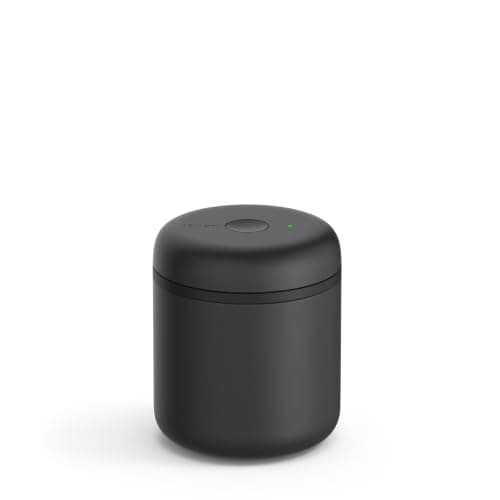
Our top pick is the Fellow Atmos, because it is the one canister that does more than "airtight." Twist the lid and it pulls a genuine vacuum, actively sucking the stale air out rather than just sealing whatever air is already in there. That is the most complete answer to the air problem, and it is a handsome steel object that earns its spot next to a grinder. The honest cons: the small 0.4L size holds only about a 6 oz bag, so bigger buyers want the larger version, and it costs more than a plain gasket jar that fast drinkers would find perfectly adequate.
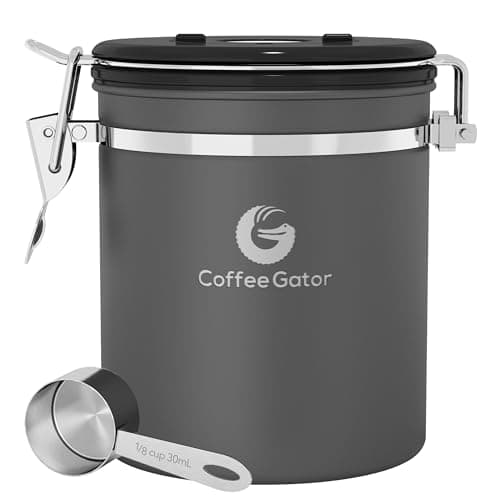
The Coffee Gator is the value pick and the smart choice for freshly roasted beans. Its lid has a one-way CO2 valve — the same idea as the little valve on a good coffee bag — that lets the carbon dioxide fresh beans off-gas escape without letting oxygen back in. A dial on the lid tracks the day you opened the bag, which is more useful than it sounds. It is a gasket-and-valve seal rather than a true vacuum, and the steel body hides how much coffee is left, but for the money it does the core job well.
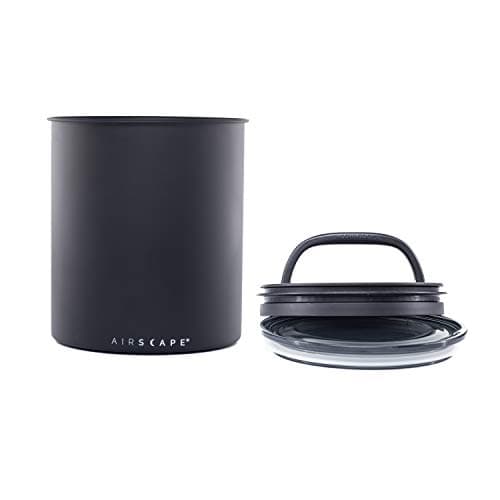
The Airscape is the answer for people who buy big. Its inner lid is a plunger: you press it down onto the coffee to push the air out, so the seal shrinks with the beans as you use them up, and a one-way valve lets the last of the air escape. The 2.2 lb size swallows a large bag that the little Fellow simply cannot hold. The trade-off is the mirror image of the sizing rule above — on a small 12 oz bag, all that volume leaves a lot of headspace unless you push the plunger all the way down every time, so it is oversized for people who buy small. Match it to a big bag and it is excellent.
One last, honest thing, because it is the point of the whole page. The biggest freshness win is not any canister — it is buying whole beans and grinding them fresh right before you brew. Pre-ground coffee stales in hours no matter how good the jar is, because grinding multiplies the surface area exposed to air by a huge factor. A great canister keeps whole beans good for weeks; it cannot rescue pre-ground coffee, and it cannot make a stale bag fresh again. Store whole beans, grind on demand, and let the container do the smaller second job of protecting what is already fresh.
It also helps to be honest about how long storage actually buys you. A good canister slows staling; it does not stop time. Roasted coffee is at its best from a few days after roast (it needs a short rest to off-gas) out to roughly three to four weeks, and after that even perfectly stored beans fade. The lesson is to buy in quantities you will drink inside that window rather than hoarding a giant bag that a canister cannot keep peak-fresh to the last scoop. This is why the Coffee Gator's date dial is more useful than it looks — knowing when you opened a bag tells you where you are in that curve. Store the container itself in a cool, dark cupboard, away from the stove, the oven, and any sunny windowsill, because heat and light undo the work the seal is doing.
The short answer
Quick picks
#ad · Live prices from the Amazon Product API, as of Sep 16, 2026. Where we have no verified live price, we show none — we would rather leave a gap than print a number that has rotted.
In detail
The picks, in full
The best-sealing canister
Fellow Atmos Electric Vacuum Canister
Automatic electric vacuumRechargeable (USB-C)Steel bodyReusable
The canister that vacuums itself — it senses the air and pumps it out automatically, no twisting.
- Build quality
- 9
- Does the job
- 9
- Ease of use
- 8
- Value
- 7
Pros
- +The electric pump removes air automatically, which slows the oxidation that turns coffee stale — the one canister that does more than 'airtight'
- +A handsome steel object that looks the part next to a grinder
- +Reusable, no consumables — recharge over USB-C
Cons
- −Pricier than a plain gasket canister that's 'good enough' for fast drinkers
- −The pump needs occasional recharging, unlike a passive lid
Don't buy this if…
…you finish a bag within a week. Beans that fresh barely oxidize — a cheap airtight jar is fine, and the vacuum is money you don't need to spend.
Best value airtight storage
Coffee Gator Stainless Steel Canister (16oz)
One-way CO2 valveDate-tracker dialStainless steelIncludes scoop
The value canister with a one-way CO2 valve and a freshness date dial. Does the job for little money.
- Build quality
- 8
- Does the job
- 8
- Ease of use
- 8
- Value
- 9
Pros
- +The one-way valve lets fresh-roast CO2 escape without letting oxygen in — the right feature for recently roasted beans
- +A dial on the lid tracks when you opened the bag, which is genuinely useful
- +Cheap, and it comes with a scoop
Cons
- −A gasket-and-valve seal, not a true vacuum like the Fellow Atmos
- −Steel body hides how much coffee is left
Don't buy this if…
…you want the maximum seal for beans you keep for weeks. The vacuum-pulling Fellow Atmos protects long-stored beans better.
Larger bags and simple sealing
Airscape Coffee Canister (2.2 lb)
Plunger inner lidHolds 2.2 lbSteel bodyOne-way valve
The plunger canister — press the inner lid down to push the air out. Simple and effective.
- Build quality
- 8
- Does the job
- 8
- Ease of use
- 8
- Value
- 8
Pros
- +The inner plunger lid presses air out as you push it down, so the seal shrinks with the coffee
- +The 2.2 lb size swallows a big bag, which the small Fellow can't
- +Well-made steel that lasts for years
Cons
- −The plunger is manual pressure, not a true pulled vacuum
- −For a small bag, the big canister leaves a lot of headspace unless you use the plunger fully
Don't buy this if…
…you buy small 12oz bags. The 2.2 lb size is oversized for that — a smaller Fellow or Coffee Gator seals a small bag better.
How to choose a coffee canister
There are really only four decisions here, and the first one — size — matters more than the fancy seal that gets all the marketing attention.
1. Match the size to your bag
This is the decision most people get wrong. A canister that roughly matches the bag you buy keeps the coffee-to-air ratio in your favor; a canister much bigger than your bag stores your beans in a jar of air. If you buy 12 oz bags, a compact canister (a larger Fellow or the Coffee Gator) is right. If you buy two-pound bags, the Airscape is built for it. Sizing right does more for freshness than upgrading the seal on a mis-sized jar.
2. Understand the three seals
A vacuum seal (Fellow Atmos) actively removes air by pulling it out — the most complete protection, and the one worth paying for if you keep beans for weeks. A one-way valve (Coffee Gator) lets gas out but not in, which is ideal for recently roasted beans that are still off-gassing CO2. A plunger (Airscape) physically presses the air out and shrinks the airspace as you go — simple, manual, and effective, especially for a large bag. All three beat a plain snap-lid jar; they differ in how hard they work at the air problem.
3. Steel and opacity — keep the light out
Light degrades coffee, so an opaque steel or ceramic body beats a clear glass jar on a sunny counter every time. All three picks here are steel, which handles the light and moisture problems by default. The only downside of opaque bodies is that you cannot see how much coffee is left, which is a minor annoyance and a fair price for the protection. If you insist on glass for the look, keep it in a cupboard rather than on the counter, and treat the clear body as a compromise you are making on light protection for the sake of appearance.
4. Remember what the canister is not for
A canister protects whole beans at room temperature in a dark, dry cupboard. It is not a fix for pre-ground coffee, which stales far too fast for any jar to save, and it is not a reason to buy more coffee than you will drink in a few weeks. Do not freeze coffee in these day to day — repeated freezer trips create condensation, and moisture is one of the three enemies. For the full method, see how to store coffee beans, and if you want the freshest cup possible, pair good storage with a proper grinderand grind on demand. It is also worth saying that the bag your coffee came in is a reasonable short-term home: a good roaster's foil bag with a one-way valve and a resealable zip protects beans well for the first week or two, and rolling the air out and clipping it shut costs nothing. A canister earns its place when you want a better, more durable seal, an opaque body that keeps light out on the counter, and something that looks and feels better than a crumpled bag — real benefits, but refinements on top of the fundamentals of buying fresh and grinding on demand.
5. The fridge and freezer question
Two common instincts here are worth heading off. The fridge is a mistake: it is humid, so it invites condensation onto the beans, and coffee is porous enough to pick up the smell of last night's leftovers. Keep it out. The freezer is a genuine tool, but only for long-term storage and only if you do it right — portion the beans into small, truly airtight bags, freeze them once, and pull out a single portion at a time, letting it come fully back to room temperature before you open it. What ruins beans is the repeated in-and-out that coats them in condensation every trip, so never treat the freezer as a daily cupboard. For beans you are drinking this week, none of this applies: a sealed canister in a dark cupboard is the right, simple answer, and the picks above all do that job well.
How we picked
We do not run a testing lab
We compiled published manufacturer specifications, computed what each option costs to run where relevant, and cross-referenced aggregated owner reviews, then scored each product against a published rubric. The scores are judgments from documented research — they are not measurements we took, because we do not have a lab and we are not going to pretend we do. Where a number came from a manufacturer or a standard, we name it in Sources.
Questions
Frequently asked
What actually makes coffee go stale?+
Air, light, moisture and heat. Oxygen oxidizes the oils that carry aroma and flavor, light speeds that reaction up, moisture dulls the coffee and makes it clump, and heat accelerates all of it. A good canister keeps beans dark, dry and away from air. Store whole beans in an opaque, sealed container in a cool cupboard, and grind only what you need right before you brew.
Vacuum, valve or plunger — which seal is best?+
A vacuum seal like the
Fellow Atmos gives the most complete protection because it actively pulls air out — best if you keep beans for weeks. A one-way valve suits freshly roasted beans that are still off-gassing CO2. A plunger is a simple, effective way to press air out of a large bag. All three beat a plain airtight jar; pick by how you buy and how long beans sit.
What size coffee canister should I buy?+
Match it roughly to the bag you buy. A canister much larger than your bag stores your beans in a jar of air, which is the opposite of what you want. For 12 oz bags, a compact canister is right; for two-pound bags, buy the larger plunger-style one. Getting the size right protects freshness more than upgrading to a fancier seal on a mis-sized container. If you buy a range of bag sizes, err toward the smaller canister and refill it more often rather than sizing up, because a snug fill with less headspace always beats a big canister half full of air.
Is a canister enough to keep coffee fresh, or should I grind fresh too?+
A canister is the smaller half of the job. The biggest freshness win by far is buying
whole beans and grinding right before you brew — pre-ground coffee stales in hours no matter how good the jar is. Use the canister to protect whole beans, and grind on demand. See
how to store coffee beans for the full routine.
Receipts
Sources
We do not run a testing lab, and we do not pretend to. Where a measured number came from a manufacturer spec sheet or a published standard, we name it and link it. Where we could not verify something, we say so on the page rather than quietly leaving it out. Read our full method.