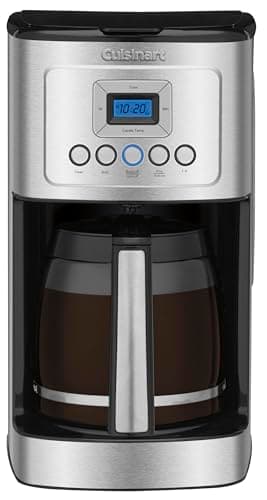
The Cuisinart PerfecTemp DCC-3200 is one of the best-selling drip coffee makers in America, and it is easy to see why: it brews fourteen cups, it runs on a twenty-four-hour timer so the pot is ready before you are awake, it has brew-strength control and a self-clean cycle, and it costs a fraction of the boutique machines. For a busy household or an office, that combination is genuinely hard to argue with. This review is about being clear-eyed about what that money buys — where the Cuisinart is exactly the right tool, and where the marketing gets ahead of the cup.
Start with what it does well, because it is a lot. The headline is volume on a schedule: a full fourteen-cup glass carafe, programmable up to twenty-four hours ahead, so a family or an office wakes up to coffee already made. The brew-strength control lets you push a bolder or milder pot, the self-clean cycle takes the guesswork out of descaling, and there is a keep-warm plate with an auto-shutoff. It is cheap, it is stocked in every big-box store, and it is a known quantity that has worked in millions of kitchens for years. If your definition of a good coffee maker is "a lot of reliable coffee, ready when I want it, for very little money," the DCC-3200 nails that brief better than anything else at its price.
The honest catch: brew temperature and the hot plate
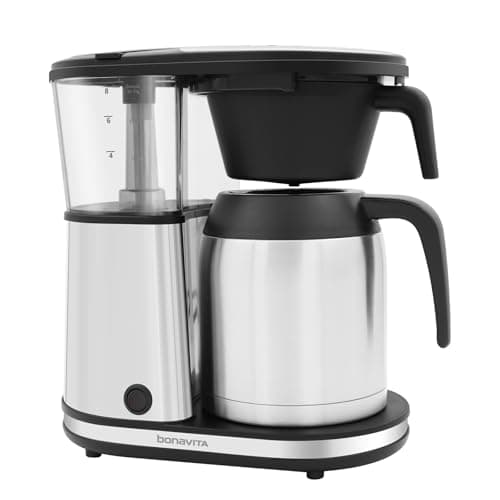
Here is the part the box does not lead with. Despite the "PerfecTemp" name, the DCC-3200 does not hit the same brew temperatures as the SCA-certified machines in our drip roundup. The Specialty Coffee Association standard puts good extraction in a window of roughly 195-205 degrees F, and machines like the OXO Brew 9-Cupand the Bonavita Connoisseur are certified to brew there. The Cuisinart runs cooler and less precisely, which means it extracts a little less sweetness and clarity from the grounds. The second issue compounds the first: it drains into a glass carafe that sits on a hot plate, and a hot plate keeps coffee hot by continuing to cook it — so the pot that tasted fine at seven is noticeably flat and bitter by nine. Neither is a defect; they are the design compromises that make a fourteen-cup machine this cheap. But they are the honest reason it ranks below the certified machines on cup quality.
The build tells the same story. The DCC-3200 is a mostly plastic machine, and it feels its price next to the metal-bodied premium brewers — the carafe is glass, the housing is light, and it is an appliance you will eventually replace rather than a repairable heirloom like the Moccamaster. Some owners also find the mid-brew "sneak-a-cup" pause and the programming buttons a little fiddly, and the plastic can pick up a faint odor over years of hard use. None of this makes it a bad machine; it makes it exactly what it is — a high-volume, low-cost workhorse rather than a precision instrument.
So how should you think about the cup it actually makes? The fair verdict is "good, not great, and mostly consistent." For everyday drinking — a mug with milk, a travel cup on the way out, a pot that keeps an office going — the DCC-3200 makes perfectly pleasant coffee, and brew-strength control lets you compensate somewhat for the cooler brew by pushing a bolder pot. Where it falls short is the top end: if you have spent real money on fresh, interesting single-origin beans and you want to taste their clarity and sweetness, a machine that misses the temperature window and then stews the result on a hot plate is not the tool that shows them off. Drink it fast, keep the beans everyday-honest, and it delivers; ask it to be a specialty brewer and it cannot.
The two alternatives here are both the upgrade path, and they cost more but chase a better cup. The OXO Brew 9-Cupis the one we would steer most people toward: it is SCA-certified to brew in the correct temperature window, it uses a "rainmaker" shower head that saturates the grounds evenly, and it keeps coffee in a double-wall thermal carafe rather than on a hot plate — and it still has a programmable timer, so you keep the convenience while gaining the cup. The Bonavita Connoisseur 8-Cup is the pick if you want that same SCA-grade brew with the least fuss: one button, a pre-infusion bloom, and a thermal carafe, though it drops the programmable timer the Cuisinart makes its name on. The honest trade in both directions is capacity and schedule versus cup quality: the Cuisinart wins on cups-per-dollar and timing, the OXO and Bonavita win on what is actually in the mug.
You can also get more out of the Cuisinart than most owners do, and it costs nothing. The machine brews what you feed it, so fresh whole beans from a burr grinderat a medium drip grind lift the cup far more than the machine's cooler brew holds it back — stale pre-ground coffee is the real reason most DCC-3200 pots disappoint. Weigh your coffee to a consistent ratio so a good pot repeats, run the self-clean cycle on schedule so scale does not drop the brew temperature even further, and pour the pot into a separate thermal flask if you drink it slowly, to sidestep the hot-plate stewing. None of this turns it into a Moccamaster, but it closes a surprising amount of the gap for free.
So who should skip it? Anyone for whom cup quality is the priority — if you care more about how the coffee tastes than how much of it there is or when it is ready, the OXO is the smarter money and the Moccamaster the endgame. Anyone who drinks a pot slowly and hates hot-plate bitterness should buy a thermal-carafe machine instead. And anyone chasing the clarity of expensive single-origin beans is buying the wrong tool. But for the very common, very honest case — a household or office that wants a lot of reliable coffee, ready on a timer, for as little money as possible — the Cuisinart DCC-3200 is the best-value programmable drip maker we would recommend, and it has earned its popularity.
Who the Cuisinart DCC-3200 is for
Buy it ifyou need volume and scheduling above all: fourteen cups on a twenty-four-hour timer for a busy household or an office, at a price nothing SCA-certified can touch. It is cheap, reliable, everywhere, and simple to live with, and brew-strength control plus a self-clean cycle cover the daily basics well. Buy it knowing exactly what it is — a high-volume workhorse that makes good, not boutique, coffee, brews a little cooler than the certified machines, and keeps the pot on a hot plate that will stew it if you leave it there for hours.
Buy the OXO Brew 9-Cup instead ifyou want a better cup without losing the convenience: it is SCA-certified for the correct brew temperature, saturates the grounds evenly with a "rainmaker" shower head, uses a thermal carafe rather than a hot plate, and still has a programmable timer. Buy the Bonavita Connoisseur instead ifyou want that SCA-grade cup with the absolute least fuss — one button, a pre-infusion bloom, and a thermal carafe — and you can live without a wake-up timer. And if you want a machine to keep and repair for a decade, the Moccamaster is the buy-it-for-life answer.
Get the most out of it
The DCC-3200 rewards better inputs more than most machines, precisely because its own brewing is average. Grind fresh from whole beans with a burr grinderat a medium drip setting — this is the single biggest upgrade and it is bigger than the difference between the Cuisinart and a pricier maker. Weigh your coffee to a repeatable coffee-to-water ratio so a good pot happens on purpose rather than by luck, and lean on the brew-strength control to push a slightly bolder pot that stands up to the cooler brew and to milk. Fresh coffee, weighed correctly, is what makes this machine punch above its cup.
A note on the hot plate and cleaning
Two habits protect the cup over time. First, the hot plate: it keeps coffee hot by cooking it, so drink the pot within twenty to thirty minutes, or decant it into a separate thermal carafe if you sip it over a morning, and you sidestep most of the flat, bitter, stewed flavor that drip coffee is unfairly blamed for. Second, cleaning: hard-water scale builds inside any machine with a heating element and drops the brew temperature over months, so run the self-clean cycle on schedule — more often in hard-water areas. Our guide to cleaning a coffee maker walks through it. Neglecting the descale is the usual reason an aging DCC-3200 brews slow and lukewarm.