Espresso is the hardest job you can hand a grinder, and it is exactly where cheap grinders come apart. Filter methods forgive a lot: a drip machine or a French press steeps for minutes and shrugs off a stray spray of fines. Espresso does none of that. It forces near-boiling water through a tightly packed puck under pressure in twenty-five seconds, so the grind is the single biggest lever on whether the shot runs sweet and balanced or gushes sour and thin. That is why an espresso grinder has to do two things a filter grinder never has to: reach a genuinely fine setting, and let you nudge that setting in tiny increments to chase the sweet spot. Both cost money, and roughly $200 is where a grinder starts doing them for real.
So the honest first question is not "which is best" but "what does a sub-$200 budget actually buy?" The good news: at this bracket you can get real, repeatable espresso from typical medium and medium-dark roasts, dial a shot in over a morning or two, and never think about your grinder again. The trade-off is where the corners get cut. Under $200 you are usually working with smaller conical burrs rather than the big flat burrs of enthusiast machines, stepped adjustment rather than truly stepless, and a hopper that leaves a few stale grams behind between beans. None of that stops you making a great shot. It just means the last few percent of control — the kind that tames a screaming light roast into a delicate lungo — lives above this price, and we say so plainly rather than pretend the gap is not there.
The spec that matters most here is adjustment resolution: how finely you can change the grind near the espresso end of the range. Espresso lives inside a razor-thin band of fineness, and one step too coarse gushes while one step too fine chokes to a bitter drip — we walk through why in espresso grind size. A truly stepless grinder slides smoothly through that band and is the enthusiast ideal; genuinely stepless grinders are rare under $200. Instead the good budget grinders use fine micro-steps — small enough that you can find a usable setting between gush and choke on most roasts, even if you cannot land on the exact micron you want. A grinder with coarse steps, by contrast, jumps straight over the sweet spot and will frustrate you every morning. That difference, more than burr size or looks, is what separates the picks below.
The second thing to weigh is consistency — how tight a particle spread the burrs produce, because a mess of fines and boulders in the basket channels water and wrecks extraction no matter how carefully you dialed in. Burr quality and build tolerances earn their keep here, and they are the quiet reason a good grinder makes your machine, not the grind, your limiting factor. Everything on this page clears that bar for home espresso; where one edges ahead of another, we point it out. Our full scoring method is on how we research, and because these pages carry Amazon links, our affiliate disclosure lays out how that works.
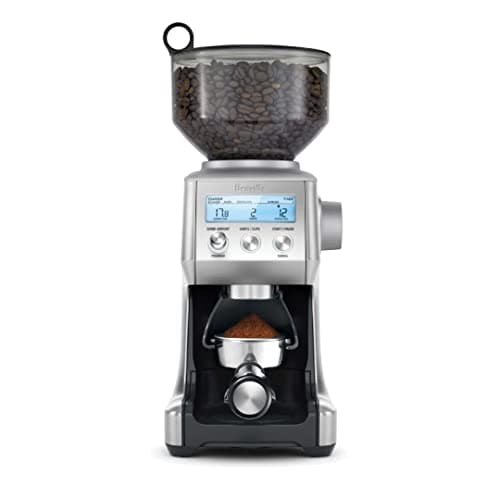
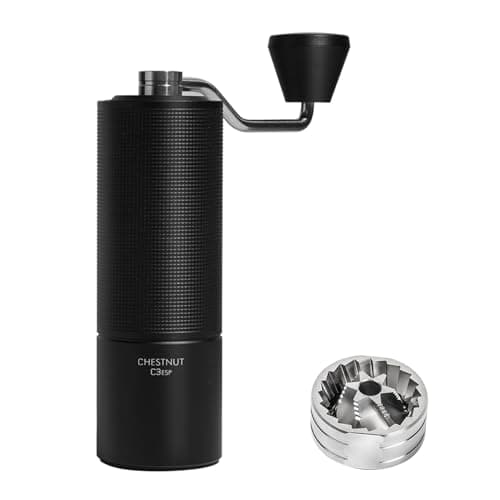
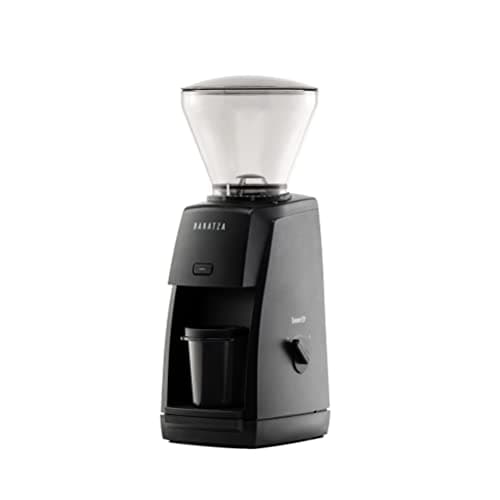
Our top pick is the Baratza Encore ESP, and it is not close for most buyers. It reaches espresso with usable micro-steps, keeps the trusted Encore filter range on the coarse half of the dial, and — the part no rival matches at this price — Baratza sells every internal part so you repair it instead of replacing it. It is the grinder we recommend to a first-time espresso buyer and then walk away; the full Encore ESP review has the long version. The Breville Smart Grinder Pro takes second on sheer convenience: sixty steps, a dose timer, and cradles that grind straight into a portafilter make it the tidiest daily driver, especially if you already own a Breville machine. The TIMEMORE Chestnut C3 ESP is the value and travel play — a hand grinder whose burrs out-grind electric boxes twice its price, at the cost of turning the crank yourself.
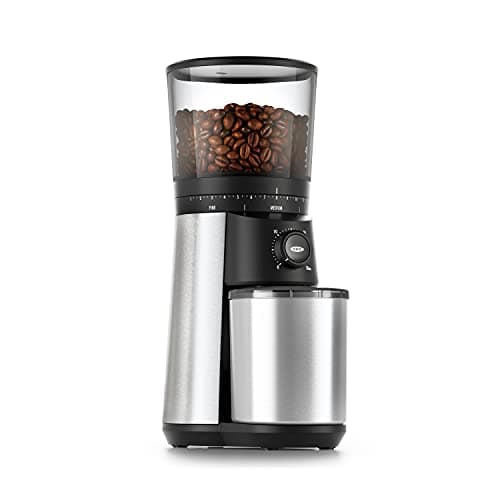
The fourth entry is a deliberate cautionary one. The OXO Brew Conicalis a superb budget grinder that shoppers constantly cross-shop against these three — and it is the wrong tool for espresso. It is a filter grinder: brilliant for drip and press, well under the $200 ceiling, but it cannot grind fine or consistently enough to pull a real shot, and OXO is honest about that. We include it here precisely because so many people are tempted by the low price and then disappointed at the machine. If espresso is genuinely your goal, skip it; if you are quietly a filter drinker at heart, it may be the smartest buy on the page. None of these four passed through our hands — we compiled the makers' published specifications, reasoned through what each burr and adjustment design does to a shot, and priced everything live.
How to choose an espresso grinder under $200
Once you have accepted that espresso needs a dedicated-capable burr grinder — not a filter grinder, and never a blade one, as our burr vs blade explainer lays out — four things decide which sub-$200 grinder is right for you. Here they are, in the order that matters.
1. Fine-adjustment resolution near the espresso end
This is the whole ballgame. You need small steps through the fine range so you can settle between a gushing shot and a choked one on the roasts you actually drink. Stepless is the dream and is uncommon at this price; fine micro-steps are the realistic target, and every pick here except the OXO offers them. The Encore ESP was rebuilt specifically to add fine micro-steps through espresso; the Breville spreads sixty steps across its range; the C3 ESP tightens its adjustment at the fine end. Coarse, jumpy steps are the fastest way to hate an espresso grinder, so treat resolution as non-negotiable and everything else as secondary.
2. Consistency, because the basket punishes fines
A tidy particle spread is what lets your carefully dialed setting actually behave in the basket. Under $200 you are mostly on conical burrs, which do this job well for home espresso; the step up to big flat burrs — the MiiCoffee DF64and the like — buys a cleaner spread and lives just over this budget. Within the bracket, build tolerances matter as much as burr size, which is part of why the C3's tight metal body punches above its price. If you are curious how far a little more money takes you, the Eureka Mignon Notte is the natural next rung up.
3. Workflow — dosing, retention, and how it meets your machine
Espresso is a daily ritual, so the small friction points add up. Do you want to grind straight into the portafilter with a timed dose (the Breville's party trick), or grind into a cup and tip it in (the Encore ESP includes a dosing cup for exactly this)? Do you mind a few stale grams of retention in a hopper grinder, or do you want the near-zero carry-over of a single-dose grinder? And does it fit the machine you own — a Breville grinder pairs naturally with a Breville espresso machine, while the hand-cranked C3 suits a minimalist or a traveler. None of this changes the shot quality much; it changes how much you enjoy making it.
4. Be honest about what $200 can't buy
Spending over the bracket buys three things: truly stepless adjustment, the cleaner particle spread of large flat burrs, and single-dosing with near-zero retention. Those matter most if you chase light roasts, weigh every dose to the tenth of a gram, or want to fuss over the last few percent of extraction. If that is you, read our best espresso grinders guide before you spend here. If instead you drink medium and medium-dark roasts and want a great, repeatable shot without a second mortgage, a sub-$200 grinder is genuinely all you need — and the money saved is better spent on fresh beans.
Dialing in once the grinder is home
A good grinder gets you to the start line; a repeatable routine wins the race. Weigh your dose and your yield rather than eyeballing, change one variable at a time, and adjust grind before anything else — our step-by-step how to dial in espresso walks the loop. Keep the burrs clean, too: espresso roasts are oily and residue dulls both flavor and consistency fast, so clean the grinder on a schedule.
The four picks, in brief
Baratza Encore ESP— our top pick and the safe default. Real espresso micro-steps, the trusted Encore filter range, and Baratza's repair-forever parts culture. Buy it if you want one grinder that does espresso and filter and still runs in a decade.
Breville Smart Grinder Pro — the convenience pick. Sixty steps, a dose timer, and grind-into-the-portafilter cradles make it the tidiest daily driver, especially for Breville machine owners. Slightly coarser stepping than a stepless grinder, and not built to be rebuilt.
TIMEMORE Chestnut C3 ESP — the value and travel pick. Stainless burrs that out-grind electric boxes twice the price, espresso-capable in the ESP trim, and packable anywhere; see the hand grinder guide. The catch is that you are the motor, and a fine espresso dose by hand is a real crank.
OXO Brew Conical — the cautionary entry. A brilliant, cheap grinder for drip and press that simply cannot do espresso; buy it only if you are honest that filter is your real habit, and see the best grinders under $100 if budget is the priority.