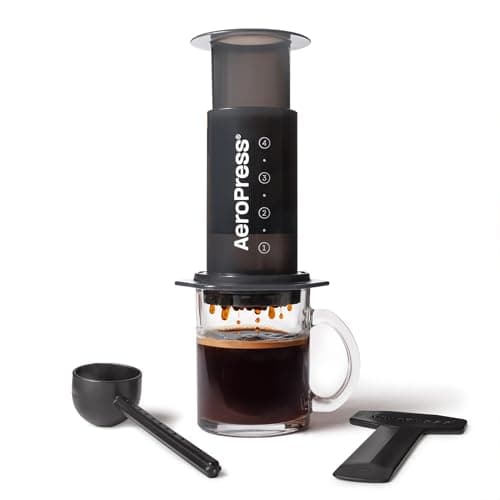
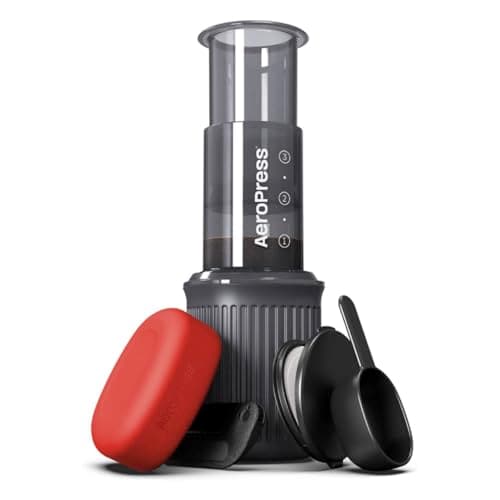
The AeroPress Go is the answer to a specific and very common problem: you love AeroPress coffee and you want it when you are away from your kitchen. It is the same brewer as the beloved Original, re-engineered to nest entirely inside its own travel mug with a lid, so the whole kit becomes a compact, packable bundle you can drop in a bag, a suitcase, or a desk drawer. The genius is that it makes no compromise on the cup to get the portability — it brews exactly like the Original. This review is about what that portability actually buys you, the honest trade-offs of the travel packaging, and whether the Go or one of its alternatives is the right AeroPress for how you live.
Start with what an AeroPress is, because it is the reason the Go is worth reviewing at all. It brews by immersion and then hand pressure: you steep grounds in hot water for a short time, then press the plunger to push the brew through a paper micro-filter and into your cup. That combination produces a clean, low-bitterness cup in about two minutes, and cleanup is the famous party trick — pop the puck of spent grounds straight into the bin and rinse in about ten seconds. The Go carries all of that over unchanged: the same brewing action, the same paper micro-filters, the same near-indestructible plastic body that shrugs off drops that would shatter a glass brewer. If you already know you love AeroPress coffee, the Go is that coffee, packed for travel.
The travel design is the whole point, and it is genuinely clever. The plunger, filter cap, filters, a scoop, and a stirrer all nest inside the included travel mug, and the mug's lid seals the bundle shut, so the entire kit becomes a single self-contained package about the size of the mug itself. That means you can brew a real cup of coffee in a hotel room, at a campsite, in an office kitchen, or on a train — anywhere you can get hot water — without carting around a fragile brewer and a bag of loose parts. The mug doubles as your drinking vessel, so you are not packing a separate cup either. For the traveler, the commuter, and the camper, this is exactly the format you want, and nothing else in our travel roundup packs a real, full-flavored brewer this neatly.
The honest cons
The travel packaging costs you two real things, and they are worth naming plainly. First, capacity: the Go is slightly smaller than the Original, so it brews a touch less per cycle — fine for the one or two cups a traveler wants, but a small step down if you regularly want a bigger single brew. Second, ergonomics at home: the Go's plunger is shorter to fit the compact design, which makes it a little more awkward to press on a kitchen counter than the full-length Original, and the travel mug is a narrower brewing target than a standard mug. And third, price: the Go costs a little more than the Original for the travel mug and packaging, so you are paying a premium specifically for portability. None of these is a dealbreaker — they are simply the cost of the format — but they are the honest reasons the Go is not the right AeroPress for everyone.
The AeroPress Originalis the alternative that matters most, and for a home-only brewer it is the better buy. It is cheaper, it holds a little more, and its full-length plunger is slightly nicer to press on a counter — and it makes an identical cup, because it is the same brewer without the travel mug. The huge recipe community that has grown up around the AeroPress applies equally to both: you can dial either toward an espresso-style concentrate, a filter-style cup, or anything between. The only thing the Original lacks is the Go's packability. So the honest split is simple: if the brewer will mostly live on your counter, buy the Original and save the money; if it needs to travel, the Go's mug-and-lid format earns its premium.
The WACACO Nanopressois the other travel alternative, but it does a different job, and it is important not to confuse them. The Nanopresso is a pocket espresso maker: you hand-pump it to build real pressure and pull a small, crema-topped espresso shot, which no AeroPress can do. It is the travel pick if what you crave on the road is espresso — a short, intense shot — rather than a mug of filter-style coffee. The trade is that it is a single-shot, one-at-a-time device that is far more demanding of your grind and technique, where the AeroPress Go is forgiving, brews a larger and more everyday cup, and is much easier to get right. Choose the Nanopresso for travel espresso; choose the Go for a travel mug of clean, satisfying coffee that is hard to mess up.
As with any manual brewer, the Go rewards good inputs, and that matters more on the road where people cut corners. It brews what you feed it, so fresh whole beans ground just before you leave — or with a hand grinder if you are truly committed — make a far better cup than the stale pre-ground coffee most travelers pack. Water just off the boil, in roughly the Specialty Coffee Association's brew-temperature range, matters too; a hotel kettle gets you there. And a rough eye on the coffee-to-water ratio keeps the cup consistent from one location to the next. Do that, and the Go makes genuinely good coffee anywhere, which is the whole reason it exists.
So who should skip it? Anyone whose AeroPress will only ever sit on the kitchen counter should buy the cheaper Originalinstead — the Go's entire value is that it packs away, and at home you are paying a premium for a feature you will not use, plus living with a shorter plunger. Anyone who wants espresso on the road, not filter coffee, should look at the Nanopresso. And anyone who needs to brew for a table wants a bigger brewer or a French press, since the Go, like all standard AeroPresses, makes one or two cups at a time. But for the traveler, commuter, camper, or office worker who wants a real, clean, forgiving cup of coffee packed into its own mug, the AeroPress Go is the best travel coffee maker we recommend, and it earns the award.
Who the AeroPress Go is for
Buy it ifyour coffee needs to travel. The Go packs the plunger, filter cap, filters, scoop, and stirrer inside its own travel mug with a sealing lid, so the whole kit is a single compact bundle for a bag, suitcase, or desk — and it brews exactly like the Original, a clean, low-bitterness cup in about two minutes with a ten-second cleanup. The mug doubles as your drinking cup, and the near-indestructible body survives the knocks that would break a glass brewer. Buy it knowing you pay a small premium over the Original for the travel packaging, that it holds a touch less, and that its shorter plunger is slightly more awkward on a kitchen counter.
Buy the AeroPress Original instead ifthe brewer will mostly stay home: it is cheaper, holds a little more, has a nicer full-length plunger, and makes an identical cup — you only give up the packability. Buy the WACACO Nanopresso instead if what you want on the road is espresso rather than filter-style coffee: it hand-pumps a real, crema-topped shot the AeroPress cannot make, at the cost of being a fussier, single-shot, one-at-a-time device. And if you need to brew for several people, look at a larger brewer or a French press, since any standard AeroPress makes one or two cups at a time.
Get the most out of it
The Go rewards better inputs more than most people bother with when traveling. Grind fresh from whole beans if you can — a hand grinder packs alongside it easily — because fresh grounds beat the stale pre-ground coffee most travelers carry by a wide margin, and it is the single biggest upgrade to the cup. Use water just off the boil, which a hotel or campsite kettle delivers, and keep a rough eye on your coffee-to-water ratio so the cup is consistent wherever you are. The huge AeroPress recipe community means you can tune the Go toward a stronger espresso-style concentrate or a longer filter-style cup depending on your mood and your beans.
A note on filters and cleanup
Two small habits keep the Go trouble-free on the road. First, pack a stack of the paper micro-filters in the mug — they are tiny, cheap, and the thing you are most likely to run out of away from home; a reusable metal filter is an option if you want to travel without consumables, at the cost of a slightly less clean cup. Second, lean on the ten-second cleanup: unscrew the cap, push the puck of spent grounds straight into a bin, and give the seal a quick rinse, and the whole kit nests back into its mug ready to go. That fuss-free cleanup is a big part of why the AeroPress travels so well — there is no soggy filter basket or carafe to deal with in a hotel sink.