The SimCoker Manual Coffee Grinder is the grinder to buy when you want to stop using a blade grinder and spend as little as humanly possible doing it — and for that one job it is genuinely good. SimCoker lists it as a hand-crank mill with a ceramic burr in a 304 stainless steel body, and for the filter coffee most people actually make — drip, French press, pour-over — a real burr grind is a real upgrade over the blade grinder or pre-ground bag it replaces. It earns our nod as the cheapest usable hand grinder, and that word — usable — is doing deliberate work. It took this slot in October 2026 from the long-running JavaPresse, which Amazon no longer sells at all. If a shot is anywhere in your plans, skip to the best hand grinders for espresso instead, because this is not the grinder for it.
Start with the thing that matters most, which is that the SimCoker uses burrs, not blades. A blade grinder is a propeller that chops beans at random into a chaotic mix of dust and boulders; the dust over-extracts into bitterness while the boulders under-extract into sourness, and no brewing skill rescues a cup made from both at once. A ceramic conical burr instead crushes beans between two abrasive surfaces set a fixed distance apart, so a bean cannot pass until it is small enough to fit the gap. The result is a far more uniform grind that extracts more evenly. That single change is the most audible improvement in home coffee, and the SimCoker delivers a version of it for pocket money — the full contrast is in our burr vs blade explainer.
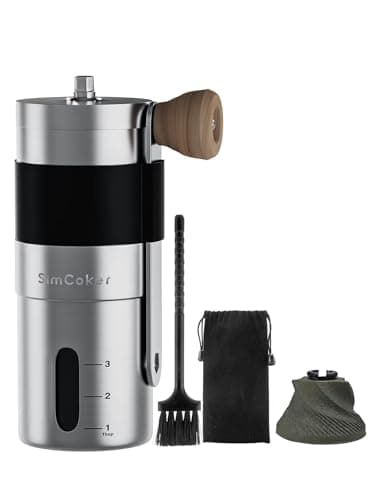
Living with it is where the SimCoker makes its case. SimCoker describes it as compact enough to disappear into a bag, and it needs no batteries and no power at all — you supply the crank, so it works in a hotel room, a tent, or an office with no outlet to spare. The listing includes a cleaning brush and a storage pouch, which is a small thing that matters on a travel grinder: stale coffee oils are what dull a burr's performance over time, and a brush in the box means you will actually do it. The body is listed as 304 stainless and the burr as ceramic, so there is nothing in it to rust. For a filter household on a strict budget, or anyone who wants fresh grounds away from the kitchen, it does the job cheaply: it pairs naturally with a pour-over or a drip coffee maker, and it will make fresh beans taste far better than any blade grinder ever let them.
Now the honest limit, because a budget grinder earns trust by owning what it cannot do. SimCoker's listing names espresso among the brew methods it supports, and we want to be direct about why we do not. No numbered settings are published for it. That is the whole objection, and it is a bigger one than it sounds. Dialing in espresso is nothing but a loop: change the grind, pull a shot, judge it, and go back to the setting that worked. A grinder with no numbers to record gives you no way to close that loop — even if you stumble onto a good shot, you cannot write down where you were and return to it tomorrow. Add the fact that espresso forces hot water through a tightly packed puck in about twenty-five seconds and is savagely unforgiving of grind error, and you get the predictable outcome: a shot that gushes one attempt and chokes the next, and a reader who blames their machine for a problem that is entirely the grinder's. Our espresso grind size guide explains why that band is so unforgiving. Treat the SimCoker as a filter grinder and it is good value; ask it for espresso and it will cost you more in wasted coffee than you saved.
Two smaller limits round out the honest picture. First, SimCoker rates the capacity at 20 g — roughly two cups — so a full pot means grinding in rounds, and the hand crank that is pleasant for one or two cups becomes a chore at volume. Second, no grind-uniformity figures are published for it, and we have not measured any: what we can say honestly is that a ceramic burr is a categorical upgrade on a blade grinder, and that the pricier hand grinders below publish tighter specifications and far more documented owner feedback at the fine end. For the price and the intended job — cheap, portable, filter — neither is a dealbreaker; they are simply the trade you make to spend this little. Whatever grinder you own, keep the burrs clean of stale oils with our grinder cleaning guide.
Where does it sit against its rivals? The moment espresso enters the picture — or you find yourself grinding for more than a cup or two a day — you have outgrown it, and there are two clear steps up. The TIMEMORE Chestnut C3 is the value all-rounder: a stainless-burr hand grinder with a consistency that shames electric grinders twice its price, and in its ESP trim it adjusts fine enough for real espresso, not just filter. If manual espresso is specifically the goal, the KINGrinder K6 adds an external numbered dial and espresso-fine steps — the exact feature the SimCoker lacks — that make dialing in a shot far easier than any grinder you set by feel. Both are a small step up in price that changes what the grinder can do; the cases are in our C3 review and K6 review. Buy the SimCoker precisely when the lowest possible price and filter-or-travel use are the whole point — and step up the moment espresso is. None of these passed through our hands; we compiled the makers' published specifications, reasoned through what each burr and adjustment design does in the cup, and priced everything live, per our research method.
The short answer
Quick picks
#ad · Live prices from the Amazon Product API, as of October 13, 2026. Where we have no verified live price, we show none — we would rather leave a gap than print a number that has rotted.
In detail
The picks, in full
The lowest-cost step up from a blade grinder
SimCoker Manual Coffee Grinder (Portable Burr Mill)
Ceramic conical burrSimCoker rates it 20g304 stainless bodyHand crank, no power
The cheap hand grinder that beats any blade grinder. Fine for filter and travel, a stretch for espresso.
- Grind consistency
- 6
- Grind range
- 5
- Ease of use
- 6
- Build quality
- 6
- Value
- 9
Pros
- +A true burr grind for pocket money — an enormous improvement over the blade grinder most people start with
- +SimCoker lists the body as 304 stainless steel and the burr as ceramic, so there is nothing in it to rust
- +Small enough to live in a bag and needs no power at all, and the listing includes a cleaning brush and a storage pouch
Cons
- −No numbered settings are published for it, so you cannot write down a grind and come back to it — that rules out dialing in a shot
- −SimCoker's stated capacity is 20g, roughly two cups, so a full pot means grinding in rounds
Don't buy this if…
…you make espresso or grind for several cups daily. The listing names espresso among its uses, but with no numbered settings you cannot repeat a shot — the TIMEMORE C3 is the small step up that changes everything.
The best-value manual grinder
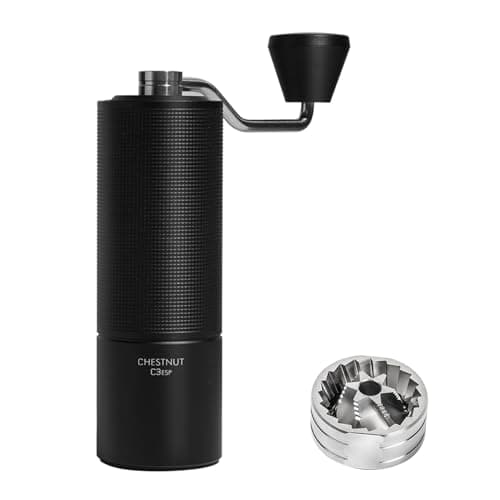
TIMEMORE Chestnut C3 ESP Hand Grinder
Stainless S2C burrsEspresso to French pressFoldable handlePortable
The hand grinder that punches absurdly above its price. Espresso-capable, and it feels premium.
- Grind consistency
- 8
- Grind range
- 8
- Ease of use
- 6
- Build quality
- 8
- Value
- 10
Pros
- +The stainless burrs and tight build give a consistency that shames electric grinders twice its price
- +The ESP version adjusts fine enough for real espresso, not just filter
- +Light, tough, and travel-friendly — a legitimate main grinder that also packs for trips
Cons
- −It's manual — grinding a fine espresso dose by hand is a genuine arm workout
- −Small single-dose capacity, so it's a one-or-two-cups-at-a-time tool
Don't buy this if…
…you make several espressos every morning. Hand-grinding fine, daily, gets tiring fast — an electric grinder like the Baratza Encore ESP is worth it for volume.
Manual espresso on a budget
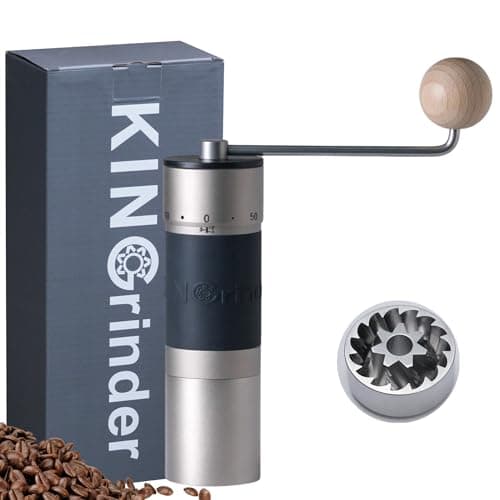
KINGrinder K6 Manual Grinder
Stainless burrsExternal numbered adjustEspresso-fine stepsManual
A lot of hand grinder for the money — external adjustment and espresso-fine steps.
- Grind consistency
- 8
- Grind range
- 8
- Ease of use
- 6
- Build quality
- 7
- Value
- 9
Pros
- +External numbered adjustment makes dialing in espresso far easier than grinders you set from inside
- +Fine, repeatable steps genuinely suited to espresso, not just an afterthought
- +Undercuts pricier hand grinders while matching a lot of their capability
Cons
- −Manual grinding for espresso is hard work, same as any hand grinder
- −Brand support and long-term reputation are thinner than TIMEMORE or 1Zpresso
Don't buy this if…
…you value a proven brand and resale value. TIMEMORE has the longer track record — the K6 is the value play, not the safe-brand play.
Who the SimCoker is right for
Buy it if you want the cheapest possible way off a blade grinder for filter coffee, or a knock-about grinder for travel and camping. A real ceramic burr turns stale, uneven grounds into fresher, more uniform ones — the single upgrade that changes every cup — and this one packs anywhere and needs no power. For a budget filter household or a bag you throw in luggage, it does exactly what it should for pocket money.
Skip it if there is any chance you make espresso, or you grind for several cups every day. With no numbered settings published you cannot record a shot setting and return to it, which is the entire job of dialing in, and SimCoker's stated 20 g capacity makes a household pot a chore. If espresso is even a maybe, step up to the TIMEMORE C3 or the KINGrinder K6 from the start, or read the hand-grinder espresso guide first.
1. Consistency for filter — the whole reason to buy it
Uniform grounds extract evenly, so the cup tastes balanced instead of sour and bitter at once — and that uniformity is exactly what a burr grinder delivers and a blade grinder cannot. A ceramic conical burr like the SimCoker's produces a real, even filter grind across the press-and-drip band, which is a large upgrade over any blade grinder. It is not the tightest particle spread on the market — the pricier hand grinders below publish tighter specifications and have far more documented owner feedback — but for everyday filter that difference is far smaller than the gap between any burr grinder and the blade grinder it replaces. Treat filter consistency as the box it needs to tick, and for the money it ticks it.
2. Grind range, and the missing numbers
SimCoker lists the burr as adjustable and names drip, pour-over, siphon, French press, cold brew and espresso as supported methods. The range, then, is broad on paper. What the listing does not publish is a settings count or any numbered scale, and that omission is the single most important fact in this review. For filter it barely matters: press and drip are forgiving bands, you find a coarseness you like by feel and you leave it alone. For espresso it is disqualifying, because espresso is a repeatability problem before it is a fineness problem, and a grinder you cannot write down is a grinder you cannot repeat. Match the range to how you brew before you buy: if the answer is filter and travel, it fits; if the answer includes espresso, it does not.
3. Portability, materials, and daily workflow
Portability is the SimCoker's real edge. SimCoker describes it as compact enough to slip into a bag, it needs no power, and the listing bundles a storage pouch for exactly that use, so it is a natural travel and camping grinder. The materials suit that life too: a 304 stainless body and a ceramic burr give it nothing to rust, which is more than can be said for cheap carbon-steel burrs. The trade is speed and volume. SimCoker rates it at 20 g per grind, and the hand crank is pleasant for one or two cups and a chore for more, so it is a one-or-two-drinks tool rather than a grinder for a busy morning pot. As a portable, power-free filter grinder for a budget or a backpack, it is exactly right; as a daily driver for a household, it runs out of patience.
4. When to step up — the C3 or the K6
The SimCoker is the floor of usable hand grinding, and two grinders are the natural steps up when you outgrow it. The TIMEMORE C3 is the value all-rounder: far better consistency and, in ESP trim, a fine enough grind for real espresso as well as filter — one grinder for both that still packs for trips. The KINGrinder K6 is the manual espresso specialist on a budget, with an external numbered dial and espresso-fine steps that make dialing in a shot genuinely easy — and the numbered dial is precisely what the SimCoker does not have. Either is a small price step that unlocks espresso and better filter consistency; see them ranked in our hand grinder guide and best grinders under $100 roundup.
The verdict, in brief
Buy the SimCoker if you want the cheapest usable hand grinder for filter coffee and travel and you accept it is not for espresso — for that job, and at that price, it is hard to beat. Step up to the TIMEMORE C3 if you want one grinder that does filter and espresso and travels, or the KINGrinder K6 if manual espresso on a budget is the goal. See the wider field in our hand grinders guide and the burr vs blade explainer.
How we picked
We do not run a testing lab
We compiled published manufacturer specifications, computed what each option costs to run where relevant, and cross-referenced aggregated owner reviews, then scored each product against a published rubric. The scores are judgments from documented research — they are not measurements we took, because we do not have a lab and we are not going to pretend we do. Where a number came from a manufacturer or a standard, we name it in Sources.
Questions
Frequently asked
Can the SimCoker grind for espresso?+
SimCoker's listing names espresso among the methods it supports, and we still say no — and this is the most important thing to know before you buy. No numbered settings are published for it, so there is no way to record a grind and return to it, and dialing in espresso is nothing but returning to settings. Even a shot that comes out well is an accident you cannot repeat tomorrow. Treat it as a filter grinder. If espresso is your goal, step up to the
TIMEMORE C3 or the
KINGrinder K6 instead.
Is the SimCoker a real upgrade over a blade grinder?+
Yes, a large one. A blade grinder chops beans at random into dust and boulders that extract unevenly and taste bitter and sour at once; a ceramic conical burr like the SimCoker's crushes beans to a far more uniform size that extracts more evenly. For drip, press, and pour-over on a budget it is a genuine step up — the full contrast is in our
burr vs blade guide.
SimCoker or TIMEMORE C3?+
The SimCoker is far cheaper and fine for filter and travel; the C3 is the step up that changes what the grinder can do. The
TIMEMORE C3 has a much tighter, electric-shaming consistency and, in ESP trim, grinds fine enough for real espresso as well as filter. Buy the SimCoker for the lowest price and filter-only use; buy the C3 if you want espresso capability and better consistency from one grinder that still travels.
Is the SimCoker good for travel and camping?+
Yes - it is one of its best uses. SimCoker describes it as compact enough to slip into a bag, it needs no batteries or power at all, and the listing includes a storage pouch and a cleaning brush for exactly that life. A 304 stainless body and a ceramic burr give it nothing to rust. The hand crank is pleasant for a cup or two, which is exactly what travel brewing tends to be, and the stated 20 g capacity is about two cups. Just keep your expectations to filter coffee - it is a cheap travel grinder, not an espresso tool.
What happened to the JavaPresse Manual Coffee Grinder?+
It is discontinued. As of our October 12, 2026 catalog check the JavaPresse Manual Coffee Grinder returns no product at all from Amazon's catalog, and no JavaPresse grinder is listed under any other number. It held this cheapest-usable-hand-grinder slot for a long time, and the SimCoker now does the same job at a similar price. Our
JavaPresse review stays up as the record of what it was, with the buy link removed.
Receipts
Sources
We do not run a testing lab, and we do not pretend to. Where a measured number came from a manufacturer spec sheet or a published standard, we name it and link it. Where we could not verify something, we say so on the page rather than quietly leaving it out. Read our full method.