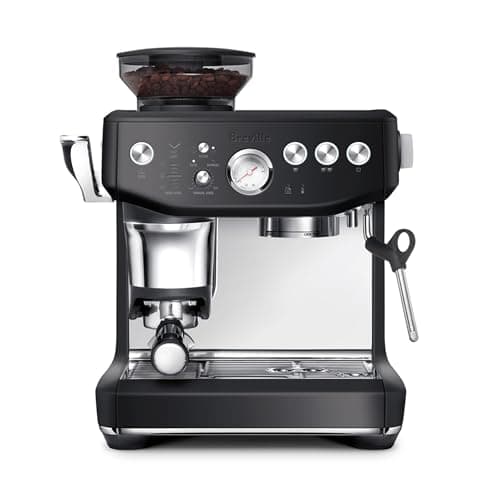
The Barista Express Impress exists to solve one problem, and it is the right problem. Nearly everything a beginner gets wrong on a Breville happens in the ninety seconds between the grinder and the group head: the dose is inconsistent, the grounds are piled unevenly in the basket, and the tamp is crooked, too soft, or a different pressure every single morning. Those are the inputs that decide whether a shot runs in twelve seconds or forty. Breville's answer is to automate them with a lever, and the published specification is unusually concrete: the Impress Puck System applies a constant 22 lb tamping force and finishes with a 7-degree twist, and the machine measures the last dose so it can adjust the next grind.
That is a genuinely useful piece of engineering, and this review is going to say so. It is also, in the most literal sense, the onlything you are buying. Underneath the lever, the Impress is a Barista Express. Same 54mm portafilter, same integrated conical burr grinder with 25 grind settings, same single Thermocoil with PID. Breville publishes brew water at 200°F and low-pressure pre-infusion ahead of a 9 bar extraction, which is the same recipe the BES870 has been running for a decade. The ceiling of the shot has not moved. What has moved is the floor — and for a lot of buyers that is worth more.
What the Impress Puck System actually does
Three things, in sequence. It measures: the machine tracks the dose from the last grind and trims the next one up or down, so you stop under-dosing a basket you cannot see into. It tamps with a published, repeatable 22 lb through a lever rather than your forearm. And it twistsseven degrees at the end of the stroke, polishing the puck surface the way a barista's wrist does.
The reason this matters is not that 22 lb is a magic number — it is not; once a puck is compressed, additional force stops doing much. The reason is that it is the same number every time. Espresso is a variance problem. If your tamp is 15 lb on Monday and 35 lb on Tuesday, your shots change for a reason you will never diagnose, because the variable is invisible and lives in your arm. Removing it does not make your best shot better. It makes your worst shot much less bad, and it means that when you change the grind you are actually measuring the grind.
The dose measurement is the quieter half and arguably the more valuable one. The single most common Barista Express failure is a basket that is simply not full enough, which produces a fast, thin, sour shot that the owner then tries to fix by grinding finer, which chokes the machine, which sends them back the other way. The Impress short-circuits that loop. It is also why the machine ships with the puck prep tools argument already half-won: you still benefit from distribution, but you are no longer guessing at two variables at once.
What it does not change
The boiler. It is a single Thermocoil. You pull your shot, then you wait for the machine to come up to steam temperature, then you steam. That is the same wait the BES870 has, and it is the structural reason a Barista Touch or a dual-boiler machine costs what it costs. If milk drinks for two people back to back is your use case, read our best espresso machines for lattes page before you commit.
The grinder.Same integrated conical burr unit, same 25 settings. It is a good grinder for the money and it is not a great grinder. Owners who get deep into espresso eventually add a dedicated one and demote this to backup duty, exactly as they do with the BES870 — our best espresso grinders under $200 is where that upgrade usually starts. Assisted tamping does not widen the grind range or make the burrs more consistent.
The basket size.54mm, like every Breville in this line. That is not a defect, but it does mean your dose ceiling is lower than a 58mm machine's and your margin for error in the basket is correspondingly tighter. It is also the reason the 54mm precision baskets in our bottomless portafilter guide are such a cheap upgrade on this machine: an 18-22g basket gives a Breville dose headroom the stock baskets do not.
The price gap. This is the honest heart of the review. The Impress costs meaningfully more than the standard Barista Express, and the extra money buys consistency rather than capability. There is no shot the Impress can pull that a BES870 with a good tamper and a steady hand cannot. If you already own a tamper you like and a WDT tool, you have already bought most of what the Impress sells, for a fraction of the difference.
Who should buy it
Buy the Impress if this is your first espresso machine, you want to make good coffee rather than take up espresso as a hobby, and the idea of learning to tamp correctly sounds like a chore rather than a pleasure. That is a large and entirely reasonable group of people, and for them the Impress is the best Breville in the line: it removes the two variables most likely to make them give up in month one, and it does it with a mechanism that is published, repeatable and requires no technique at all.
Buy the standard Barista Express instead if you want the same shot for less and are willing to learn a skill that takes about two weeks. Buy the Barista Proif your real complaint is the wait — the Pro's ThermoJet heats up in seconds, which is a bigger daily quality-of-life change than tamping assistance. And buy the Bambino Plusif you already own a decent grinder, because then you are paying for a grinder you do not need and the Bambino's auto-steam does more for your milk than the Impress lever does for your puck.
The verdict
The Barista Express Impress is the rare convenience feature that is not a gimmick. It targets the correct variable, it publishes a real number for what it does, and the result is a machine whose bad days are much less bad. What it is not is a better espresso machine than the Barista Express — the boiler, the grinder, the basket and the brew recipe are the same, and the shot ceiling is the same. Pay the premium if consistency is what you want to buy. Do not pay it expecting a different cup at the top end, because there is not one. If you want to see the difference puck prep makes before you spend anything, a bottomless portafilter on your current machine will show you in a single shot.
Published specifications
Everything in this list is published by Breville on the BES876 product page. We have not measured any of it; where a figure is a manufacturer claim, we say so, and how we research explains the rest of our method.
- Puck prep:Impress Puck System — assisted tamping at a constant 22 lb force with a 7-degree finishing twist; precision dosing that adjusts the next dose from the last one.
- Grinder: integrated conical burr grinder, 25 grind settings.
- Dose: Breville names 18g as the target dose for the double basket.
- Portafilter: 54mm stainless steel, with 1-cup and 2-cup single-wall and dual-wall baskets included.
- Pump and extraction: 15 bar Italian pump; low-pressure pre-infusion, then 9 bar extraction.
- Heating:Thermocoil with PID temperature control, brewing at 200°F.
- Dimensions: 16.6 x 14.4 x 12.2 in (W x D x H), stainless steel housing.
- In the box: 54mm portafilter, 480ml stainless milk jug, four filter baskets, water filter and holder, the Razor trimming tool, cleaning tablets and disc, descale powder, steam wand cleaning tool, brush and Allen key.
Breville does not publish the water tank capacity, bean hopper capacity, weight or warranty term on the US product page, and retailer listings disagree across regions — so we are not going to quote a number for any of them. Check the warranty terms for your own market at the point of sale rather than trusting a figure copied from an overseas listing.
How it compares inside the Breville line
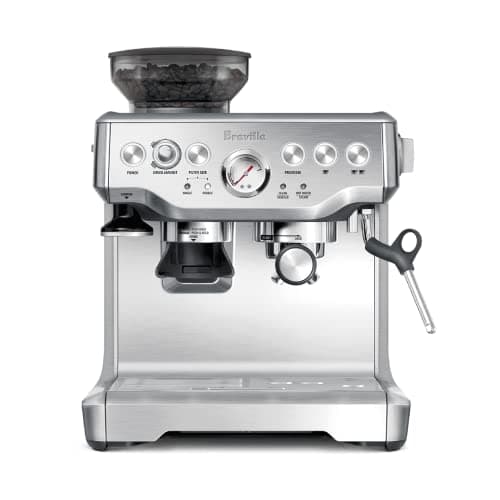
vs the Barista Express (BES870XL): identical grinder, boiler, basket size and brew recipe. The Impress adds assisted dosing and tamping and costs more. That is the entire difference. Our Barista Express vs Barista Pro comparison covers the other axis of this decision.
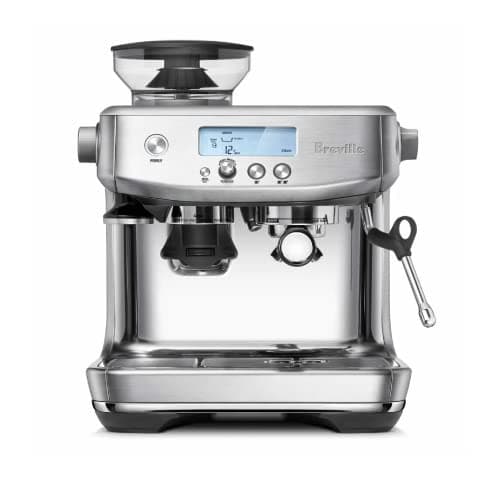
vs the Barista Pro (BES878): the Pro swaps the Thermocoil for a ThermoJet that reaches temperature in seconds, which changes your morning more than tamping assistance does. The Pro does not have the Impress lever. If you want both, the price moves into machines under $1,000 territory.
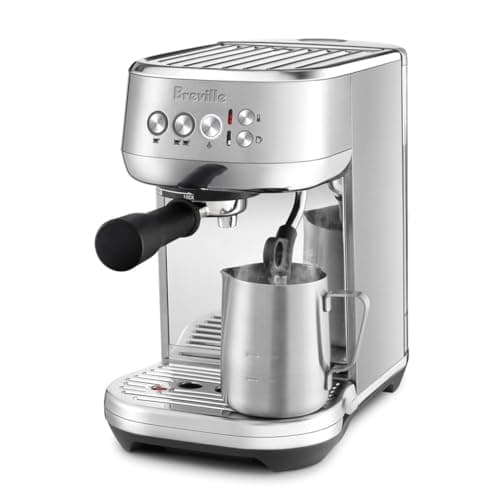
vs the Bambino Plus (BES500):no grinder at all, auto-steam for milk, much smaller footprint. If you already own a grinder, this is the better buy and it is not close — Bambino Plus vs Barista Express lays out that trade in full.
What to buy with it
Very little, which is part of the appeal. Skip the tamper — the machine is the tamper. The upgrades that still pay on an Impress are a scale so you can weigh the dose and the yield, a 54mm bottomless portafilter so you can see whether the assisted puck is actually extracting evenly, and better beans. Our best coffee beans for espresso page is the cheapest upgrade of the three and makes the biggest difference to the cup.