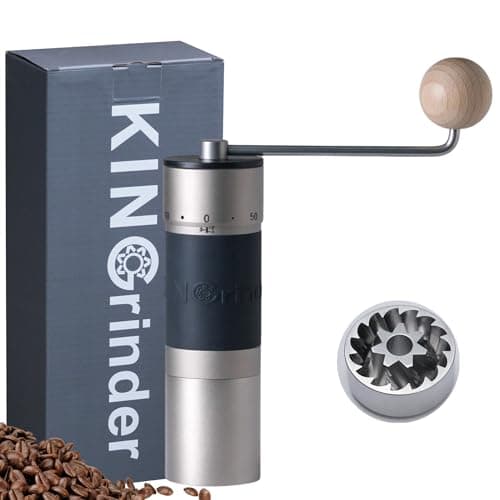
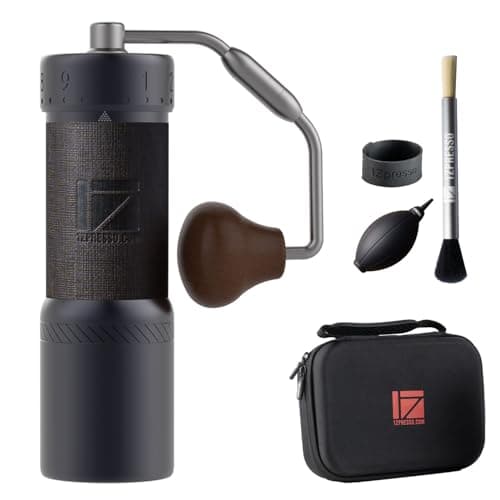
The 1Zpresso J-Ultra and the KINGrinder K6 chase the same buyer from opposite ends of the price range: someone who wants to grind espresso by hand and dial in shots precisely. Both are built around the feature that makes manual espresso practical — an external numbered dial with fine, repeatable steps, so you can count clicks, record the setting that pulled a great shot, and return to it exactly. The difference is what surrounds that dial. The J-Ultra is the premium specialist, a machined instrument 1Zpresso positions with a consistency that rivals grinders costing far more; the K6 is the value challenger that undercuts the pricier hand grinders while matching a lot of their capability. This comparison weighs them on the three things that decide it — price, grind consistency and espresso adjustment, and build and brand — and gives a verdict by budget. Both feature in our best hand grinders for espresso guide.
Start with price, because it frames the entire comparison. The K6 is the value play, full stop: it delivers external numbered adjustment and espresso-fine steps — the features that used to cost a premium — for meaningfully less than the J-Ultra. The J-Ultra is a genuine premium outlay for a manual grinder, and the whole question is whether what that money buys, in refinement and consistency and brand assurance, is worth it to you. If your budget is the binding constraint and you want a hand grinder that can genuinely dial in espresso, the K6 makes that possible for the least money. If you are prepared to pay more for the most polished tool and will use it daily, the J-Ultra's premium starts to make sense. We never quote prices that go stale here — check both live and weigh the gap against how much you will actually pull shots.
The heart of the comparison is grind consistency and espresso adjustment. Both grinders share the right architecture for espresso: an external numbered dial that divides the fine range into small, repeatable steps, which is exactly what turns dial-in from guesswork into a routine. Where the J-Ultra pulls ahead is refinement. 1Zpresso positions its grind consistency at a level good enough for dialed-in espresso, not fine on paper only, and reviewers of the premium 1Zpresso line consistently praise how repeatably it returns to a setting. The K6's stainless burrs and external adjustment deliver a lot of that same capability, and for most drinkers the gap in the cup is narrower than the price gap implies — but at the very fine espresso end, the J-Ultra's extra precision and uniformity are the reason it costs what it does. If you dial in shots daily and want the least fuss chasing the sweet spot, that refinement is the J-Ultra's argument; our how to dial in espresso guide explains why that repeatability matters so much.
Build and brandis where the premium shows most plainly. The J-Ultra's machined bodyfeels premium and rigid — and that stiffness is functional, because a body that does not flex under the load of a fine grind keeps the burrs from shifting, protecting the very consistency you paid for — and 1Zpresso's reputation and resale value are among the strongest in the category. The K6 is well built and its stainless burrs are genuinely espresso-capable, but its brand support and long-term track record are thinner than the established names, and its resale value is lower. That is the trade you make to spend less: the K6 is the value play, not the safe-brand play. If a proven brand, long-term support, and resale matter to you, the J-Ultra is the reassuring choice; if raw capability per dollar is the goal, the K6 answers. The full cases are in our J-Ultra review and KINGrinder K6 review.
Now the shared honest con, the one every hand grinder carries: you are the motor. Grinding fine for espresso means the burrs sit close together, the beans resist harder, and each dose takes more turns and more force than a coarse filter grind. On both of these grinders that effort is real, dose after dose — a pleasant ritual for one or two drinks, a genuine arm workout for a round of milk drinks or several shots. Neither grinder solves effort; they only decide what the effort gets you, and volume-heavy drinkers should look at an electric espresso grinderregardless of which hand grinder tempts them. The other honest note is fit: if you mostly brew filter, the J-Ultra's premium espresso range is overkill, and even the K6 is more grinder than a pure pour-over drinker needs — a general-purpose hand grinder from our hand grinder guide would serve better. Decide how serious you are about espresso before you spend on either.
The verdict follows cleanly from budget. For the buyer who wants manual espresso for the least money and accepts a thinner brand story in exchange, the KINGrinder K6 is the smart value pick — external numbered adjustment and espresso-fine steps at a price that undercuts the field. For the buyer who wants the most refined, most consistent, best-supported hand grinder and will use its precision daily, the 1Zpresso J-Ultrais worth its premium and does the espresso job better. If budget is tight, buy the K6 and enjoy most of the capability; if you want the reference instrument and the brand behind it, buy the J-Ultra. Both were assessed from the makers' published specifications, reasoned through against what each burr and adjustment design does to a shot, and priced live — our full method is on how we research.
How to choose between the J-Ultra and the K6
Both are espresso-capable hand grinders with external numbered dials, so they are far more alike than the price gap suggests. Four questions settle which one is right for you, in the order that matters — the first is really the whole decision.
1. What is your budget, and how much espresso will you pull?
This is the deciding question. The K6 is the value play by a wide margin — it gives you external numbered adjustment and espresso-fine steps for meaningfully less than the J-Ultra. The J-Ultrais a premium outlay justified only if you will use its fine range and refinement often. Weigh the gap against how frequently you actually pull shots: if espresso is occasional, the K6's value is decisive; if it is a daily ritual you will build around, the J-Ultra earns its keep. We do not quote prices that go stale — check both live before you decide.
2. Grind consistency and espresso resolution
Both share the right architecture — external dials with fine, repeatable steps — so both can genuinely dial in espresso. The difference is refinement: 1Zpresso positions the J-Ultra with a consistency good enough for dialed-in shots and a repeatability the premium line is known for, while the K6 delivers a large share of that capability for less. For most drinkers the gap in the cup is narrower than the gap in price; only at the very fine espresso end, or if you obsess over repeating a setting exactly, does the J-Ultra's extra precision earn its premium. Read how to dial in espresso to judge how much that resolution matters to you.
3. Build, brand, and resale
The J-Ultra's machined body is rigid enough to keep the burrs steady under a fine grind — functional refinement, not just feel — and 1Zpresso's brand support and resale value are among the strongest in the category. The K6 is well built and espresso-capable, but its brand track record is thinner and its resale value lower; it is the value play, not the safe-brand play. If a proven name, long-term support, and holding value matter to you, lean J-Ultra; if capability per dollar is the goal, the K6 is hard to argue with. Keep either clean of oily espresso residue with our grinder cleaning guide and both hold their edge for years.
4. Are you sure you want a hand grinder at all?
Be honest about effort and volume. Grinding fine for espresso by hand is real work on either grinder, dose after dose — fine for one or two drinks, a chore for several shots or a round of milk drinks. If you pull espresso in volume, an electric grinder from our best espresso grinders guide is the saner buy, and our hand grinder vs electriccomparison lays out the trade. If you want portability, no power, and the ritual — and you mostly pull one or two shots — a hand grinder is the right call, and then it comes down to the K6's value or the J-Ultra's refinement.
The verdict, in brief
Buy the KINGrinder K6 if you want manual espresso for the least money and can accept a thinner brand story — external numbered adjustment and espresso-fine steps at a value price. Buy the 1Zpresso J-Ultra if you want the most refined, most consistent, best-supported hand grinder and will use its precision daily. See both ranked against the manual field in our best hand grinders for espresso list, or the value all-rounder alternative in our TIMEMORE C3 vs J-Ultra comparison.