The short answer: one level tablespoon of ground coffee per 6 oz "cup" of water, which is about 5 g. Most coffee scoops that come with a machine hold two tablespoons — so that is half a scoop per 6 oz cup, or one full scoop per 12 oz mug. If your coffee has been coming out weak, this is almost always why: a "cup" on a coffee maker is 6 oz, not the 12 oz mug you actually drink from.
That is the useful answer, and the rest of this page is the reason it is only approximately right — because a scoop measures volume and what matters is weight, and the relationship between the two changes with every bag of coffee you buy.
The table, by carafe size
Using the 6 oz machine "cup" and a 2-tablespoon scoop, at the standard strength most brewers are designed around:
4 cups (24 oz water): 4 level tablespoons, 2 scoops, about 20 g. 6 cups (36 oz): 6 tablespoons, 3 scoops, about 30 g. 8 cups (48 oz): 8 tablespoons, 4 scoops, about 40 g. 10 cups (60 oz): 10 tablespoons, 5 scoops, about 50 g. 12 cups (72 oz): 12 tablespoons, 6 scoops, about 60 g.
For a single mug: a 10 oz mug wants about 2 level tablespoons (one scoop, roughly 10– 12 g); a 12 oz mug wants a generous scoop, around 14 g. Those land near a 1:16 ratio of coffee to water by weight, which is the standard filter starting point — our coffee to water ratio guide has the full version by brewer.
Why a scoop is an unreliable measure
A tablespoon of coffee is a fixed volume holding a variable mass, and three things change that mass.
Grind size.Fine grounds pack together with less air between particles than coarse ones, so a level tablespoon of espresso-fine coffee weighs appreciably more than a level tablespoon of French-press-coarse coffee — the gap runs to roughly 20 to 30 percent across the usable range. Change your grinder setting and you have silently changed your dose.
Roast level. Roasting drives off moisture and expands the bean, so dark roasts are less dense than light ones. A scoop of dark roast weighs less than the same scoop of light roast. This is the quiet reason switching to a darker bag can make your usual routine taste weaker.
How you fill it. Heaped versus level is an enormous difference, and nobody heaps consistently. Dipping the scoop into the bag and lifting also compacts the grounds differently each time.
None of this means scoops are useless. It means they are a starting point that drifts, and that chasing consistency with a scoop is chasing something a scoop cannot give you.
What cafes do instead
They weigh it, in grams, every time. The useful frame is the brew ratio: grams of coffee to grams of water, where 1 ml of water weighs 1 g, so weighing water is trivially easy. Filter coffee sits around 1:15 to 1:17; espresso is about 1:2. Once you think in ratios, every brewer and every size uses one number you already know, and scaling a recipe up or down is arithmetic instead of guesswork.
The practical benefit is not precision for its own sake — it is reproducibility. When you weigh the dose, a cup that tastes wrong tells you something useful, because you know the dose was not the variable. When you scoop it, you cannot tell whether the problem was the grind, the water or the fact that today's scoop was heaped.
Do you need a scale?
If you are happy with your coffee, no — the table above is enough and a scoop is fine. Buy a scale when one of these is true: you want the same cup every morning rather than a good one most mornings; you have started buying better beans and want to taste what you paid for; you are brewing espresso, where a gram or two changes the shot visibly; or you are troubleshooting and need to hold one variable still. It is also the cheapest upgrade in coffee — cheaper than almost any accessory and with more effect on consistency than most.
What to look for
0.1 g resolution if you brew espresso, where the dose is small enough that whole grams are coarse. 1 g resolution is fine for filter. A built-in timer matters more than it sounds, because brew time is the variable you most often want to change next. A tare button you can reach while holding a kettle. Capacity of at least 2 kg if you want to weigh water into a full carafe, and a flat, wipeable top, because you will spill coffee on it.
The picks
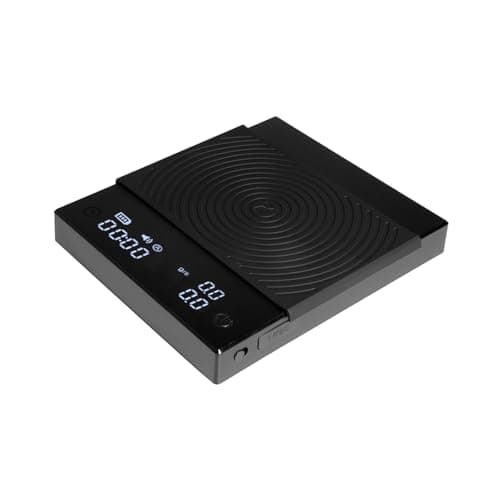
TIMEMORE Coffee Scale Basic 2.0. The all-round pick: 0.1 g resolution, a timer, a flat pad that takes a V60 or a press, and a price that makes the decision easy. This is the one to buy if you brew more than one way.
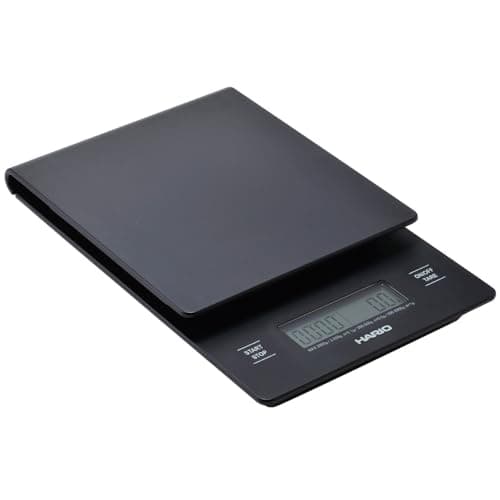
Hario V60 Drip Scale.Built for pour-over by the company that designed the V60 — scale and timer in one, sized so a dripper and carafe sit on it comfortably. If pour-over is your method, it is purpose-made for the job.
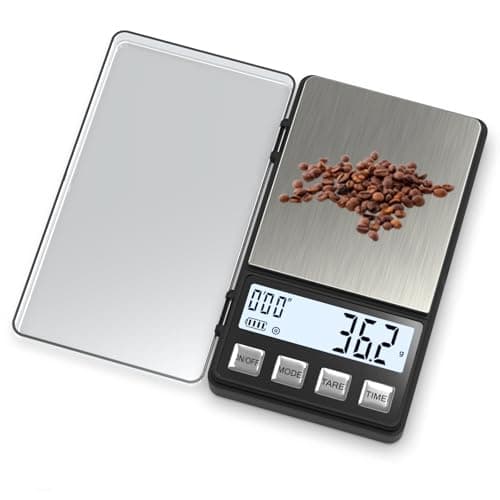
Weightman Espresso Scale with Timer. The cheapest way to stop guessing. 0.1 g resolution, a timer, and small enough to sit on an espresso drip tray. It does not feel premium; it does end the scoop problem for very little money, which is the entire point.
For the wider field, including the espresso-specific scales with flow-rate displays, see best budget coffee scales and best espresso scales.
A scale is pointless with stale pre-ground coffee
Worth saying plainly so you spend in the right order. Weighing a dose of coffee that was ground three months ago just gives you a precise amount of stale coffee. The NCA puts ground coffee at one to two weeks of real freshness against one to three for whole beans. If you are still buying pre-ground, a grinder under $100 comes before a scale; if you grind fresh already, the scale is the next thing.
The one measurement that is not negotiable
Whatever you measure with, measure the watertoo. Most "my coffee is inconsistent" problems are water problems: filling a carafe by eye, topping up a kettle, or using a 12 oz mug while dosing for a 6 oz cup. Water is the easier half to get right because 1 ml weighs 1 g, and getting it right halves the number of things that can drift. If your coffee is reliably weak, that mismatch is the first place to look — why is my coffee weak covers the rest.