Brew coffee between 195°F and 205°F(about 90–96°C). That is the window, and it is the same window the Specialty Coffee Association's certification standards for home brewers are built around — machines are tested on whether they reach the correct temperature band and hold it. Water above it scorches the coffee and tastes harsh; water below it under-extracts and tastes sour and thin.
The practical headline for anyone brewing by hand: water straight off a rolling boil is too hot.At sea level that is 212°F, seven degrees above the top of the window. The fix costs nothing — boil the kettle, then wait about thirty seconds to a minute with the lid off before you pour. That is genuinely the whole technique, and it is the single most common reason home pour-over tastes bitter.
Why the window exists
Brewing is extraction: hot water dissolves compounds out of ground coffee, and different compounds come out at different rates. The pleasant acids and sugars dissolve readily; the bitter compounds dissolve more slowly and more readily as temperature rises. Too cool and you only get the first group partially — the cup reads sour, weak and salty, because you have under-extracted. Too hot and you accelerate the bitter end and strip compounds that should have stayed in the grounds — the cup reads harsh and ashy.
Temperature also interacts with everything else. Hotter water extracts faster, so a hot brew needs less time or a coarser grind; cooler water needs longer or finer. That is why cold brew works at all: at room temperature or below, extraction is so slow that it takes twelve to twenty-four hours to reach the same place, and the acids that need heat never fully come out — which is exactly why cold brew tastes smooth and low-acid. See how to make cold brew.
By brewing method
Drip machines:not your decision — it is the machine's, and this is the single biggest difference between a good drip brewer and a cheap one. Many inexpensive machines never reach 195°F, which is why they make weak, sour coffee regardless of the coffee you put in. It is the main thing SCA certification tests, and our SCA certified coffee makers page lists the machines that have passed.
Pour-over:200–205°F for medium and light roasts, nearer 195°F for dark roasts, which are more soluble and scorch more easily. This is the method where temperature control pays off most, because you control it directly. How to make pour-over coffee has the method.
French press:around 200°F. The long steep means a few degrees matter less than they do in a fast pour-over, but boiling water in a press is still a common cause of bitterness. AeroPress:175–205°F is all workable — the lower end suits light roasts and longer steeps and is unusually forgiving. Moka pot:you are not setting the temperature, you are setting the heat. Medium heat, not high — high heat is half the reason moka coffee tastes burnt. Espresso:195–205°F at the group head, which is what a PID or a well-designed thermoblock exists to hold; see water for espresso.
Hitting it without a thermometer
Three reliable approaches. The thirty-second rule:boil, remove from heat, wait 30–60 seconds with the lid off; a litre of water in a metal kettle drops roughly into the window in that time. The splash: add a small splash of room-temperature water to a just-boiled kettle. Altitude awareness:water boils cooler the higher you are — around 203°F at 5,000 feet — so at altitude boiling water is already inside the window and you should not wait at all. That detail catches people out when they move.
The short answer
Quick picks
#ad · Live prices from the Amazon Product API, as of October 20, 2026. Where we have no verified live price, we show none — we would rather leave a gap than print a number that has rotted.
In detail
The picks, in full
The best electric gooseneck kettle
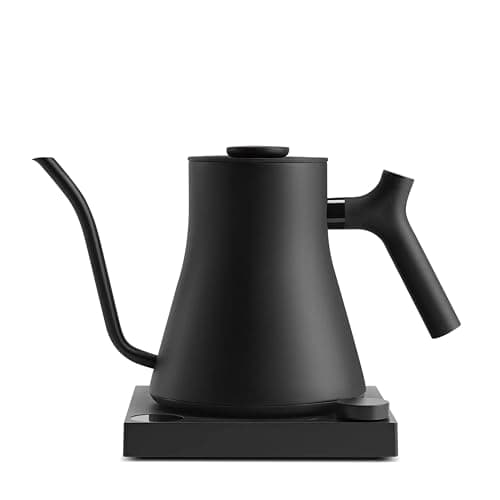
Fellow Stagg EKG Pro Electric Kettle
Electric, variable tempTo-the-degree controlPrecision gooseneck spoutBrew stopwatch
The pour-over kettle enthusiasts actually want — precise gooseneck, 1°F temperature control, a brew timer.
- Build quality
- 9
- Does the job
- 9
- Ease of use
- 9
- Value
- 7
Pros
- +The gooseneck spout gives the slow, precise pour that controls a pour-over — the single biggest technique upgrade for filter coffee
- +Sets temperature to the degree and holds it, which matters because different roasts and methods want different water temps
- +A built-in brew timer and a genuinely beautiful counter object
Cons
- −Premium price for a kettle — the Cosori does the core job for a third of the cost
- −0.9L capacity is modest for boiling large amounts
Don't buy this if…
…you only make French press or drip. The gooseneck's precision is wasted if you're not hand-pouring — a normal kettle boils water for less.
Best value gooseneck kettle
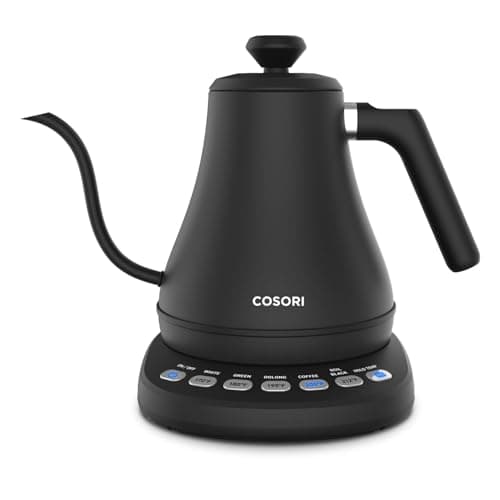
Cosori Gooseneck Electric Kettle
Electric, variable temp5 preset tempsGooseneck spout0.8L
The best-value gooseneck — variable temperature and a real pouring spout for a fraction of the Fellow.
- Build quality
- 7
- Does the job
- 9
- Ease of use
- 8
- Value
- 10
Pros
- +Gives you the two things that matter — a gooseneck spout and temperature control — for a third of the boutique price
- +Preset temperatures cover pour-over, tea and French press without fiddling
- +The pour is controllable enough for genuinely good pour-over technique
Cons
- −Not as precise or as heavy-feeling as the Fellow Stagg
- −No brew timer, and the build is plasticky where the Fellow is metal
Don't buy this if…
…you want to-the-degree precision and a premium object. That's the Fellow Stagg EKG — the Cosori is the value pick, not the luxury one.
Precision without the boutique price
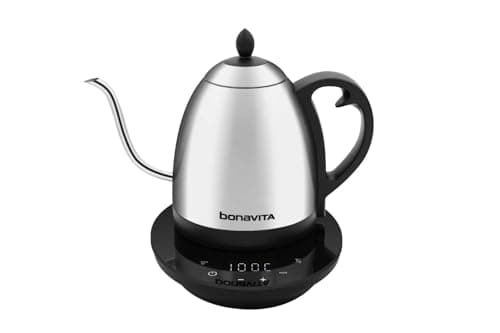
Bonavita Cosmopolitan 1.0L Gooseneck Kettle
Electric, 1°F control6 preset temps1L capacity60-minute hold
The sensible middle of the gooseneck market — single-degree control and an hour-long hold, without the boutique price.
- Build quality
- 8
- Does the job
- 9
- Ease of use
- 8
- Value
- 7
Pros
- +Bonavita rates it to a single degree across 140-212°F, so you can match the water to the roast instead of guessing
- +1L capacity is larger than the Fellow or Cosori, so fewer refills
- +A 60-minute hold and a 1200W element Bonavita says brings a full liter to the boil in about five minutes
Cons
- −Roughly twice the Cosori for the same core job — a gooseneck spout and temperature control
- −No brew stopwatch: if you want the timer as well as the temperature, that's the Fellow EKG Pro
Don't buy this if…
…you'd only ever use one preset. The Cosori does the gooseneck-plus-temperature job for around half, and the difference buys a better grinder.
Do you need a variable-temperature kettle?
Need, no. The thirty-second rule gets you into the window for free. What a variable kettle buys you is repeatability— the same number every morning without thinking — and that matters once you are trying to taste the difference between two coffees rather than just make a decent cup. If you brew pour-over daily and buy specialty beans, it is one of the better purchases available. If you brew in a drip machine, the machine owns the temperature and a kettle changes nothing.
Two features, and they are separable: a gooseneck spout for pour control, and temperature setting for the number. Pour-over wants both. A French press or an AeroPress only wants the second, and arguably neither.
The picks, and what each is for
Fellow Stagg EKG Pro.The one to buy if you want it to be a pleasure as well as a tool: a precise gooseneck, to-the-degree temperature setting, hold-at-temperature so it stays there while you grind, and a built-in stopwatch. It is the most expensive option here and most of the premium is design and interface rather than brewing capability — which is a legitimate thing to pay for, but worth naming honestly.
Cosori Gooseneck Electric Kettle. The value pick, and the one most people should buy. Preset temperatures covering the coffee and tea range, a hold function, and a proper gooseneck, for a fraction of the Stagg. It does the job the Stagg does with a plainer interface.
Bonavita Cosmopolitan Gooseneck.The brewing-first option — a precise variable-temperature gooseneck from a brand whose drip machines hold several SCA certifications. If you want the function with neither a premium nor a compromise, this is the middle of the road in the good sense.
A stovetop gooseneck like the Hario Buono is the cheapest route to pour control if you are happy to use a thermometer or the thirty-second rule for the temperature — our gooseneck kettle roundup covers the full field including the stovetop options.
Temperature is not the first thing to fix
Worth keeping in proportion. If your coffee is disappointing, the order of likely causes is: stale beans, then grind (size and evenness), then ratio, then temperature. A fresh bag ground properly and brewed with slightly-too-hot water beats stale pre-ground brewed at exactly 200°F. Fix the inputs first — coffee to water ratio and grind size are the two with more leverage than this page.
Preheat, or you will miss the window anyway
A cold brewer and a cold mug steal several degrees from water that was correct when it left the kettle. Rinse a V60 and its filter with hot water before brewing, warm a French press beaker, and warm the cup. This costs ten seconds and is the difference between theoretically correct and actually correct. It is also why the first cup from a cold drip machine often tastes thinner than the second.
How we picked
We do not run a testing lab
We compiled published manufacturer specifications, computed what each option costs to run where relevant, and cross-referenced aggregated owner reviews, then scored each product against a published rubric. The scores are judgments from documented research — they are not measurements we took, because we do not have a lab and we are not going to pretend we do. Where a number came from a manufacturer or a standard, we name it in Sources.
Questions
Frequently asked
What is the ideal water temperature for coffee?+
195–205°F (about 90–96°C). That is the band the SCA's home brewer certification standards are built around — certified machines are tested on reaching it and holding it. Below it coffee under-extracts and tastes sour; above it, it scorches and tastes harsh.
Can you use boiling water to make coffee?+
It is hotter than ideal. At sea level boiling water is 212°F, about seven degrees above the top of the window, and it is a common cause of bitter home-brewed coffee. Boil, then wait 30–60 seconds with the lid off before pouring. At high altitude water boils cooler — around 203°F at 5,000 feet — so there you can pour straight away.
What temperature should water be for a French press?+
Around 200°F. The long steep makes a press more forgiving than a pour-over, but boiling water straight into a press is still a frequent cause of bitterness. Preheat the beaker, since a cold glass carafe pulls several degrees out of the brew immediately.
Does water temperature matter more than grind size?+
No. Freshness and grind both have more leverage over your cup than a few degrees of water temperature. Fix stale beans and an uneven grind first; temperature is the refinement after those, and the one that matters most once you are brewing pour-over by hand.
Do I need a variable temperature kettle?+
Not to make good coffee — boiling and waiting thirty seconds lands you in the window. A variable kettle buys repeatability and a hold function, which is genuinely useful for daily pour-over and specialty beans. If you brew in a drip machine, the machine controls brew temperature and a kettle makes no difference.
Why does my coffee taste sour?+
Usually under-extraction, and water that is too cool is one of the three causes — the others being a grind that is too coarse and a brew that was too short. Raise one of them at a time.
Sour vs bitter walks through diagnosing it from the cup.
Receipts
Sources
We do not run a testing lab, and we do not pretend to. Where a measured number came from a manufacturer spec sheet or a published standard, we name it and link it. Where we could not verify something, we say so on the page rather than quietly leaving it out. Read our full method.