A gooseneck kettle is the least glamorous purchase in coffee and the one that most reliably fixes a disappointing home pour-over. The point is the spout: a long, narrow, curved neck delivers a thin, slow, aimable stream of water instead of the wide gush a normal kettle dumps out. That control is the whole reason a pour-over tastes better than a mug of instant. You can wet the grounds gently to let them bloom, then pour in slow, even circles that keep the bed level and every particle in contact with water for the same amount of time. Try that with a regular kettle and you blast a crater in the grounds, channel water straight through, and pull a thin, uneven cup no matter how good the beans are.
One thing to be clear about up front, because it trips people up: a gooseneck kettle is a brewing tool, not a brewer. It heats and pours the water — it does not hold coffee or grounds. You still need a dripper such as a Hario V60 or a Chemex, a filter, and ideally a scale. The kettle is the piece that turns all of those into a repeatable, good cup, which is why we treat it as core pour-over kit rather than an accessory.
The other half of a good kettle is temperature. The Specialty Coffee Association puts the extraction sweet spot at 195-205 degrees F (about 90-96 degrees C). Water that is too cool under-extracts and leaves the cup thin and sour; water straight off a rolling boil can scorch a delicate light roast. That is the case for a kettle that sets and holds a temperature to the degree — and it is also the one real dividing line in this list, between electric variable-temperature kettles that do it for you and a stovetop kettle that leaves the temperature to you and a thermometer.
Between those two poles, the everyday skill a gooseneck unlocks is pour technique. The narrow stream lets you start with a bloom — a small pour, roughly twice the weight of the coffee, that wets the whole bed and lets trapped carbon dioxide escape over thirty to forty-five seconds so the later pours extract evenly. From there you pour in slow, concentric circles or in distinct pulses, keeping the water level steady and off the paper wall. None of that is possible with a kettle that empties in a gush; the spout is the piece that turns a bag of good beans into a repeatable, balanced cup rather than a lucky one. It is a small motor skill that takes a few brews to settle, and a good kettle is what makes it learnable in the first place.
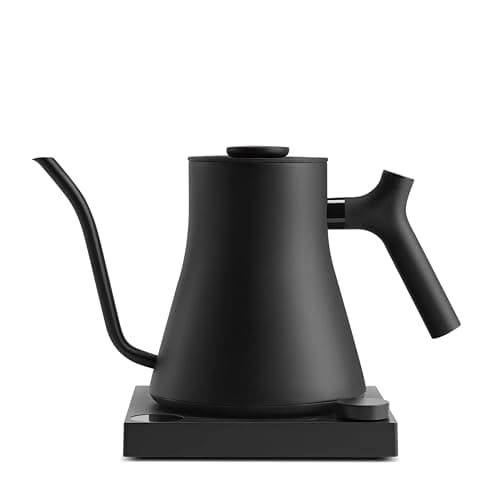
The Fellow Stagg EKG Pro tops the list because it does both jobs about as well as a home kettle can. The precision gooseneck gives you the slow, deliberate pour that controls extraction, it sets and holds temperature to a single degree, and it adds a built-in brew stopwatch so you can time the bloom and total draw-down. It is also a genuinely handsome object. The catch is the price — it is a premium kettle, and the 0.9L capacity is modest if you are boiling for more than coffee.
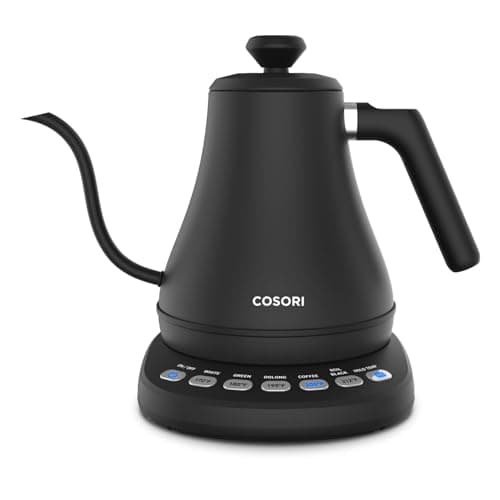
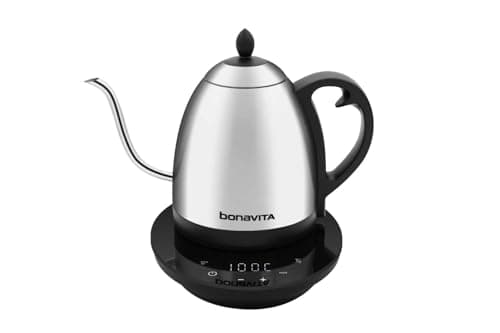
For most people the smarter buy is the Cosori Gooseneck Electric Kettle, our value pick. It gives you the two things that actually change the cup — a real gooseneck spout and variable temperature with presets — for roughly a third of the Fellow's price. The pour is controllable enough for genuinely good technique; you give up the to-the-degree precision, the brew timer, and the metal-heavy build, and gain the money for a better grinder. The Bonavita Cosmopolitan 1.0L is the sensible middle: Bonavita rates it to a single degree across 140-212 degrees F, with six presets and an hour-long hold, and its 1L body means fewer refills than either kettle above it. It sits between the Cosori and the Fellow on price and does not pretend otherwise.
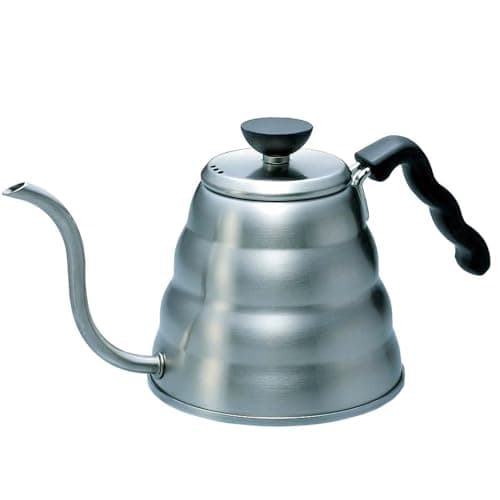
The Hario V60 Buono is the choice for anyone who does not want another plug and base unit eating an outlet. It is the stovetop gooseneck that has been the default hand-pour kettle in cafés for years — a slim, controllable spout, a stainless body, and nothing electronic to fail. You heat it on the hob and judge temperature yourself, which is the honest trade: no set-and-hold, no timer. Hario lists it for induction, gas, electric, radiant and halogen hobs, so the one thing it does not ask is that you own a particular kind of stove. What to skip? Do not pay the Fellow EKG premium if you will not use the to-the-degree control and the timer — the Cosori pours nearly as well for far less. And do not buy any gooseneck at all if you only ever brew French press or run a drip machine, where the precision spout does nothing a cheap kettle cannot. One last practical check before you buy the stovetop model: Hario rates the usable fill at 800ml of the 1.2L body, and it heats more slowly than an electric kettle, so if you want water hot in a hurry one of the three electric picks is the better match.
How to choose a gooseneck kettle
Work through these in order. The first two decide whether the kettle actually improves your coffee; the rest are convenience and cost.
1. The spout is the whole point
Every kettle here has a gooseneck, so the differences are in feel. A longer, straighter spout tends to give a slower, more predictable flow that is easier to control at low pour rates; a shorter, more curved spout can start faster until you learn it. What you are buying, in every case, is the ability to lay down a thin, aimed stream so you can bloom the grounds and then pour in slow, even circles. If a kettle cannot do that — if it gushes — it is not a pour-over kettle, whatever the label says.
2. Temperature: set-and-hold, or do it yourself
Extraction happens in the SCA's 195-205 degrees F band, and hitting it consistently is most of what separates a great pour-over from a sour one. An electric variable-temperature kettle (the Fellow EKG, Cosori, and Bonavita) lets you dial the exact number and holds it, which also lets you match the water to the roast — hotter for a dense light roast, cooler for a dark one. A stovetop kettle (the Hario Buono) leaves that to you: heat to a boil, then let it settle for thirty to forty-five seconds, or use a thermometer. If you value repeatability, buy electric; if you want the simplest, most durable tool and do not mind the off-boil rule, the stovetop is honest and cheaper.
3. Capacity, build, and the extras
Capacity matters more than it sounds. The Fellow EKG holds 0.9L and the Cosori 0.8L, which is plenty for one or two cups but tight if you also want tea or a second brew without a refill; the Bonavita's 1L gives you a little more room, and the Hario Buono's 1.2L body takes a practical 800ml. Build is the other spend: the Fellow feels like metal and looks the part on a counter, the Cosori is plastickier, and the Bonavita pairs 304 stainless with a glass touch panel. Extras — a brew stopwatch, presets, an hour-long hold — are nice, but none of them change the cup. Decide which you will genuinely use and buy the cheapest kettle that has them.
4. Remember it is only one piece of the setup
A kettle by itself makes no coffee. To brew you also need a dripper — the Hario V60 is the classic starting point — paper filters, fresh beans, and ideally a scale so you can weigh the coffee and water instead of guessing. The kettle controls the pour; the grind controls almost everything else, which is why an even, medium-fine grind from a burr grinder lifts the cup as much as the kettle does. Our guide to using a gooseneck kettle and how to make pour-over coffee walk through putting the whole set together.
5. Match the kettle to how much you spend elsewhere
A useful way to decide is to think about the whole setup rather than the kettle in isolation. If you are building a pour-over station from scratch, the budget is better balanced across the kettle, the dripper, and above all the grinder — a mid-priced kettle like the Cosori next to a good burr grinder beats a boutique kettle next to a blade grinder every time. If you already own a grinder and a dripper you love and brew every day, stepping up to the Fellow EKG or the Bonavita is a reasonable indulgence you will feel each morning. And if you are not yet sure pour-over will stick, start with the value option: the Cosori proves the method for little outlay, and upgrading later wastes nothing, since a spare kettle always earns its keep for tea and quick top-ups.