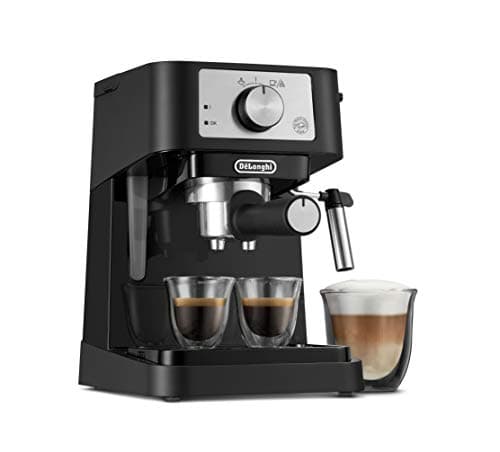
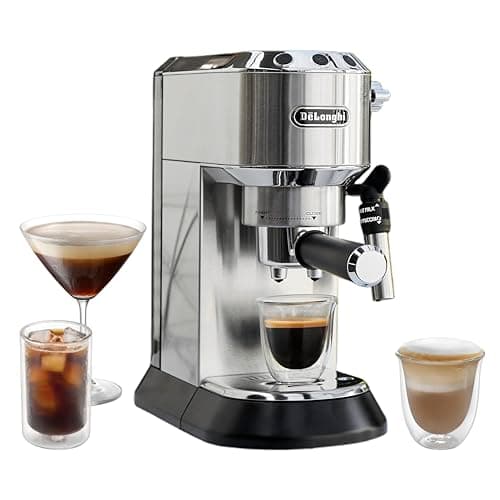
The De'Longhi Dedica and the De'Longhi Stilosa are the brand's two most popular budget machines, and they're close enough that plenty of first-time buyers can't tell which one to get. Both are true-budget espresso machines with a 15-bar pump, a manual milk wand, and no grinder; both pull a pressurized shot that's forgiving of imperfect grinding; and both sit near the bottom of our under-$300 guide. This comparison is about the real differences underneath that shared budget DNA — width, heat-up speed, adjustability, steam, and price — and which buyer each one actually suits.
Start with what they share, because it's most of the machine. Both use a 15-bar pump and a pressurized basket, so each produces a thick, crema-topped shot even from mediocre grinding — beginner-friendly, but flattering the coffee rather than rewarding great technique. Both have a manual steam wand, which is a genuine plus for learning milk since you texture it yourself, though the steam at this price is modest and takes patience. And crucially, neither has a grinder, so the real cost of either is the machine plus a burr grinder — and the grinder decides more of the cup than the choice between these two does. If you take one thing from this comparison, let it be that: sort the grinder out first, then pick the machine.
The first real difference is size, and it's the Dedica's headline. De'Longhi lists the Dedica at under five inches wide — barely wider than a wine bottle — and that genuinely solves the "no counter space" problem better than almost anything else at this price. The Stilosa is compact too, but the Dedica is in a different class of narrow. If your kitchen constraint is width, this alone can settle the decision: the Dedica fits where the Stilosa won't. The trade for that slimness is a small boiler and tank, so the Dedica is built for one or two drinks at a time rather than a back-to-back run.
The second difference is heat-up and control. The Dedica uses a thermoblock heating system that De'Longhi rates to pre-heat quickly, so you're pulling a shot sooner from cold, and it adds adjustable, programmable shot volumes so you can set your drink and repeat it. The Stilosa is the barer machine: it pulls a real shot but with fewer conveniences and more modest temperature stability. In day-to-day use the Dedica simply feels a step more refined — faster to ready, easier to make consistent — which is a meaningful part of what its slightly higher price buys beyond the slim footprint.
The third difference is steam and build feel, and here they're closer. Both have manual frothers that let you learn milk texturing, and neither will produce the tight microfoam a pricier machine manages — the steam at this tier is modest on both. The Dedica's overall fit and finish feel a touch more polished for the extra money, while the Stilosa is honestly plastic-heavy and feels its price. Neither is a milk powerhouse; if effortless milk is the priority, that's a different tier entirely, covered in our best machines for lattes.
The fourth difference is price, and it favors the Stilosa. The Stilosa is the cheaper of the two — noticeably so — and it includes a real pressurized shot, a manual steam wand, and a tamper for the least money of any De'Longhi here. That matters more than it looks, because both machines depend on a grinder you have to buy separately: the money you save on the Stilosa can go straight into a better grinder, which improves the cup more than the gap between these two machines does. On a fixed total budget, the Stilosa is often the smarter allocation, not just the cheaper option.
So the verdict comes down to the buyer. Choose the De'Longhi Dedicaif counter width is your real constraint, or if the faster heat-up and adjustable, repeatable shots are worth a small premium to you — it's the more refined machine and the one to pick when slimness or convenience is the deciding factor. The full case is in our Dedica review. Choose the De'Longhi Stilosaif price is the priority and space isn't — it pulls the same style of pressurized shot for less and frees up budget for the grinder that matters more; the full case is in our Stilosa review. Both are honest budget machines, and for the committed enthusiast, both are places to startrather than land — if you already know you're serious, a machine one tier up, like the Gaggia Classic Pro, is the machine you grow into.
Neither machine was in our hands. We compared De'Longhi's published specifications, the well-documented behavior of pressurized baskets and entry-level thermoblock machines, and aggregated owner reports, and we priced both live. Where a point rests on a maker's claim — the Dedica's sub-five-inch width and fast pre-heat, the 15-bar pumps — we say so rather than claim a measurement we didn't make, in line with our research method.
De'Longhi Dedica vs Stilosa: the decision in detail
Because these two share a budget and a basic recipe, choosing well means understanding exactly where they differ and which buyer each difference favors — in the order that changes the decision.
What's identical — and why it matters
Both are 15-bar machines with a pressurized basket, a manual steam wand, and no grinder. That means both pull a forgiving, crema-topped shot that flatters imperfect grinding, both let you learn milk by hand on a modest wand, and both cost more in practice than the sticker because you still need a grinder. If neither the shot style nor the manual-milk approach appeals — if you want the machine to do the work — the comparison is moot and you want a guided all-in-one or a super-automaticinstead. If it does appeal, the differences below decide it.
Size and counter fit
This is the Dedica's signature and often the whole decision. De'Longhi lists it at under five inches wide, which fits counters the Stilosa can't. The Stilosa is compact but not remarkably so. If width is your genuine constraint, the Dedica wins outright — the slimness is real and hard to find elsewhere at this price. The trade is a small boiler and tank, so the Dedica suits one or two drinks at a time rather than a crowd; plan around that if you regularly make several drinks in a row.
Speed and consistency
The Dedica's thermoblock pre-heats quickly and its adjustable, programmable shot volumes make a repeatable drink easy, so it feels a step more refined day to day. The Stilosa pulls a real shot but is the barer machine, with fewer conveniences and more modest temperature stability. If you value getting to a consistent shot fast with the least fuss, that's a concrete point for the Dedica; if you're happy to work a simpler machine and learn its rhythm, the Stilosa gives up little that a good grinder and our dialing-in guidecan't recover.
Steam and milk
Both have manual frothers and modest steam — neither is a milk powerhouse, and both reward practice rather than doing the work for you. That's a plus for anyone who wants to learn milk texturing and a hurdle for anyone who wants it hands-free. The Dedica's slightly more polished build gives it a marginal edge in feel, but the milk ceiling is similar. Our guide to steaming milk applies to either; if effortless microfoam is the point, look one tier up instead.
Price and where the savings go
The Stilosa is the cheaper machine, and because both depend on a grinder you buy separately, the savings are strategic, not just a discount. Money kept back on the Stilosa can go into a better grinder, which improves the cup more than the difference between these two machines does. On a fixed total budget, that logic often tips the decision to the Stilosa — unless the Dedica's width or refinement solves a problem you actually have.
The verdict by buyer and budget
Buy the Dedicaif counter width is your constraint, or if the faster heat-up and adjustable shots are worth a small premium — it's the more refined, more convenient machine. Buy the Stilosaif price is the priority and space isn't — it pulls the same style of shot for less and frees budget for the grinder. And if you already know you're a committed enthusiast, treat both as a starting point and read our under-$300 guide and the tier above it before you spend. Pair whichever you choose with a grinder and fresh beans for espresso.