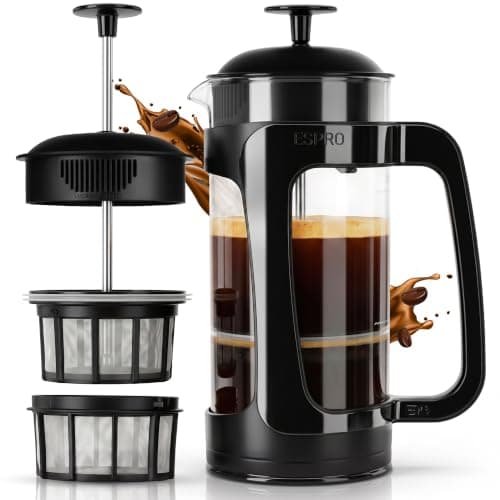
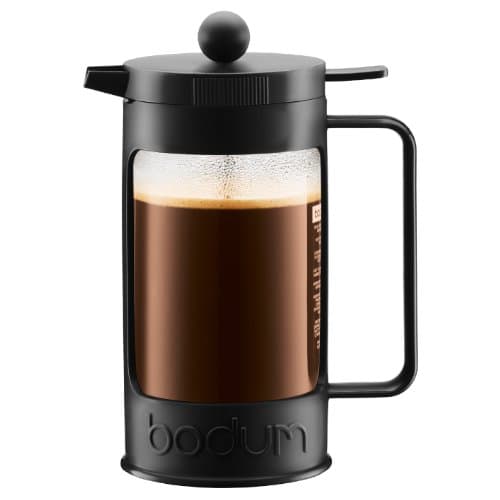
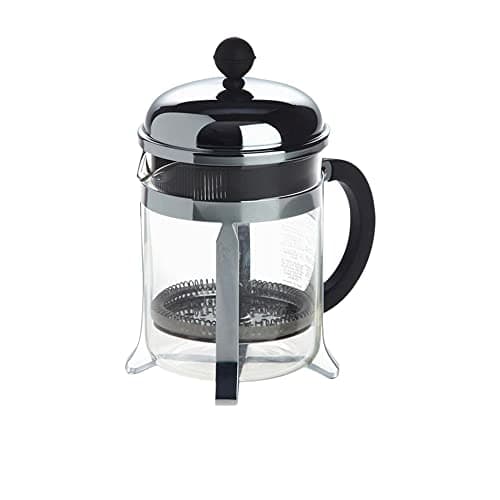
The best French press under $50 is the Bodum Chambord — it is the press everyone pictures, it is still the one to buy, and replacement glass and parts for it are cheap and everywhere. The budget pick is the Bodum Bean: the cheapest press we rank, brewing the same coffee through the same borosilicate glass in a plastic shell instead of a steel cage, and at 34 oz it is the bigger pot of the two. All three picks below sat under $50 at the last price check (as of November 22, 2026) — the Quick Picks table carries each one's live price with the same stamp, and the order inside the band moves, so trust the table over this sentence.
This page exists because the French press is the one brewer where a bigger budget buys you almost nothing in the cup. A press is a jar, a plunger and a filter. There is no pump, no heating element, no shower head and no electronics to get right, which is why a press under $50 brews the same coffee as a press over $100 — and why we think a price ceiling is the honest way to shop for one. What more money buys is durability, insulation and sediment control, in that order. None of those is the brew.
The criteria we ranked on
Filtration. A standard press uses a single metal mesh, which lets fine particles through — the grit in the last sip that people either never notice or cannot stand. A double micro-filter catches far more of it. This is the single biggest real difference between presses, and it is the one that decides this page for a lot of people.
Capacity, honestly stated. Press capacities are quoted in ounces of brewed coffee, and the difference between a 17 oz pot and a 34 oz pot is the difference between two mugs and a table. Presses also brew badly when run far under capacity, because the plunger needs enough depth of coffee to work against. Buy for your normal morning, not your occasional one.
What happens when it breaks. Glass presses break. That is not a defect, it is the material, and the right question is whether a replacement beaker is cheap and easy to find. For the Bodum presses it is, which is a large part of why they have outlived every design fad in this category.
Running cost: zero. No paper filters, no pods, no cartridges. Every press here costs nothing to run after you buy it, which is worth remembering when you compare one against a pod machine that costs less up front.
Who each pick is for
Bodum Chambord (17 oz) — the default. Borosilicate glass in a stainless frame, made in Portugal, and the shape that defines the category. Full-immersion brewing through a metal filter gives you the heavy, oily body that paper filters strip out, which is the entire point of a press. Honest cons: the metal mesh lets fine sediment through, so the last sip has grit; the glass carafe will eventually meet a hard floor; and at 17 oz it is a two-mug pot, so brewing for a table means going again — and it costs more than the larger Bean. Read our full Chambord review for the detail.
ESPRO P3 (32 oz) — the press to buy if grit bothers you. Its patented double micro-filter catches far more fines than a standard mesh, so the cup is clean to the bottom, and the filter also stops the brew when you plunge, which reduces the over-extraction that makes press coffee turn bitter as it sits in the pot. Same full-immersion body, minus the trademark sediment. Honest cons: the double filter is more to rinse and clean than a plain mesh, and you are paying for a fix to a problem that only bothers some drinkers — if a little grit does not bother you, the Chambord is the simpler press.
Bodum Bean (34 oz) — the budget pick, and the best value on this site full stop. It is the cheapest press we rank and it makes better coffee than anything electric near the money. The beaker is the same heat-resistant borosilicate glass as the Chambord's and the brew is identical; the difference is that it sits in a plastic shell rather than a steel cage, and that at 34 oz it is the bigger pot of the two. Honest cons: the plastic shell feels cheaper than the Chambord's steel, and it has the same mesh-filter grit as any standard press.
When to spend past the band
There is exactly one good reason to go over $50 on a French press, and it is not the coffee. The Frieling Double-Wall (36 oz) is double-walled stainless rather than glass: it keeps the brew hot far longer, it survives drops that would end a glass press, and it is dishwasher safe. If you brew a large pot and drink it over an hour, or if there are children, pets or a tile floor in the picture, that is a real purchase rather than a vanity one. Its own trade-offs are that you cannot see the brew level or color through steel, and it costs several times what a glass Bodum does. If you drink your press coffee straight away and watch your budget, the insulation and toughness are simply wasted — which is the whole argument for staying inside this band. Our main French press roundup ranks it alongside everything here with no price ceiling.
The verdict
Buy the Chambord if you want the classic and two mugs is your morning. Buy the ESPRO P3 if the gritty last sip has ever made you put a press down, or if you want a bigger pot with a cleaner cup. Buy the Bean if you want the most coffee for the least money and do not care how it looks on the counter — it brews the same cup as the Chambord. Then put the money you saved into the two things that actually change press coffee: a grinder that grinds coarse and beans that suit immersion. That is not a throwaway line — it is the single most useful thing on this page.
Why the grinder matters more than the press
A French press uses a metal filter with openings large enough to let oils through, which is what gives press coffee its body. Those same openings let fine particles through too. If your grinder produces a lot of fines — and every blade grinder does, by design — you get a muddy, bitter cup regardless of which press you plunged it in. A burr grinder set coarse produces particles of a consistent size, so the mesh has far less to leak. Burr vs blade explains the mechanism, and best grinder for French press ranks the coarse-end field. This is the upgrade that changes the cup. The press is the vessel.
The recipe, in four numbers
Coarse grind, roughly the texture of raw sugar. About 1:15 coffee to water by weight — so 30 g of coffee to 450 ml for a two-mug pot — adjusted to taste. Water just off the boil, around 200°F. Four minutes, then plunge slowly and decant immediately into mugs or a carafe. That last step is the one most people skip and it is the one that matters: coffee left sitting on the grounds keeps extracting and turns bitter, which is why the fourth cup from a press tastes worse than the first. The ESPRO's filter mitigates it; decanting eliminates it. How to use a French press has the full method and coffee-to-water ratio converts it for other pot sizes.
Glass or steel
Borosilicate glass is the standard because it handles thermal shock, it lets you watch the bloom, and it is cheap to replace. Its failure mode is obvious. Stainless steel presses do not break and hold heat much better, but they cost more, hide the brew, and — in double-wall form — keep the coffee hot enough to keep extracting if you leave it on the grounds, which makes decanting more important rather than less. Under $50 the field is glass, and that is fine: a replacement beaker costs a fraction of a new press.
Sediment: how much is normal, and how to get less
Some sediment is inherent to the method and part of what people like about it. If yours is excessive, work through this in order. Grind coarser. Let the pot settle for 30 seconds after plunging instead of pouring immediately. Pour gently and stop before the last half-inch. Skim the foam and floating grounds off the surface before plunging. If all of that still is not enough, the double-filter ESPRO is the equipment answer — and a paper-filtered pour-over is the honest answer if what you actually want is a clean cup rather than a press.
Cleaning, and the part everyone forgets
Knock the grounds into the bin or compost rather than the sink — press grounds are the fastest way to block a drain. Then take the plunger assembly apart. The filter screen unscrews from the rod on every press here, and the coffee oils that collect between the mesh and the spiral plate are what make an old press taste stale and rancid. Washing it whole does not reach them. Once a week is enough for most households. How to clean a French press has the routine in full.
Who should not buy a French press at all
Three groups, stated plainly because a roundup that recommends its category to everyone is not telling you much. If you want a clean, bright, articulate cup that shows off a light single origin, a press is the wrong tool — it is built to give body, not clarity, and a V60 or Chemex is the brewer. If you want coffee waiting when you wake up, a press cannot do it and a programmable machine can. And if you brew one cup at a time and hate washing up, an AeroPress makes a comparable cup and cleans in ten seconds. Our best coffee makers under $100 page puts all of those in one band if you have not settled on a method yet.