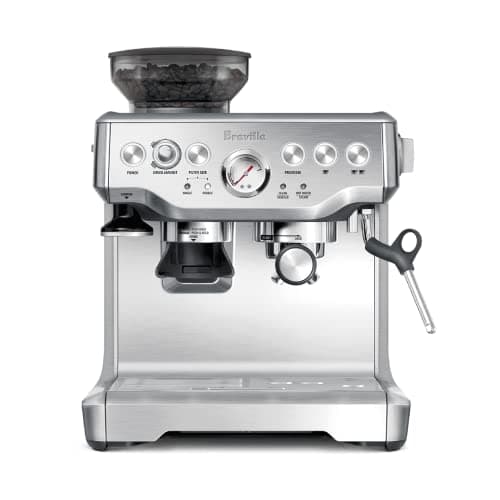
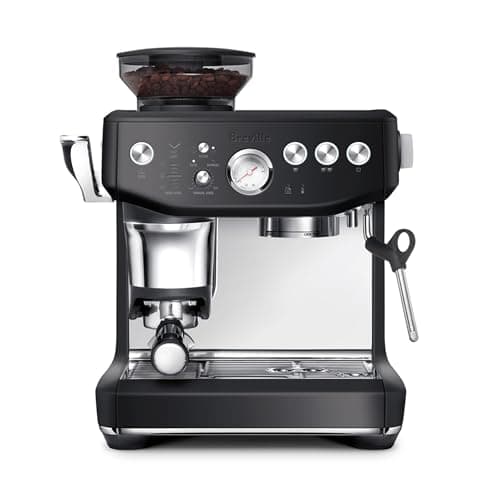
Buy the Barista Express Impress (BES876)if you are starting from zero and want the fiddliest part of espresso taken off your hands — it doses, tamps at a published 22 lb and twists, so your puck prep stops being the variable that ruins mornings. Buy the standard Barista Express (BES870XL) if you already own a tamper you like, enjoy the ritual, or simply want the lowest price on a machine with a grinder built in. The shots these two can make at their best are the same. You are paying the difference for consistency, not for a better ceiling.
That is the whole comparison in two sentences, and it is worth being blunt about it because the listings are not. Both machines are 54mm Breville semi-automatics with a built-in conical burr grinder, a single heating system, a 15-bar pump and the same steam wand. Put the same beans, the same grind and a perfectly prepared puck in each one and you cannot tell the shots apart. Everything below is about how much work it takes you to get to that puck.
The one difference: the Impress Puck System
On the standard Barista Express, you grind into the portafilter, eyeball the dose, knock the basket level, and tamp by hand. Every one of those is a skill, and the two that go wrong most often for beginners are dose (too much or too little coffee, which shifts your whole recipe) and tamp (angled or inconsistent pressure, which causes channeling).
The Impress replaces both. Breville's precision dosing adjusts the next grind based on what the last dose actually weighed, so the machine converges on your target instead of drifting. Then the Impress lever tamps with a published, constant 22 lb of forceand finishes with a 7-degree twist to polish the puck surface. Breville also publishes PID temperature control at 200°F and a low-pressure pre-infusion stage ahead of the 9-bar extraction — the same mechanics that make a good shot on any machine, with the human variance removed.
The honest framing: this is a repeatability feature. It does not make a better maximum shot than a careful hand tamp with a WDT tool. It makes your average shot much closer to your best one, which for most people in their first year is a bigger deal than the ceiling.
What is identical, and why that matters to the price
Both machines share the 54mm portafilter (so the same bottomless portafilters and baskets fit either one), the same built-in grinder concept, the same single heating system — which means you still wait a few seconds between pulling a shot and steaming milk on both — and the same steam wand that wants actual technique. Neither is a dual boiler. Neither will pour latte art for you.
So when you compare the two prices in the table above, you are not comparing a cheap machine to a good machine. You are comparing a machine where you buy the tamper and the skill separately to a machine that has both built in.
The Barista Pro, and why it is in this comparison
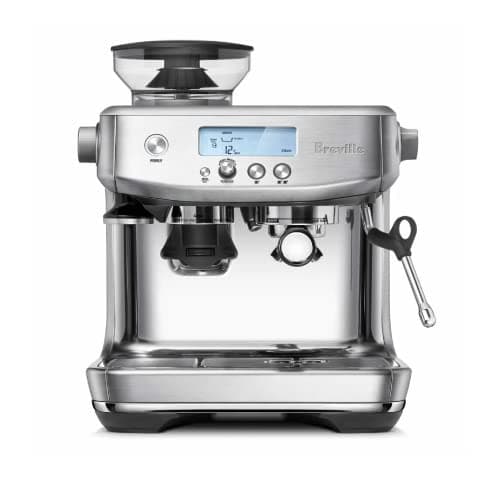
The Barista Pro (BES878)sits in the middle of the two on price and answers a different complaint. It keeps hand dosing and hand tamping, but adds Breville's ThermoJet heater, which reaches temperature in about three seconds, plus an LCD that makes grind size and shot timing visible instead of guesswork. If your frustration is waiting rather than tamping, the Pro is the machine that fixes your actual problem. If your frustration is tamping, it does nothing for you. Our Barista Express vs Barista Pro comparison goes deeper on that pair.
The case for spending less, not more
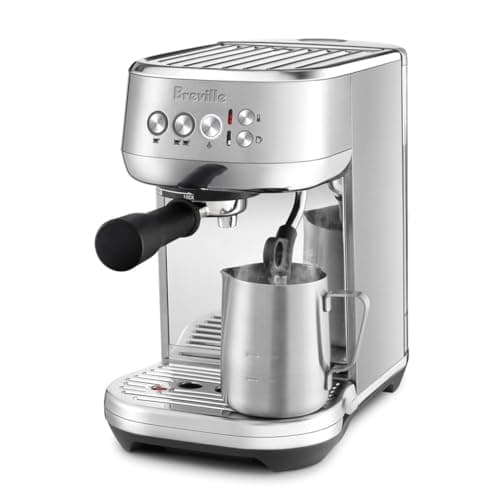
The Bambino Plus (BES500)is here as the contrarian pick, and it is a serious one. It has no grinder, so if you already own a decent burr grinder — or would rather buy a dedicated grinder under $200 than take Breville's built-in one — the Bambino Plus costs less, takes less counter space, heats in about three seconds and auto-textures milk to a set temperature with no wand technique at all. Plenty of people who bought an Impress for the tamping would have been better served by a Bambino Plus plus a standalone grinder, because a better grinder reduces channeling more than a better tamp does.
So which one
Impress if this is your first machine, nobody in the house wants a hobby, and you want the drink to be the same on a Tuesday as it was on Sunday. Standard Expressif you want the cheapest grinder-included route and are willing to spend a few weeks learning to tamp — the money saved buys a good scale, a WDT tool and a lot of beans. Pro if waiting for the machine is what annoys you. Bambino Plus if you already own a grinder.
Does assisted tamping actually reduce channeling?
Partly, and it is worth understanding which part. Channeling is water finding a path of least resistance through an unevenly packed puck. Three things cause it: an inconsistent grind, uneven distribution of grounds in the basket, and an angled or inconsistent tamp. The Impress system addresses the third completely and the second partially — the twist at the end of the tamp smooths the surface, but it does not stir the bed.
It does nothing at all about the first. If the grinder is producing clumps and boulders, a perfect 22 lb tamp compresses an uneven bed perfectly evenly, and you still channel. That is why we would put a WDT tool in the basket of either machine before we paid the Impress premium: it is the cheapest intervention in espresso and it fixes the distribution problem that the tamp cannot reach. If you want to see whether you are channeling on either machine, a bottomless portafilter makes it visible in one shot.
The dual-wall basket trap, on both machines
Breville ships pressurized (dual-wall) baskets with these machines alongside the single-wall ones. A pressurized basket builds back-pressure artificially through one small hole, which produces convincing-looking crema from almost any coffee — including stale pre-ground. It is a crutch, and specifically a crutch that hides extraction faults.
If you are on a dual-wall basket, the Impress premium is largely wasted, because the basket is already papering over the puck problems you paid the machine to solve. Use the single-wall basket, grind fresh whole beans, and let the machine do its job.
What neither machine fixes
Both are single-heating-system machines. You pull a shot, then the machine switches to steam mode, and there is a short wait. For one or two milk drinks in a morning that is a non-event. For a houseful of guests it is the real bottleneck, and no amount of assisted tamping changes it — that is a dual boiler problem.
Neither has an automatic milk wand either. Breville's auto-texturing lives on the Bambino Plus and the Barista Touch, not on the Express line. If hands-off milk is what you actually want, read the best espresso machines for lattes before you buy either of these.
Running costs are the same
Beans, water filters and descaler, and that is it — identical across both machines, because the water path is the same. If you want the arithmetic on what a daily shot costs at home versus a cafe, our espresso cost calculator runs the numbers, and how much an espresso machine costs covers the full first-year spend including the things nobody budgets for.