Home espresso machines sold in the US fall into four honest tiers: an entry machine that proves whether you will actually do this, a grinder-less machine for people who already own a grinder, an all-in-one with a built-in grinder— which is where most first-time buyers land — and a prosumer machine that pulls a shot and steams milk at the same time. The live prices in the table below are the current real numbers for one representative machine in each tier, dated, from the Amazon listings themselves. The part the listings will not tell you is that the machine is usually not your biggest expense.
A grinder is not optional. Pre-ground coffee makes bad espresso in any machine, at any price, because ground coffee goes stale within days and espresso is the brewing method least able to hide it. So the real question is not "how much does an espresso machine cost" but "how much does an espresso setupcost" — and the honest answer is that if you buy a machine without budgeting for a grinder, you have bought an appliance that will disappoint you.
The four tiers, and what each one buys
Tier 1: the entry machine
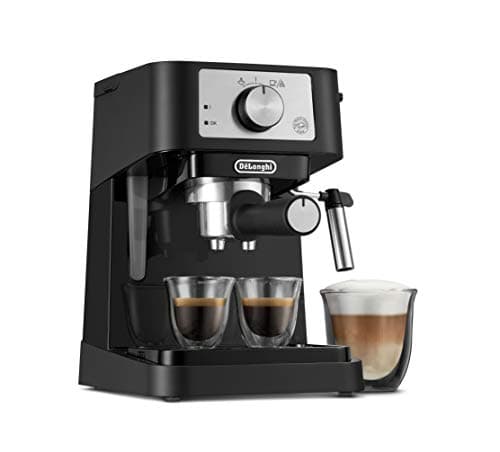
A machine like the De'Longhi Stilosais the cheapest honest way into real espresso: a 15-bar pump, a genuine manual steam wand so you can practice milk, a tamper in the box, and a footprint small enough to stash in a cupboard if the hobby does not stick. What you give up is the shot ceiling — no grinder, a single-walled basket and modest temperature stability — and a plastic-heavy build that feels its price. It is the right buy for exactly one person: someone who is not sure yet. If you already know you are serious, you will outgrow it and end up buying twice.
Tier 2: no grinder, because you already have one
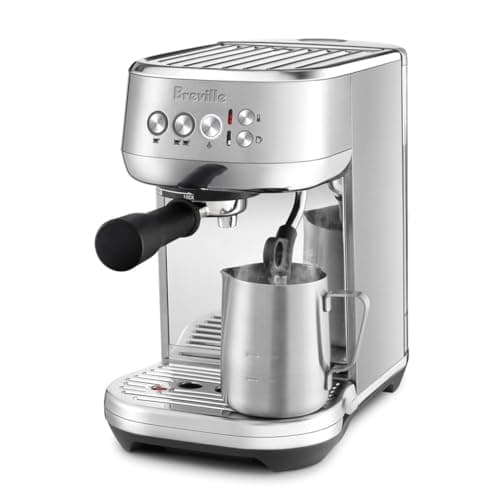
The Breville Bambino Plusis the tier people most often overlook. It has no grinder, which sounds like a downgrade and is actually a feature if you own or plan to buy a decent burr grinder — you get Breville's roughly three-second heat-up, a tiny footprint, and automatic milk texturing to a set temperature with no wand technique at all. The trap is buying one and not owning a grinder, because the machine gives you nowhere to grind.
Tier 3: the all-in-one, where most people land
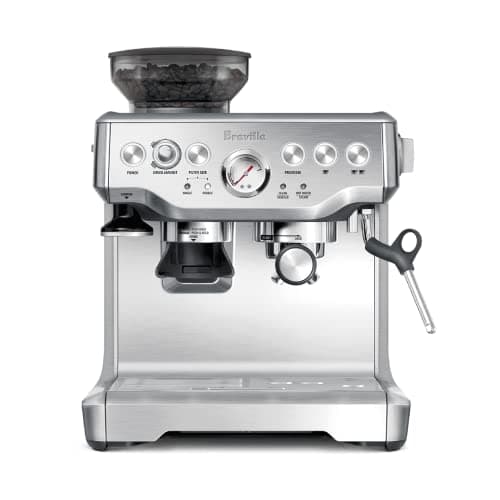
The Breville Barista Expresshas been the default first real machine for over a decade for one reason: the grinder is built in, so one purchase gets you a grind-to-shot setup. Dose, grind size and shot volume are all adjustable, so you can genuinely dial in rather than being stuck with one recipe, and Breville's US parts and service network is the least painful in the category. The honest limits: the built-in grinder is good rather than great, and the single ThermoCoil means a few seconds of waiting between the shot and the steam.
Tier 4: the enthusiast and prosumer step
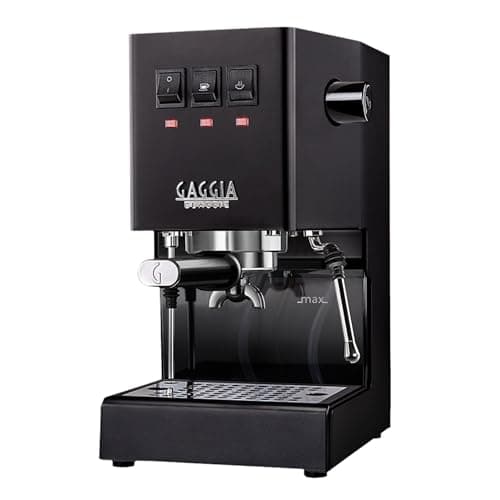
The Gaggia Classic Evo Prois the enthusiast entry rather than a luxury machine, and it is here because it illustrates what you are buying at this level: a 58mm commercial-size portafilter (so accessories are everywhere and your skills transfer upward), a metal body, a real commercial-style steam wand, and a platform with a deep community and endless mods. It has no grinder and no training wheels. Above it, a true dual boiler extracts and steams simultaneously with no temperature compromise — the jump that defines a prosumer machine, and a large step in price. Our prosumer roundup covers that end.
The three costs nobody budgets for
1. The grinder.This is the big one, and it is the purchase that most changes your cup. A grinder that cannot grind fine and consistently will produce sour, gushing shots on a machine of any price — which is why we say the grinder matters more than the machine. Budget for it from the start: the best espresso grinders under $200 is the realistic starting range, and under $100 is the floor if money is tight.
2. A scale, and a couple of small tools.A 0.1 g scale with a timer turns guesswork into a repeatable recipe, and it costs very little next to the machine — see espresso scales. A WDT tool is the cheapest fix for channeling there is. Those two plus a decent tamper are the whole essential list; our gear checklist puts the rest in priority order and says plainly what to skip.
3. Beans, forever. This is the recurring cost and the one that actually decides whether home espresso saves you money. A double shot uses roughly 18 g of coffee, so a 2.2 lb bag is about 55 doubles. Work out your own per-shot cost from the live prices on our espresso beans page, and run the full comparison against your cafe habit with the espresso cost calculator— it does the arithmetic including the machine, so you can see your real break-even point rather than guessing at it.
So what should you actually spend?
The rule we would give a friend: decide your total budget first, then split it roughly in half between machine and grinder.A mid-tier machine with a good grinder makes better espresso than a premium machine with a bad one, every time. If that total is small, buy an entry machine and a decent hand grinder rather than an all-in-one with no budget left. If you already own a grinder, skip tier 3 entirely and buy the grinder-less machine — you will spend less and end up with more.
Why pre-ground coffee is a false economy
Ground coffee has thousands of times more surface area than whole beans, so the volatile aromatics that make espresso taste of anything escape within days of grinding and oxidation does the rest. Espresso is the method where this shows up most harshly, because you are tasting a concentrated 1:2 extraction rather than a diluted brew. That is why buying a $700 machine and feeding it supermarket pre-ground is a worse setup than a $200 machine with a grinder. Whole bean vs ground has the detail.
The hidden cost of a dual-wall basket
Many machines in tiers 1 and 3 ship with pressurized (dual-wall) baskets, which force the coffee through one small hole to create crema artificially. They flatter stale, pre-ground coffee — which is precisely why they are included — and they also hide the extraction faults you need to see in order to improve. Treat the single-wall basket as the real basket, and if your machine did not come with one, add it to the budget. A bottomless portafilter with a single-wall basket is the cheapest diagnostic in espresso.
Running costs, concretely
Beyond beans: descaler (a few times a year, more in hard-water areas), a group-head cleaner for backflushing on machines that support it, and water filtersif your machine takes them. None of these is large, but skipping them is how machines die early — how to clean an espresso machine has the routine and our cleaning supplies picks cover what to buy. Electricity is negligible at household volumes; the machine is on for minutes a day.
What a more expensive machine actually buys
In rough order of how much difference it makes: temperature stability (PID control holds brew water steady shot to shot, which single-boiler machines cannot), simultaneous shot and steam (a second boiler, the defining prosumer jump), a 58mm commercial group (better accessory availability and heat mass), build and repairability, and convenience features like automatic milk texturing or assisted tamping. Notice what is not on that list: a higher bar number. Every machine advertises 15 or 20 bar, and it tells you nothing about the cup. Boiler types explained is the page for the first two.
When an espresso machine is the wrong purchase
If you drink one milky coffee a day and do not want a hobby, a bean-to-cup machine costs more up front and asks nothing of you. If you want espresso-like coffee for very little money, a moka potmakes a rich, strong shot for the price of lunch — it is not espresso, and moka pot vs espresso machine is honest about the gap. And if convenience is the whole point, pods are cheaper to buy and more expensive to run; Nespresso vs an espresso machine runs that comparison.