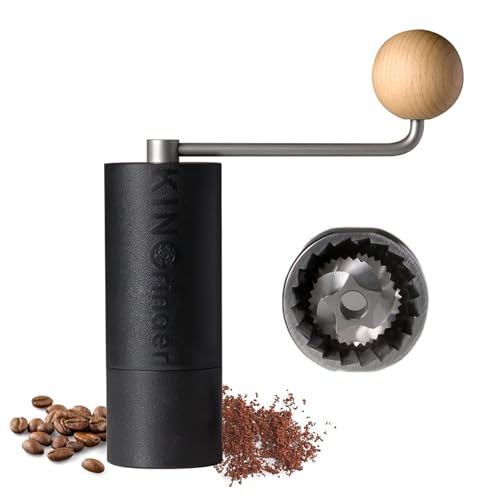
The best coffee grinder under $50 is the KINGrinder P0 — stainless steel burrs, an honest listing that names the three brew methods it is built for, and a body light enough to travel. The budget pick is the SimCoker Manual Coffee Grinder, the cheapest thing here and still a genuine burr grind rather than chopped gravel. If you will not hand-grind, the SHARDOR Electric Burr 2.0 is the only electric burr grinder we found that fits inside the budget.
This page exists because fifty dollars is where most people actually start, and it is also where the single worst purchase in home coffee lives. Walk into any store with $40 and the shelf will offer you a blade grinder — a little spinning propeller in a cup. It is not a cheap burr grinder. It is a different machine that does a different thing, and no amount of technique fixes what it does to coffee. So the first job of this page is to get you past that shelf, and the second is to be honest about what the $50 band genuinely gives you and what it does not.
How we picked, in order of weight
1. Burrs, with no exceptions. Every pick here crushes beans between two shaped surfaces set a measured distance apart, so the grounds come out at roughly one size. A blade grinder chops at random until you stop it, producing boulders and dust in the same batch: the dust over-extracts and turns bitter while the boulders under-extract and stay sour, in the same cup, every time. That is why burr vs blade is the only comparison in coffee gear we will call night and day. No blade grinder appears on this page at any price.
2. Adjustment you can actually use. A grinder with two usable settings is a one-brewer grinder. We weighted how many real steps there are and how hard it is to change them — an external dial you turn in a second beats an internal nut you reach by part-disassembling the grinder, which is how a surprising number of cheap mills work.
3. Burr material. At this price the choice is stainless steel or ceramic. Steel takes a sharper edge and cuts more cleanly, especially at coarse settings for press and cold brew; ceramic is slower to wear and cannot rust, and it is what the Japanese mills have used for decades. Neither is wrong. Steel is the better default, and we say which each pick uses.
4. Honesty about espresso. Several grinders in this band advertise an espresso range. Under $50, treat that claim with suspicion — espresso needs a fine grind held repeatably within a few microns, and nothing at this price does that. We scored a grinder up for a listing that does not over-claim and down for one that does.
5. Live price. Every pick had a live Amazon price under $50 and returned In Stock when we built this page. Prices on this page are pulled from the listing rather than typed in, so what you see is current rather than what was true the day we wrote it.
The one thing to accept before you spend $50
Under $50, you are the motor. Four of the five picks here are hand grinders, and that is not us being purist — it is arithmetic. A hand grinder has no motor, no gearbox, no electronics and no safety circuitry, so almost the entire cost goes into burrs and the frame that holds them square. An electric grinder at the same money has to pay for a motor first and buys burrs with what is left. That is why the $29 hand grinder on this page out-grinds the $38 electric one, and it keeps being true well above this band: hand grinder vs electric works through the full trade.
The cost is about 40 to 60 seconds of cranking for a single cup, and noticeably longer for a full French press dose. If that is a dealbreaker, buy the SHARDOR and accept a less even grind. If it is not, the hand grinders are simply better coffee.
1. KINGrinder P0 — best overall under $50
The P0 is KINGrinder's lightweight entry model, and it wins this page on the two things that matter most here: it has stainless steel burrs where most of its price rivals use ceramic, and its listing names pour-over, French press and AeroPress as what it is for — rather than claiming the espresso range a grinder at this price cannot hold. That restraint is a feature. KINGrinder splits its range deliberately: the metal-bodied K-series goes after espresso, and the P-series is the filter line. Buying the P0 means buying a filter grinder on purpose, which is exactly the right decision if filter is what you brew.
The ABS body is the compromise, and it is the reason this is the one grinder here you will genuinely throw in a bag. Honest cons: the listing does not claim espresso and it should not — a shot is outside what this is built to do; and plastic is less rigid under load than metal, so it does not feel like the K-series and will not hold burr alignment as well over years of hard use. If you want a fuller picture of what moving up the KINGrinder range buys you, our KINGrinder K6 review covers the all-metal, espresso-capable end of the same lineup.
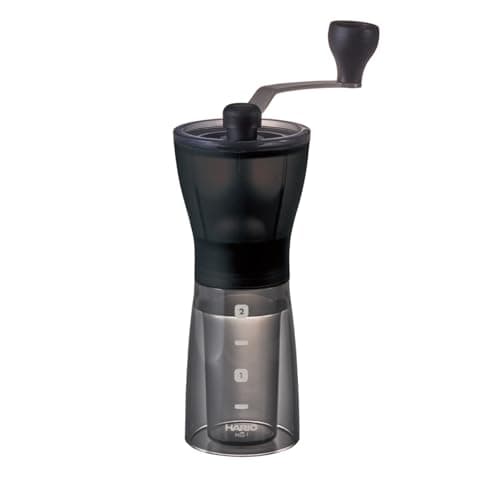
2. Hario Mini-Slim Plus — best for travel and for buying once
Hario has been making ceramic hand mills longer than most of this category has existed, and the Mini-Slim Plus is the thin, pack-flat one. Hario rates the hopper at 24 g, the burr is a ceramic conical, and the crank detaches so the whole thing slides into a bag pocket. Ceramic burrs do not rust and wear slowly, which is a real argument for a grinder you will own for a decade and occasionally leave damp in a rucksack.
It is the most expensive pick on this page, and it is the one we would hand to someone who wants to buy a hand grinder once rather than twice. Honest cons: the adjustment is a nut under the burr rather than an external dial, so changing grind between brew methods is fiddly enough that most owners lock it to one setting and leave it; and the slim body means a small dose and a narrow, slightly awkward grip for a full press. It is a filter mill — Hario does not pitch it at espresso and nor do we.
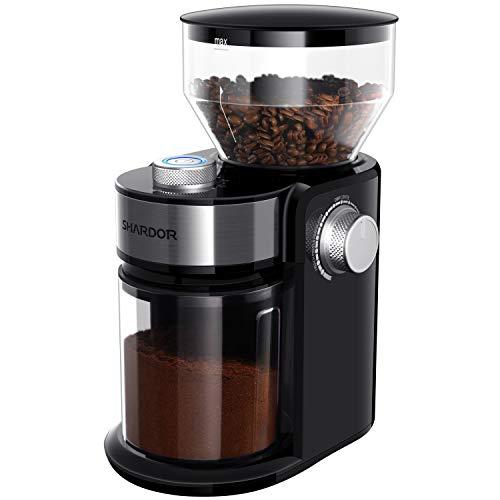
3. SHARDOR Electric Burr Coffee Grinder 2.0 — the only electric that fits
We looked for electric burr grinders under $50 and found essentially one. The SHARDOR 2.0 is a burr mill, not a blade grinder, with 16 grind settings listed and a cup-count dial: you pick how many cups you want ground and it stops itself. For a household where someone will not stand there cranking a handle at 6 a.m., that convenience is the whole product, and it is still an enormous step up from the blade grinder it sits next to on the shelf.
Honest cons: grind uniformity is clearly behind the hand grinders here — the money that went into a motor did not go into burrs and alignment, and the gap is widest at the fine end; and the listing advertises an espresso range that we would not rely on, because a grinder at this price will not hold a repeatable espresso-fine grind. Read its fine settings as moka-pot territory rather than shot territory. Buy this one for the convenience, knowing you are paying for the motor with cup quality. If an electric grinder is non-negotiable and you can stretch, the next tier is where electrics start to make sense: best coffee grinders under $100 has that field.
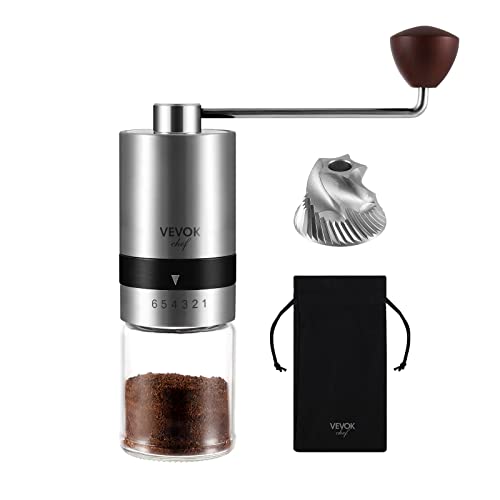
4. VEVOK CHEF Manual Coffee Grinder — best external dial for the money
The VEVOK CHEF is the vintage-looking one, and the reason it is here rather than dismissed as styling is the adjustment: six external settings on a dial you turn without taking anything apart, over a stainless steel conical burr. For under thirty dollars, having steel burrs and an outside dial at the same time is unusual. If you brew press one day and pour-over the next, this changes grind faster than the Hario.
Honest cons: six settings is coarse control — you are picking a neighborhood rather than a number, so there is no dialing in and no chasing a recipe the way a 30-click grinder lets you; and the short crank on a narrow body makes grinding a full press dose slower and more awkward than the taller grinders here. It is the grinder to buy if you want steel burrs, an easy dial and a camping-proof body, and you do not need fine steps.
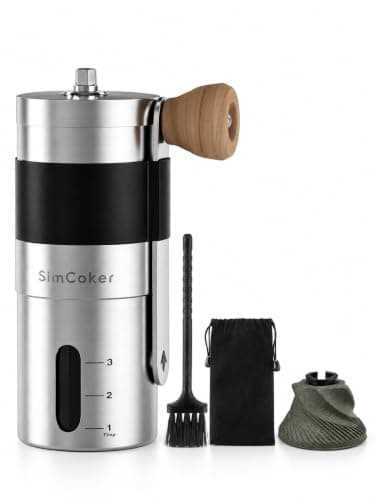
5. SimCoker Manual Coffee Grinder — the budget pick
The cheapest thing on this page, and the one we would press into the hands of anyone currently using a blade grinder. SimCoker lists a ceramic conical burr in a 304 stainless body rated at 20 g, with a brush and a pouch in the box. The upgrade from a blade grinder to this is far larger than the upgrade from this to anything else on the page, and it costs about the same as two bags of supermarket beans.
Honest cons: the adjustment range and step size are the loosest here, so it is a one-or-two-brewers grinder; and the small body and ceramic burr make it slow through a coarse dose, which is exactly the dose a French press wants. Our SimCoker review goes through it properly. Treat it as the cheapest legitimate exit from blade-ground coffee, not as the grinder you keep forever.
What $50 does not buy
Three things, and being clear about them is the point of the page. It does not buy espresso. Not from any grinder in this band, including the ones that say otherwise. Espresso lives or dies on holding a fine grind within a few microns, dose after dose, and that requires either micro-adjustment or precision alignment, and usually both. If an espresso machine is anywhere in your plans, skip this page and read best espresso grinder under $200 instead — buying a filter-only grinder you will replace in six months is the most common expensive mistake in this hobby.
It does not buy a fast electric. You get a hand grinder that grinds well, or a cheap electric that grinds adequately. There is no cheap electric that grinds well, because the motor has to be paid for first. And it does not buy large doses. Every hand grinder here holds around 20–25 g by its own maker's rating, which is one or two cups. A full eight-cup French press means grinding in rounds, and that is the single most common reason people trade up out of this band.
The verdict
Best coffee at the price, and the one we would buy: the KINGrinder P0. Buying a hand mill once and keeping it for ten years: Hario Mini-Slim Plus. Will not turn a handle: SHARDOR Electric Burr 2.0, with eyes open about the grind. Want steel burrs and a dial you can actually reach for under thirty dollars: VEVOK CHEF. Spending the absolute minimum to escape a blade grinder: SimCoker. And the honest meta-advice: if you can stretch to around $70, the TIMEMORE C3 ESP in the under-$100 field is a meaningfully better grinder that also reaches espresso — for many people that is twenty dollars extremely well spent.
Why the blade grinder on the same shelf is not a cheaper version of these
It is worth understanding the mechanism, because it is the whole reason this page has a rule against blades. A blade grinder is a propeller in a sealed cup: it chops whatever it hits, and the pieces it has already chopped keep getting chopped. Run it longer and you do not get a finer grind, you get a wider one — more dust and still some boulders. In the brewer, the dust gives up its flavor almost immediately and then keeps giving up bitter compounds, while the boulders never fully extract and stay thin and sour. The cup is bitter and weak at once, which is a genuinely strange thing to taste and a very common one. A burr grinder sets a gap and only lets through what fits, which is why its output is roughly one size. That is the entire difference, and it is bigger than any difference between the five grinders on this page.
Steel or ceramic burrs: pick by how you brew, not by price
Both materials are legitimate at this money. Stainless steel takes and holds a sharper edge, so it shears beans more cleanly — most noticeable at coarse settings, where a dull burr tears beans into fluff that makes French press muddy. Ceramic is harder and wears more slowly, is immune to rust, and is what Hario has built mills around for decades; the trade is that ceramic is more brittle, so a stone in a bag of beans is likelier to chip it than to blunt it. If you mostly brew press or cold brew, lean steel. If you want a mill that lives in a bag for years and only ever grinds one way, ceramic is fine.
Count the steps, not the settings
"Adjustable" means almost nothing on its own. What matters is how many usable steps sit between your coarsest and finest brew, and how repeatable they are. A grinder with six broad steps can brew good press and good pour-over but cannot move between two nearby pour-over recipes. A grinder with a clicked dial that counts can. For a single brew method, either is fine — you set it once. For two or more, or for any ambition to improve, the finer adjustment is worth real money. Our coffee grind size chart shows where each brewer sits so you can see how much range you actually need.
Check where the adjuster lives before you buy
This is the single most under-reported thing about cheap hand grinders. Some put the adjustment on an external dial or ring: turn it, done. Others put it on a nut under the burr, which means removing the handle and the catch cup and counting turns by feel. If you brew one way forever, an internal adjuster costs you nothing. If you switch between press and pour-over, it is the difference between a grinder you use flexibly and one you set once and quietly stop adjusting. On this page the VEVOK CHEF and the KINGrinder put adjustment where you can reach it; the Hario is the classic under-burr nut.
Dose size decides whether this band works for you at all
Every hand grinder here is rated by its own maker at roughly 20–25 g of beans, which is one strong cup or two normal ones. A standard eight-cup French press wants 55–60 g. That is three loads and three rounds of cranking, every morning, which nobody keeps doing. So before anything else: if you brew for a household or you brew a full pot, a sub-$50 hand grinder is the wrong tool no matter how good its burrs are, and the honest answer is to save up for a hopper-fed electric. If you brew one or two cups for yourself, this band is genuinely excellent value.
Spend the rest of your money on fresher beans, not a better grinder
Once you are grinding with burrs at all, the next biggest jump in your cup is not a better grinder — it is beans that were roasted recently and ground moments before brewing. Pre-ground coffee has lost most of its aromatics inside a week of opening, which is exactly the problem a grinder at any price solves; whole bean vs ground lays out what actually changes. Pair any grinder on this page with decent cheap whole beans and keep them sealed and out of the light, per how to store coffee beans, and the total upgrade will beat spending twice as much on the grinder alone.
Clean it, or it gets worse at the job you bought it for
Coffee oils accumulate on burrs and in the grind path, go rancid, and then flavor everything you grind afterwards. Cheap grinders are not exempt and most owners never do it. A brush every couple of weeks is enough — how to clean a coffee grinder has the routine, and on a hand grinder it is a two-minute job because the whole thing comes apart by hand. If your current grinder got worse rather than being disappointing from day one, start there before you buy anything.
When to skip this band entirely
Three cases, stated plainly. You pull espresso, or might: go straight to best espresso grinder under $200. You brew for more than two people: you need a hopper, so look at best coffee grinders under $200. You can stretch another twenty dollars: the under-$100 tier is where hand grinders start reaching espresso and where the first genuinely good electrics appear. If none of those apply, buy the KINGrinder P0 and spend the difference on beans.