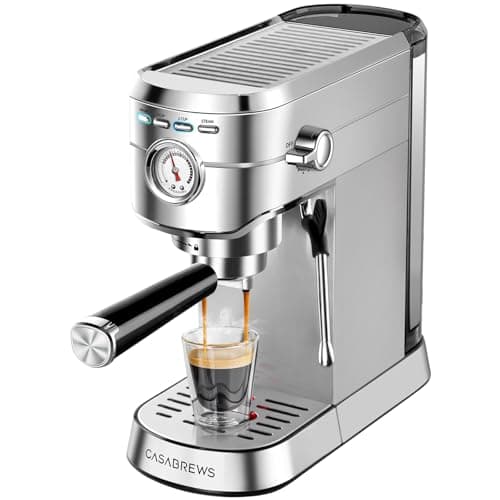
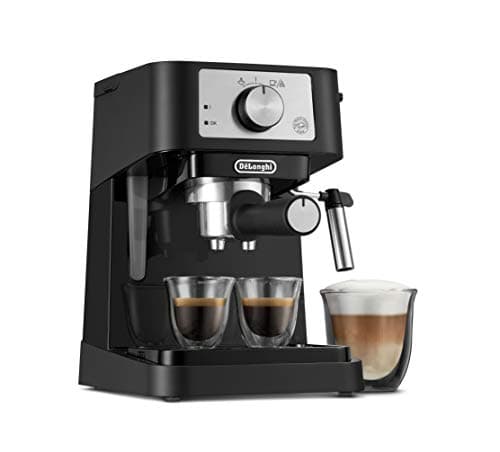
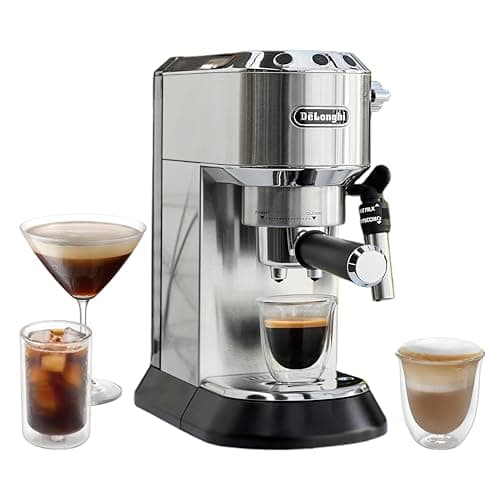
If you want the best shot of the three and can stretch to it, buy the De'Longhi Dedica Deluxe— a thermoblock machine with a proper 15-bar pump in a 6-inch-wide body, and the only one here we would call a real starting point for learning espresso. If the budget is firm, the CASABREWS CM5418is the better buy than the cheapest De'Longhi: it undercuts the Dedica substantially, steams milk, and feels more solid than its price suggests. The De'Longhi Stilosais the one to buy only if it is on a sharp discount — it is the most basic machine here and the brand name is doing a lot of the work.
The reason people land on this comparison is that CASABREWS machines look, on paper, like they beat De'Longhi: higher stated bar ratings, bigger tanks, stainless bodies, noticeably lower prices. So it is worth starting with the spec that misleads most.
Ignore the bar rating — both brands quote the pump, not the puck
Every machine in this class advertises 15 or 20 bar, and the number tells you almost nothing. It is the maximum pressure the pump can generate, not the pressure at the coffee. Espresso is brewed at about nine bar, and machines with a 15- or 20-bar pump reach that figure by restricting flow elsewhere — so a 20-bar machine is not brewing at 20 bar and would make worse espresso if it did. When CASABREWS quotes 20 bar and De'Longhi quotes 15, that is a marketing difference, not a quality one.
What actually separates machines at this price is less exciting: how stable the brew temperature is, whether the basket is pressurised, how usable the steam wand is, and whether the portafilter is a size you can buy accessories for.
The question that decides it: pressurised baskets
This is the single most useful thing to understand before buying any machine in this class. A pressurised(or "dual wall") basket has a tiny restriction built into it that creates back-pressure artificially. The effect is that it produces a thick-looking crema even from a bad grind or supermarket pre-ground coffee — which is genuinely useful if you do not own a grinder, and a dead end if you do.
With a pressurised basket, grind size and tamping barely change the result, because the restriction is doing the work rather than the coffee bed. That means the machine is forgiving, and also that you cannot improve the shot by improving your technique. A non-pressurised basket does the opposite: it demands a decent grinder and a level tamp, and rewards both. Budget machines generally ship pressurised baskets, and the upgrade path on each one is whether you can fit a standard basket later.
The practical consequence: if you are buying a sub-$200 machine and not buying a grinder, pick whichever machine is cheapest and keep the pressurised basket. If you are buying a grinder too, the Dedica is the one of these three worth building on. Our what is a portafilter guide covers basket types in detail.
De'Longhi Dedica Deluxe (EC685)
The pick of the three. A thermoblock heats water on demand, so it is ready in well under a minute and does not hold a tank of water at temperature. The body is 6 inches wide, which makes it the machine to buy if counter space is the binding constraint — it is genuinely narrower than almost anything else that makes real espresso. It takes a 51mm portafilter, and 51mm accessories are easy to buy, so a bottomless portafilter and a better basket are both available when you want them — see bottomless portafilters.
The honest cons: the steam wand is a panarello-style frothing aid rather than a bare wand, so it produces foamy milk easily but makes proper latte-art microfoam hard; and the small thermoblock means you wait between pulling a shot and steaming. Full detail in our Dedica review, and Dedica vs Stilosa compares the two De'Longhis directly.
CASABREWS CM5418
The value play, and a legitimate one. It is the cheapest machine here that steams milk properly, it has a stainless body that feels better than the price, a 34 oz removable tank that is larger than the Dedica's, and a built-in pressure gauge — which is more useful as a learning tool than as a measurement, because it shows you when you have choked the puck.
What you are accepting: CASABREWS is a direct-to-Amazon brand, so the long-term story on spare parts and support is weaker than De'Longhi's, and that matters on an appliance with a pump and a boiler in it. Temperature stability is the usual weak point at this price, and accessories for its basket size are a smaller market than 51mm or 58mm. Our CASABREWS CM5418 review is the long version. If you want the cheapest competent machine and are not planning to upgrade the puck prep, this is the sensible buy.
De'Longhi Stilosa (EC260)
The entry De'Longhi, and the one we are least enthusiastic about at full price. It is a simple manual machine with a 15-bar pump and a basic steam wand, it does make real pressurised espresso, and it is a legitimate way to find out whether you will stick with the hobby for very little money. But it has a plastic body, a pressurised basket, and no feature the CASABREWS lacks — so unless it is discounted below the CASABREWS, you are paying for the badge. See the Stilosa review.
The one-line answer by situation
Buying a grinder too, want to actually learn espresso: Dedica (or save toward a proper beginner machine). Tight budget, want milk drinks, no grinder yet: CASABREWS CM5418. Narrowest possible counter: Dedica, at 6 inches wide. Cheapest way to test the hobby:whichever of the Stilosa and CASABREWS is discounted harder today — the prices above are live.
The budget split nobody wants to hear
If your total budget is under about $300 for espresso, the grinder deserves a bigger share of it than feels natural. Espresso is the brewing method least tolerant of an uneven grind, because water under pressure finds the path of least resistance through the puck — and pre-ground coffee is both too coarse and too stale to resist it evenly. A cheap machine with a capable hand grinder makes better espresso than a nicer machine fed pre-ground. Our best hand grinders for espresso is the realistic starting range, and espresso grinders under $200 covers the electrics.
The honest alternative: if you cannot afford both, buy the machine with the pressurised basket, use good pre-ground coffee, and accept that you are making a decent coffee drink rather than chasing a great shot. That is a perfectly reasonable place to be, and it is cheaper than the half-measure of a good machine with no grinder.
Portafilter size is the upgrade path
Check the portafilter diameter before you buy, because it determines what you can fit later. 58mm is the commercial standard with the widest accessory market; 54mm is Breville's size; 51mm covers the Dedica and several others. A machine on an unusual size is a machine you cannot buy a better basket, a bottomless portafilter or a puck screen for. If you expect to tinker, that is worth more than a bigger water tank.
Steam wand: panarello or bare?
A panarello (the plastic sleeve over the wand) injects air automatically and makes thick, bubbly foam with no skill — good for a cappuccino, bad for a flat white, and essentially incapable of latte art. A bare wand needs technique but can produce proper glossy microfoam. Both De'Longhis here are panarello-style. If milk texture is the point of the purchase, that is the specification to check, and how to steam milk explains what you are aiming for.
What a machine at this price will not do
Set expectations honestly. None of these will hold temperature like a machine with a PID, none will let you pull a shot and steam at the same time, and none has a 58mm commercial group. What they will do is make genuine pressurised espresso and a decent milk drink for a fraction of what a café charges. If what you actually want is a shot you can dial in and chase, the step up is a machine like the Gaggia Classic Evo Pro or the Bambino Plus, and it is a real step rather than a marginal one. Our best espresso machines under $200 page covers the whole budget tier, and how much an espresso machine costs lays out the tiers and the purchases people forget.
Descaling is not optional on a cheap machine
Thermoblocks and small boilers scale up faster than big ones, and scale is what kills budget machines. If your water is hard, descale on the manufacturer's schedule rather than when it starts tasting odd — how to clean an espresso machine covers the routine and descaling supplies covers what to use. A descaled $150 machine outlives a neglected $400 one.