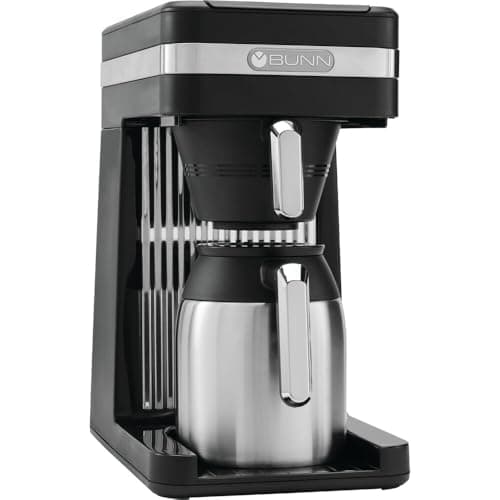
Buy the BUNN Speed Brew Platinum Thermal (CSB3T). It is the same brewer as every other Speed Brew, pouring into a vacuum carafe instead of onto a hotplate — and a hotplate is the single thing most likely to ruin a pot of coffee you already brewed correctly. If you empty the carafe within half an hour, the glass-carafe Speed Brew Elite (CSB2G) saves you money for no real loss. The BX Speed Brew Classic and the GRB Velocity Brew are so close to each other that price on the day is the only sensible tiebreaker. And if you want coffee waiting when you wake up, the Heat N Brew (HB)is the only programmable BUNN — which it pays for by brewing at ordinary drip-machine speed.
Before any of that, understand what you are actually buying, because BUNN is not competing on the same axis as the rest of the drip aisle. Almost every other coffee maker heats water after you pour it in. BUNN heats it before. The company's own description of the Speed Brew family is a "commercial-grade stainless steel internal hot water tank" that "always has 70oz of hot water at your disposal, kept at approximately 200° F". Water that is already at brewing temperature does not need to be brought up to it, which is why BUNN publishes 10 cups in about four minutes and 20 oz in about two, and why it describes competing machines as "Burp and Boil" designs that "take twice as long."
Why the hot tank matters, and what it costs
The speed is the headline, but it is not the interesting part. The interesting part is temperature stability. BUNN argues that in a boil-and-release machine the water "exceeds and falls beneath the recommended 200ºF standard throughout the brew," whereas its own temperature-controlled water "passes over the grounds in one consistent flow." It pairs that with an "exclusive sprayhead design that showers the entirety of the coffee grounds" — a multi-stream head rather than a single hole. If you have ever lifted the lid on a cheap drip machine and found a crater drilled through the middle of a dry bed, you know exactly what problem that solves. Our water temperature for coffeepage covers why the 195–205°F window is where extraction behaves itself.
Now the cost, which BUNN does not advertise. Keeping 70 oz of water at 200°F means the machine is heating water all day whether you drink coffee or not. That has three consequences you should weigh before buying. First, there is a standby power draw that a machine which heats on demand does not have. Second, you cannot sensibly program a Speed Brew, which is why none of them have a clock — the tank is the timer. Third, a tank that permanently holds hot water is a tank that accumulates scale, so deliming is maintenance you actually have to do rather than something you can ignore for two years. Scale inside any brewer drops brew temperature, which under-extracts no matter how good your coffee is; how to clean a coffee maker has the routine.
The certification question, answered honestly
BUNN's whole pitch is brewing temperature, so the obvious question is whether anyone independent has verified it. The answer is no. The Specialty Coffee Association publishes a Certified Home Brewer list — machines tested against its brewing standard for temperature, contact time and extraction — and as of this writing no BUNN model appears on it. The list is dominated by Technivorm Moccamaster, Bonavita, OXO, Breville's Luxe Brewer and the Café Appliances / GE Café drip machines. That does not mean a BUNN brews badly; plenty of uncertified machines brew well, and certification costs money a brand may simply decline to spend. It does mean that when you buy a BUNN you are trusting BUNN's own figures. If third-party verification is what you want, our SCA-certified coffee makers roundup is the page to read instead, and the Moccamaster review covers the machine that defines that end of the market.
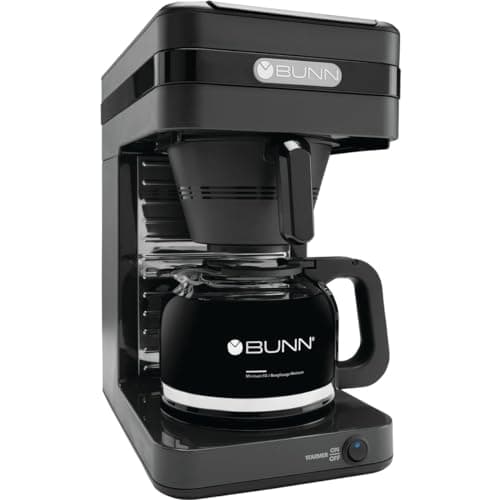
1. BUNN Speed Brew Platinum Thermal (CSB3T) — the one to buy
Everything good about BUNN, minus the worst thing about BUNN. You get the 70 oz tank, the four-minute pot and the multi-stream sprayhead, and the coffee lands in a double-wall vacuum carafe rather than sitting on a warming plate slowly turning bitter. That is a bigger upgrade than it sounds. A hotplate keeps cooking the coffee it is holding, so the cup you pour at 7:40 tastes materially worse than the one you poured at 7:10 — and on a machine built to brew fast, slowly ruining the result afterwards is a strange thing to pay for. BUNN backs the family with a 3-year warranty serviced from Springfield, Illinois, which is a genuinely unusual length in this price bracket.
The honest cons. It is the most expensive Speed Brew, it is not SCA certified, and like every Speed Brew it cannot be programmed. A thermal carafe also pours more slowly than glass and you cannot see how much is left without opening it. If a thermal carafe is the part you care about most, our thermal carafe coffee makers roundup compares it against the rest of the field.
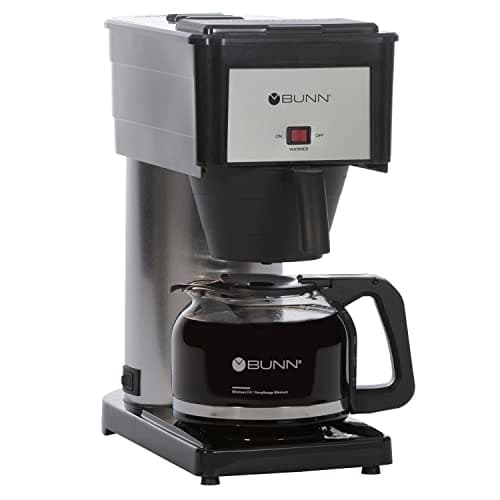
2. BUNN Speed Brew Elite (CSB2G) — the value version
Mechanically identical, glass carafe, warming plate, lower price. For a household that brews a pot and drinks it inside half an hour, this is the correct purchase and the thermal model is money spent on a problem you do not have. The drip-free carafe BUNN advertises across the line genuinely works, and glass has two practical advantages over thermal: you can see the level, and you can get a brush and a sponge all the way inside it.
The con is the hotplate, and it is not a small one. There is no auto-off on the Speed Brew models, so the plate stays on until you switch the machine off. If your pot routinely sits for an hour, you will taste it, and you will have spent the saving on coffee you poured away. Buy the CSB3T instead in that case.
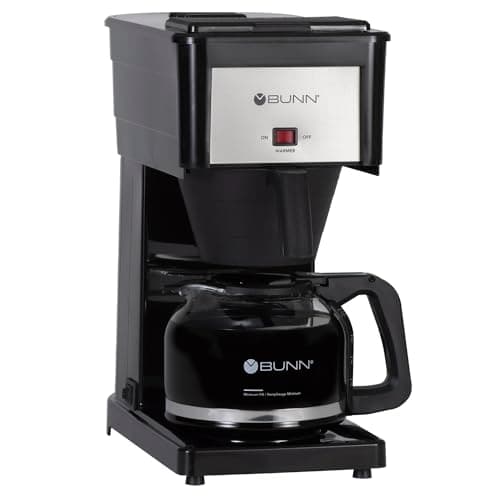
3 and 4. BX Speed Brew Classic and GRB Velocity Brew — the twins
These two are the reason a BUNN roundup needs writing. Both are 10-cup pour-in brewers with the internal hot tank, a drip-free glass carafe, one switch and no display. BUNN sells the current entry machine as Speed Brew Classic; the Velocity Brew name is the longer-standing one and is still widely stocked. On paper there is no meaningful functional difference, and we are not going to invent one. Buy whichever is cheaper on the day you look, and check both live prices on this page before you commit, because the gap between them moves week to week.
What you give up against the Elite is styling and the newer carafe, not brewing. What you give up against the Platinum is the thermal carafe, which matters more. These are the right BUNN if you want the mechanism and nothing else — and they are frequently the cheapest decent 10-cup machine on the shelf, which puts them squarely in the conversation with our cheap coffee makers picks.
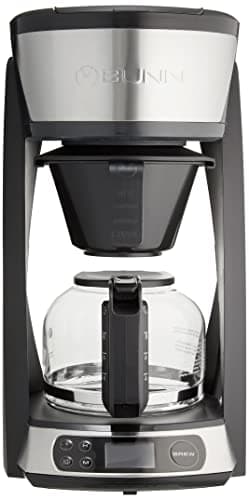
5. BUNN Heat N Brew (HB) — the only programmable one
A different machine wearing the same badge. The Heat N Brew has no always-hot tank; BUNN describes "Heat & Release Technology"that "precisely measures when the water reaches the ideal brewing temperature" and holds it until it is inside the 197.6ºF–204.8ºFwindow. That is a sound approach and the published range sits right where it should. It also means the speed is gone: BUNN's own figures are about 10 minutes for 10 cups and about six minutes for 20 oz, against four and two for a Speed Brew.
What you get back is a digital clock with a programmable brew start time and a warmer plate that turns itself off after two hours — both things no Speed Brew offers. If waking up to a finished pot is the feature you were shopping for, this is the only BUNN that does it. If you were shopping for the four-minute pot, this is the wrong model and you should not buy it by accident. It is also tall, so measure your under-cabinet clearance.
The one-line answer by situation
Best overall BUNN: Speed Brew Platinum Thermal (CSB3T). Best value: Speed Brew Elite (CSB2G). Cheapest way in: whichever of the BX Classic and GRB Velocity Brew is cheaper today. Want a timer: Heat N Brew (HB). Want independent verification of brew temperature:none of them — go to the SCA-certified list. For the wider field, best drip coffee makers is the parent page.
Who BUNN is actually for
Three households. The one where several people want coffee at slightly different times and nobody wants to wait ten minutes — the hot tank means the second pot is as fast as the first. The one that fills a travel mug on the way out of the door, because 20 oz in about two minutes is faster than most people can find their keys. And the one that wants a machine to last: a 3-year warranty and a design with very little to go wrong is why decade-old BUNNs are still on counters.
Who it is not for: anyone brewing one cup at a time (a 70 oz tank heated all day for a single mug is absurd — see coffee makers for one person), anyone who wants their machine to be silent and off when not in use, and anyone whose priority is third-party-verified brewing.
Thermal or glass, decided properly
Time the gap between brewing and your last cup. Under 30 minutes, glass is fine and cheaper. Over an hour, thermal every time — a warming plate does not hold coffee, it keeps cooking it, and the bitterness that develops is not something a better bean fixes. Over three hours, no carafe of either kind is going to taste good and you should brew less. If you do go thermal, warm the carafe with hot water first; a cold vacuum carafe takes real heat out of the first cup.
The BUNN filter detail nobody mentions
BUNN states its funnel is designed for BUNN filters, which are a quarter-inch taller than other filters. Generic flat-bottom basket filters will physically fit, but the shorter wall is why people report grounds washing over the rim on a full 10-cup brew. If your BUNN seems to be putting sediment in the pot, this is the first thing to check, before you touch the grind. It is a small recurring cost to budget for, in the same way a V60 needs its own paper.
Grind and dose for a BUNN
Treat it as a standard flat-bottom drip brewer: a medium, kosher-salt grind, and the National Coffee Association's Golden Ratio of one to two tablespoons of ground coffee per 6 oz of water as a starting point. Because the water arrives fast and hot, a BUNN is slightly less forgiving of too fine a grind than a slow machine — fines plus a fast flow is how you get an overflowing basket and a bitter pot at the same time. If that happens, go one step coarser before you change anything else. Our coffee-to-water ratio page converts the ratio into grams, and the best grinders for drip coffee covers the machines that produce a consistent bed in the first place. Fresh beans matter more than any of it: best coffee for drip.
Deliming is not optional on a BUNN
This is the maintenance consequence of the design. A tank holding hot water permanently is the ideal environment for mineral scale, and scale on a heating element both slows the machine and drops the temperature of the water reaching your coffee — which quietly undoes the entire reason you bought a BUNN. Use filtered water if your supply is hard, delime on the schedule in your model's manual rather than when you notice a problem, and never use a descaler not approved for the machine. Our descaling and cleaning supplies roundup covers what to buy.
Should you unplug it between pots?
You can, and some owners do to avoid the standby draw. Understand the trade: an unplugged BUNN has a cold tank, and a cold tank takes roughly fifteen minutes to come up to temperature, which makes your four-minute machine a twenty-minute machine. Switching it off overnight and on when you get up is the usual compromise — you lose the speed on the first pot and keep it for the rest of the day. If you resent the always-on behavior enough to do that every day, a machine that heats on demand is a better fit, and the Heat N Brew is BUNN's own version of that answer.
Where a BUNN sits against the alternatives
Against a Moccamaster: the Moccamaster is certified, hand-built and considerably more expensive; the BUNN is faster and cheaper. Against a Cuisinart: the Cuisinart gives you programmability and a bigger carafe, the BUNN gives you speed and a longer warranty. Against pour-over: pour-over gives you control and costs you five attentive minutes every morning, which is the actual reason most people own a drip machine. And against a percolator: a percolator re-boils coffee through the bed, which is a different and generally worse idea; see pour-over vs drip for where the methods actually diverge.